🌽 Sugar in Corn Calculator
Calculate exact sugar & carb content in corn — by ear, cup, or weight. Supports sweet, white, and baby corn.
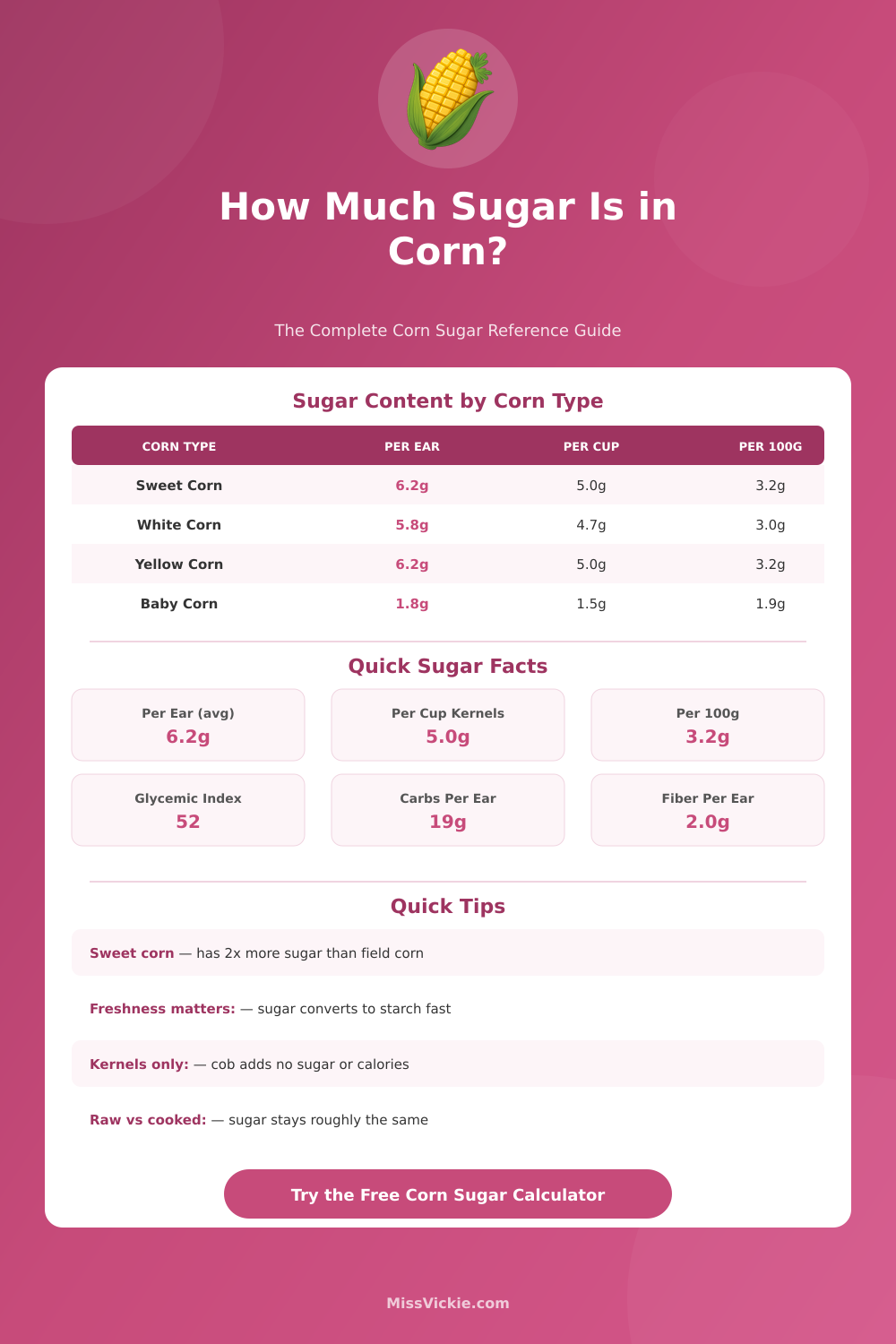
| Corn Type | Per Ear | Per Cup Kernels | Per 100g | Glycemic Index |
|---|---|---|---|---|
| Sweet Corn (Yellow) | 6.2g | 5.0g | 3.2g | 52 |
| White Sweet Corn | 5.8g | 4.7g | 3.0g | 50 |
| Baby Corn | 0.5g | 1.5g | 1.9g | 46 |
| Popcorn / Field Corn | 2.1g | 0.2g (popped) | 0.6g | 65 |
| Canned Sweet Corn | — | 5.4g | 3.5g | 55 |
| Frozen Sweet Corn | — | 4.8g | 3.1g | 47 |
| Serving Description | Grams | Ounces | Approx. Sugar |
|---|---|---|---|
| 1 small ear (kernels only) | 77g | 2.7 oz | 2.5g |
| 1 medium ear (kernels only) | 154g | 5.4 oz | 6.2g |
| 1 large ear (kernels only) | 200g | 7.1 oz | 8.1g |
| 1 cup kernels | 154g | 5.4 oz | 5.0g |
| 1/2 cup kernels | 77g | 2.7 oz | 2.5g |
| 1 tablespoon kernels | 10g | 0.35 oz | 0.3g |
| 1 can (whole kernel, drained) | 256g | 9.0 oz | 9.0g |
| Nutrient | Per Ear (med) | Per 100g | % of Carbs |
|---|---|---|---|
| Total Carbohydrates | 19.1g | 12.4g | 100% |
| Dietary Fiber | 2.1g | 1.4g | 11% |
| Total Sugars | 6.2g | 3.2g | 32% |
| └ Sucrose | 3.4g | 1.8g | 18% |
| └ Glucose | 1.5g | 0.6g | 8% |
| └ Fructose | 1.3g | 0.8g | 7% |
| Starch | 10.8g | 7.0g | 57% |
Corn, or we say the scientific name for it (is a strongly growing grass), that gives eatable grains. It belongs to the family Poaceae and ranks between the most heavily grown food plants globally. The plant itself bears leafy stalks, that bears male organs (called tassels) for spreading pollen, and female parts (the ears), that actually forms the grains, that we know as kernels.
The history of corn goes far back, at least 9 000 years. Everything started in the south of Mexico, where ancient farmers took wild grass called teosinte and tamed it over many generations. That early plant?
Corn: History, Uses and How to Grow It
It had only few kernels, hidden in thick, hard shell. What we grow currently, is basically a mix from teosinte and local species of America. When European settlers arrived in North America, the natives already grew it evreywhere through the region.
Now corn became the biggest grain-crop by weight in the whole world. It is a starchy vegetable, that appears on tables everywhere, whether as kernels still on the cob or stuffed in tortillas. Especially in United States it ranks between the favourite vegetables.
The crop benefits in areas, where other grasses fail, and it benefited from the wave of farming progress, that altered the farming.
Here something, what maybe surprises you: big part of the grown corn does not end on the plates of folks. Rather, it feeds creatures. Cows, pigs and birds depend strongly on corn as basic feed, and the used amount adjusts according to the number of creatures, that one raises.
That explains, that it involves around 40 percent of the whole nationally used corn.
In nutrition value, corn naturally carries sweetness and fills in starch, so that most of its calories come directly from carbohydrates. It also carries good amount of protein and fiber, although the fat is very little. The kernels are rich in B-vitamin together with minerals as zinc, magnesium, copper, iron and manganese.
Interesting fact is, that corn has tough fiber, that makes it food with low sugar index, that means, that your body breaks it slowly, and you escape sudden spikes of blood-sugar. It is also low in sodium, packed fat and cholesterol. Even so, if you have diabetes, recall, that half of cup of corn stores around 15 grams of carbohydrates.
The skin of the kernel consists chiefly from undigested cellulose, but the internal part? Hear lie the nutrients. Even so not each weighs it well, some folks suffer stomach pains because of the fiber.
Moreover, the silky hairs of corn can stay between your teeth, what bothers.
Sweet corn benefits best, if one plants it in blocks instead of scattering it. Most gardeners advise at least four rows, with ten or more plants each row, for enough pollen and good spread. When the tassels appear, shaking the stalks helps a lot.
You have many types to choose, different flavors and colours answer well for home gardens. The sweet days run from May until September, when corn reaches its biggest sweetness, juice and fullness. Truly the late summer is the time, whenfresh corn on the cob shines most.