🍫 Caffeine in Chocolate Calculator
Calculate the exact caffeine content in your chocolate by type, cacao percentage, and serving size
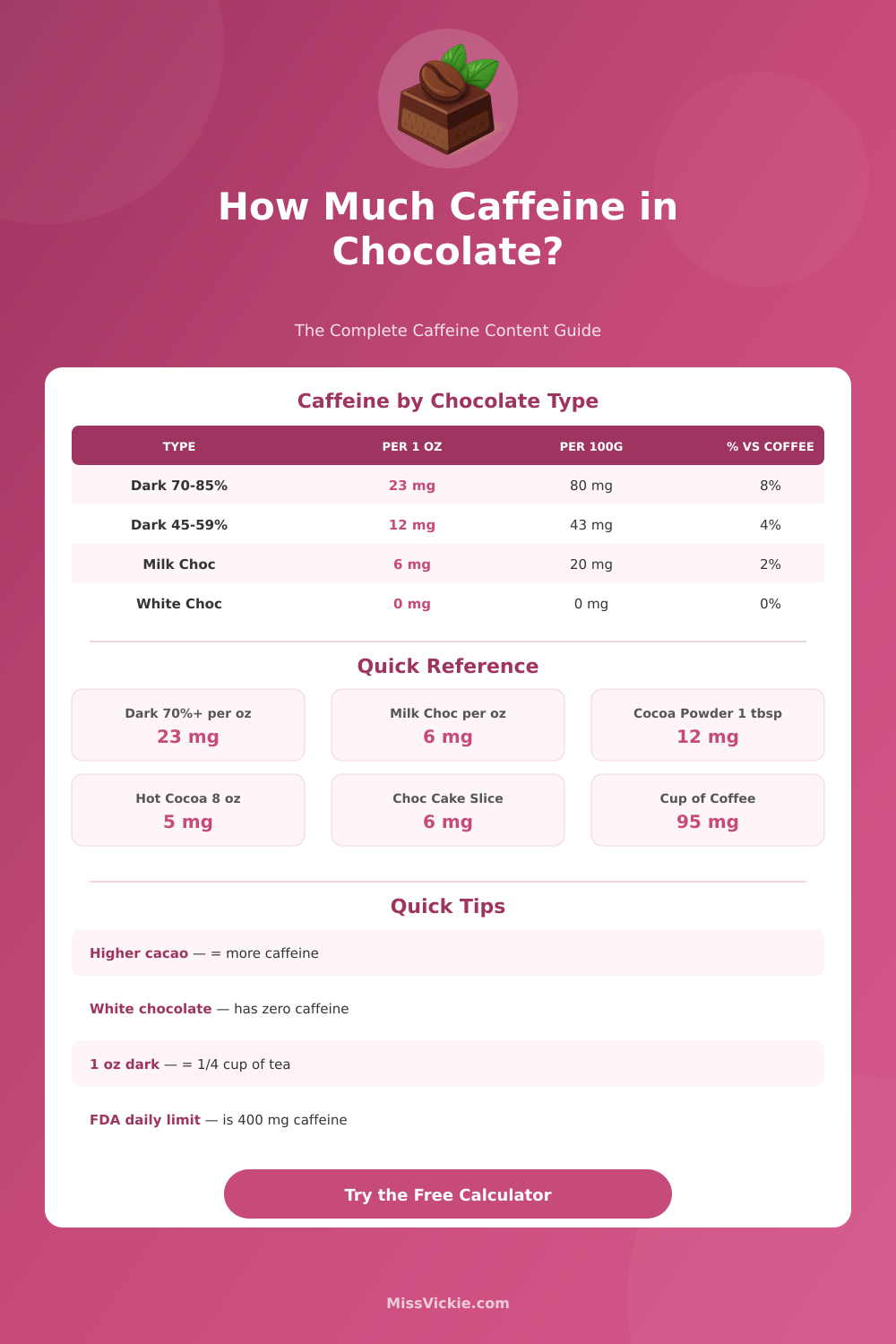
| Chocolate Type | Caffeine per oz | Caffeine per 100g | Theobromine per oz |
|---|---|---|---|
| Dark 85% Cacao | 23 mg | 80 mg | 130 mg |
| Dark 70–80% Cacao | 20 mg | 70 mg | 115 mg |
| Dark 50–60% Cacao | 14 mg | 49 mg | 80 mg |
| Milk Chocolate | 6 mg | 20 mg | 44 mg |
| White Chocolate | 0 mg | 0 mg | 0.5 mg |
| Cocoa Powder (unsweetened) | 12 mg/tbsp | 230 mg | 65 mg/tbsp |
| Semisweet Chips | 18 mg | 63 mg | 100 mg |
| Milk Chocolate Chips | 5 mg | 18 mg | 40 mg |
| Chocolate Syrup (2 tbsp) | — | — | — |
| Item | Serving Size | Caffeine (mg) | Equivalent in Dark 70% Choc |
|---|---|---|---|
| Brewed Coffee | 8 fl oz (240 ml) | 95 mg | ~4.75 oz / 135g |
| Espresso | 1 fl oz (30 ml) | 63 mg | ~3.15 oz / 89g |
| Black Tea | 8 fl oz (240 ml) | 47 mg | ~2.35 oz / 67g |
| Green Tea | 8 fl oz (240 ml) | 28 mg | ~1.4 oz / 40g |
| Cola Soda | 12 fl oz (355 ml) | 34 mg | ~1.7 oz / 48g |
| Energy Drink | 8 fl oz (240 ml) | 80 mg | ~4 oz / 113g |
| Dark Chocolate 70% | 1 oz (28g) | 20 mg | 1 oz / 28g |
| Milk Chocolate | 1 oz (28g) | 6 mg | ~0.3 oz / 8.5g |
| Product | Standard Serving | Weight (oz) | Weight (g) |
|---|---|---|---|
| Chocolate Bar (standard) | 1 bar | 1.5 oz | 43 g |
| Chocolate Bar (king size) | 1 bar | 3.0 oz | 85 g |
| Chocolate Square | 1 square | 0.35 oz | 10 g |
| Cocoa Powder | 1 tbsp | 0.18 oz | 5 g |
| Chocolate Chips | 1 cup | 6 oz | 170 g |
| Brownie | 1 piece (2″ sq) | 2.0 oz | 56 g |
| Chocolate Cake Slice | 1 slice | 3.5 oz | 100 g |
| Hot Cocoa | 8 fl oz | — | 240 ml |
| Chocolate Syrup | 2 tbsp | 1.4 oz | 39 g |
| Chocolate Ice Cream | 1/2 cup | 2.4 oz | 66 g |
Dark chocolate with 70-85% cocoa carries around 20-23 mg of caffeine in one serving of 1 ounce (28 g), according to data from the food database of USDA FoodData Central. By comparison milk chocolate has much less, average only 5-6 mg per ounce. And white chocolate?
It does not have even a trace of caffeine, because it consists only of cocoa butter without cocoa solids.
How much caffeine is in chocolate?
Between chocolate products, plain cocoa powder comes first according to caffeine density, with around 12 mg per spoon (5 g), or even 230 mg per 100 g. One such spoon gives almost as much caffeine as two whole pieces of milk chocolate. Natural cocoa powder that did not pass Dutch process contains 12-15% more caffeine per gram than Dutch-processed kind, because the alkaline treatment removes a bit of those alkaloid elemants.
A bigger version of 3 ounces (85 g) jumps to 60 mg, around 63% of the caffeine in an 8-ounce cup of filtered coffee. Moreover, European-style dark chocolate bars of 3,5 ounces (100 g) with 70% cocoa deliver around 70 mg of caffeine.
In chocolate hides another stimulant that commonly stays under the radar: theobromine. This similar compound appears in levels 5-10 times higher then caffeine. In dark chocolate with 70% cocoa, theobromine reaches 115 mg per ounce, compared to 20 mg of caffeine per ounce.
Milk chocolate still has notable 44 mg of theobromine per ounce. Although the caffeine amounts in chocolate seem modest beside coffee, the combination of caffeine and theobromine creates a genuinely felt boost.
A full cup of semi-sweet chocolate chips (170 g / 6 ounces) contains around 104-108 mg of caffeine. If one uses milk chocolate chips instead, the amount falls to 33-36 mg per cup. When one folds those chips in cookie dough according to standard ratio of two spoons per cookie, each finished cookie bears around 3-4 mg of caffeine from semi-sweet chips or only 1-1,5 mg, if one used milk chocolate chips.
Warm cocoa from store packages has a modest 5 mg of caffeine per 8 fluid ounces (240 ml) cup. With homemade warm chocolate from real dark chocolate, the number goes up to 25-40 mg per cup, according to the ratio of chocolate to milk. Mocha latte adds caffeine from two main sources: around 63 mg from espresso shot plus 10-15 mg from chocolate syrup, totaling 73-78 mg in a 12-ounce serving.
A two-inch square of brownie weighing around 2 ounces (56 g) adds 5-8 mg of caffeine, depending on the chocolate amount in the recipe. A slice of chocolate cake (around 3,5 ounces / 100 g) averages 6 mg. Chocolate ice cream has about 1,3 mg per ounce, so a normal half-cup serving (66 g) adds up to around 3 mg.
And two spoons ofchocolate syrup? Roughly around 3 mg.
According to the FDA, 400 mg of caffeine a day are widely safe for healthy adults. To reach that limit only by means of chocolate, one would need to eat around 20 pieces (567 g) of dark chocolate (or even 67 pieces (1),9 kg) of milk chocolate. 20 pieces of dark chocolate match to around 13,3 standard 1,5-ounce bars.
The origin of cocoa beans also affects caffeine levels by 10-20%. Forastero varieties that form around 80% of global production have average 0,8-1,1% caffeine from dry weight. Criollo varieties, much more rare, only 5% of the market, tend to have less, 0,6-0,9%.
Trinitario hybrids rest in between, at 0,7-1,0%. Practically: a bar from high-caffeine Forastero can contain up to 15% more caffeine than one from Criollo, even if the cocoa percent on the label is the same.
Canadian Health Agency advises that children of 4-6 years limit caffeine to 45 mg daily. For pregnant women, the advised maximum is 200 mg a day.