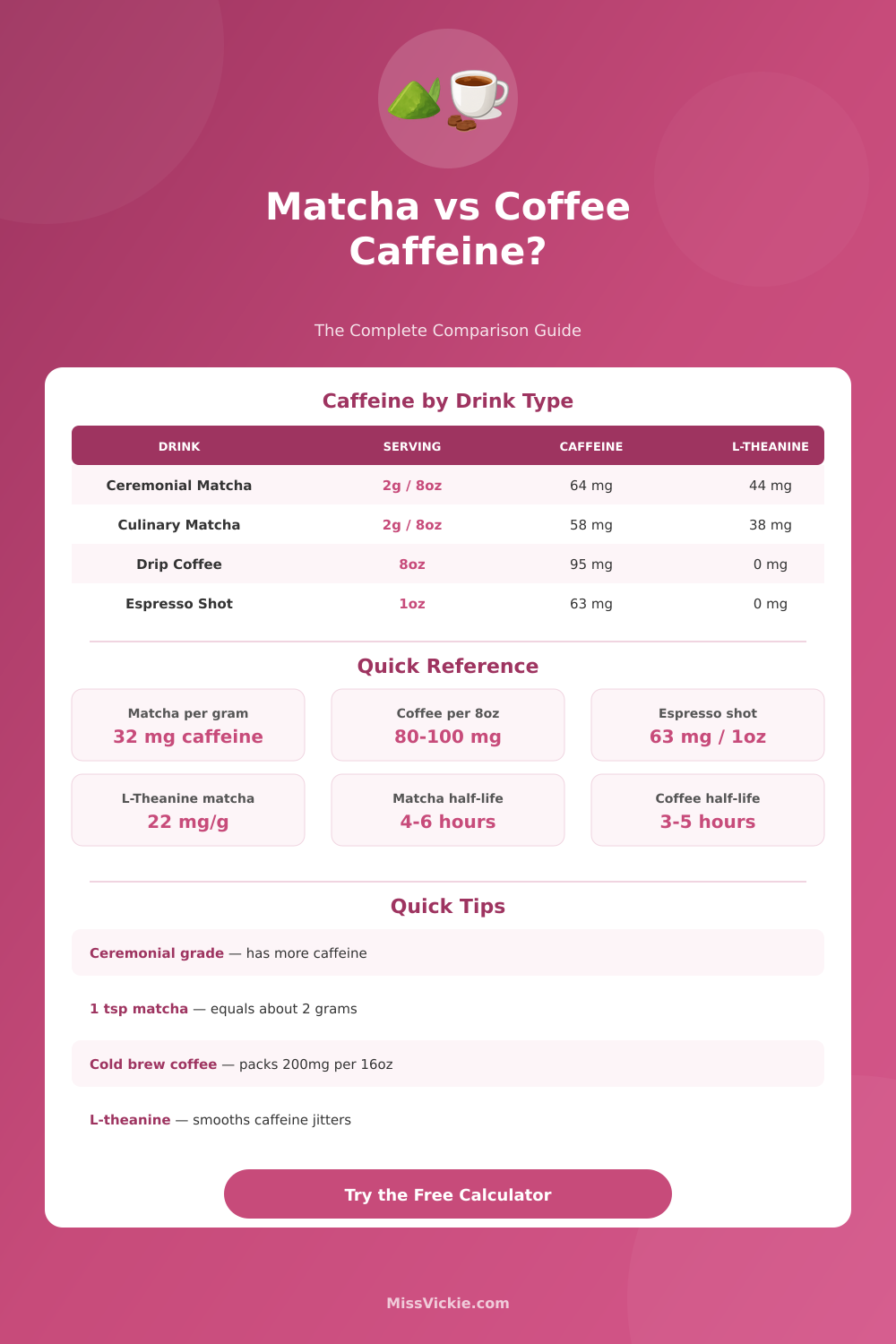
Compare caffeine, L-theanine, and more — side by side
⚡ Quick Presets
🍵 Matcha Details
☕ Coffee Details
🍵 vs ☕ Caffeine Comparison
📖 Caffeine Content Reference Table
Drink
Serving Size
Caffeine (mg)
Caffeine per oz
Ceremonial Matcha (1 tsp)
2g in 8 oz
64 mg
8 mg/oz
Culinary Matcha (1 tsp)
2g in 8 oz
58 mg
7.3 mg/oz
Drip Coffee
8 oz (237 ml)
95 mg
11.9 mg/oz
Espresso
1 oz (30 ml)
63 mg
63 mg/oz
Cold Brew
8 oz (237 ml)
100 mg
12.5 mg/oz
French Press
8 oz (237 ml)
108 mg
13.5 mg/oz
Instant Coffee
8 oz (237 ml)
62 mg
7.8 mg/oz
Decaf Coffee
8 oz (237 ml)
5 mg
0.6 mg/oz
🧪 L-Theanine & Other Compounds
Compound
Matcha (per 2g)
Coffee (per 8 oz)
Effect
L-Theanine
44 mg
0 mg
Calming focus
EGCG (Catechin)
59 mg
0 mg
Antioxidant
Chlorogenic Acid
Trace
70–120 mg
Antioxidant
Caffeine
64 mg
95 mg
Stimulant
Calories
5 kcal
2 kcal
Energy
📊 Matcha Powder Measurements
Measure
Weight (g)
Weight (oz)
Caffeine (mg)
1/2 teaspoon
1 g
0.035 oz
32 mg
1 teaspoon
2 g
0.07 oz
64 mg
1.5 teaspoons
3 g
0.1 oz
96 mg
2 teaspoons
4 g
0.14 oz
128 mg
1 tablespoon
6 g
0.21 oz
192 mg
🧠 Nutrition Snapshot (Per Standard Serving)
5
Matcha Cal
2
Coffee Cal
64 mg
Matcha Caffeine
95 mg
Coffee Caffeine
44 mg
L-Theanine
59 mg
EGCG
0.3 g
Matcha Protein
0.3 g
Coffee Protein
💡 Tip: Matcha caffeine is released more slowly due to L-theanine, providing about 4–6 hours of steady energy vs coffee’s sharper 1–3 hour peak. One teaspoon of matcha powder weighs about 2 grams and contains roughly 64 mg of caffeine for ceremonial grade.
⚖️ Measurement Tip: When measuring matcha, sift the powder first for accuracy. A loosely packed teaspoon can weigh 1.5–2g while a firmly packed one can reach 2.5g. For best results, use a kitchen scale.
A single teaspoon of ceremonial matcha (about 2 grams) delivers roughly 64 mg of caffeine, which honestly surprised me because an 8 oz cup of drip coffee lands around 95 mg. Thats only about 67% of coffees punch. The kicker is L-theanine at 44 mg per serving, something coffee simply doesnt have.
The information below does not come from some computer program or automatic translator. It is based on real users, discussions in forums and experiences of online communities through the whole net.
Matcha: What It Is and How to Use It
matcha is made of finely ground powder from specially grown green tea leaves. One grows the tea plants in shade for three to four weeks before one harvests them which gives matcha its bright green colour and strong umami taste. During the preparation one removes the stems and veins from the leaves, before grinding them.
This way one gets fine green dust, that looks entirely different than average teas.
Rather than usual green tea, where one soaks the leaves and later throws them away, matcha means that one drinks the whole leaf. One mixes the dust in warm water instead of soaking it, what creates a foamy drink. The best mode is to sift two grams of matcha for one serving, pour around 60 millilitres of warm water at 80 degrees Celsius and stir quickly for around 15 seconds.
The finsihed serving matches two units, similarly big as a small cup.
Two main ways exist for enjoying matcha. One of them is usucha, meaning thin tea, that stays the traditional best method for drinking it. The other is koicha, meaning thick tea.
If one mixes two grams of matcha with 50 to 60 millilitres of water, one gets thick, creamy and full bodied tea.
matcha has its own taste. It feels nice and fresh with sea nuances, more alike to seaweed than too fish. Good matcha should not have bad taste.
Starting with good matcha matters a lot, because cheap ones are only used as extras in lattes and smoothies. There is also food quality, meant specially for baking and cooking. Matcha is present in lattes, ice, smoothies, pastries, sweets and various recipes.
It gives a bit sweet taste rich in umami to dishes.
The best matcha comes from tea leaves that grow in regions like Kyoto in Japan. The mark “ceremonial grade”, that one uses in the West, is not an official real standard.
Sometimes one calls matcha the espresso of teas. It stores caffeine together with a substance called L-theanine, that likely slows the energy fall, that usually comes after coffee. An average serving of one spoon has around 70 milligrams of caffeine.
For health benefits drinking two to four servings a day can be best. One gram of matcha has many catechins, and around 61 percent of them is EGCG. Those catechins help to fight free radicals from pollution, UV rays and chemicals.
Matcha stores around fourtimes more catechins than in soaked green tea.
matcha passes through the placenta, so it matters to control the amount during pregnancy.