🤛 Protein in Breast Milk Calculator
Estimate your baby's protein intake from breast milk based on feeding volume & lactation stage
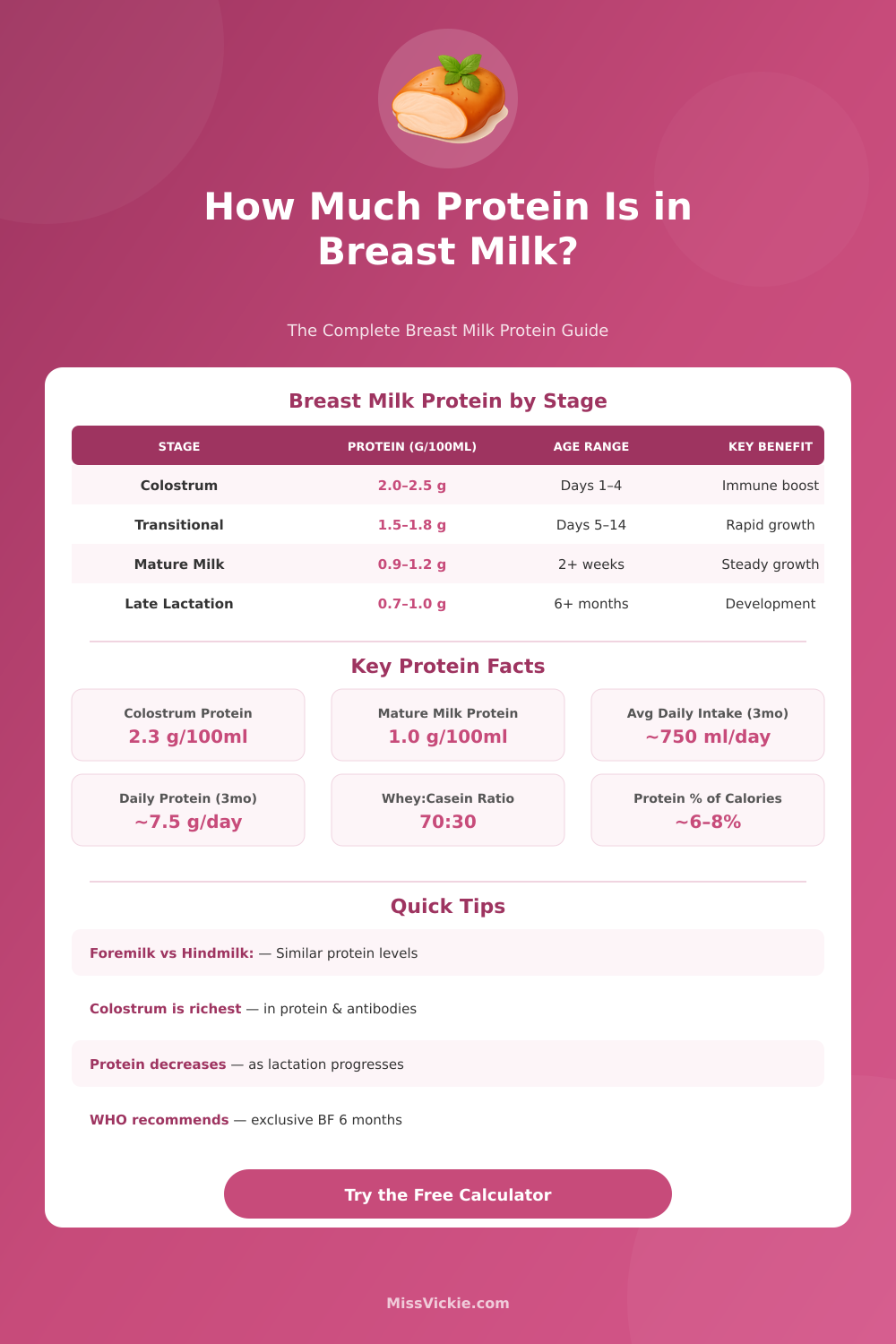
| Stage | Protein (g/100ml) | Age Range | Whey:Casein | Key Proteins |
|---|---|---|---|---|
| Colostrum | 2.0 – 2.5 g | Days 1–4 | 80:20 | sIgA, lactoferrin |
| Transitional | 1.5 – 1.8 g | Days 5–14 | 75:25 | Lactoferrin, IgA |
| Early Mature | 1.2 – 1.5 g | Weeks 2–4 | 70:30 | α-lactalbumin |
| Mature (1 mo) | 1.1 – 1.3 g | 1 month | 70:30 | α-lactalbumin |
| Mature (3 mo) | 1.0 – 1.2 g | 3 months | 60:40 | β-casein |
| Mature (6 mo) | 0.9 – 1.1 g | 6 months | 60:40 | Mixed |
| Late (9 mo) | 0.8 – 1.0 g | 9 months | 55:45 | Mixed |
| Late (12+ mo) | 0.7 – 1.0 g | 12+ months | 50:50 | Mixed |
| Preterm Milk | 1.8 – 2.4 g | Premature | 80:20 | High lactoferrin |
| Baby Age | Avg Daily Volume | Protein Conc. | Est. Daily Protein | Protein/kg/day* |
|---|---|---|---|---|
| Day 1–2 | 30–90 ml | 2.3 g/100ml | 0.7–2.1 g | ~0.3–0.7 g/kg |
| Day 3–4 | 150–300 ml | 2.1 g/100ml | 3.2–6.3 g | ~0.9–1.8 g/kg |
| Week 1–2 | 400–600 ml | 1.7 g/100ml | 6.8–10.2 g | ~1.8–2.8 g/kg |
| 1 Month | 600–750 ml | 1.2 g/100ml | 7.2–9.0 g | ~1.6–2.0 g/kg |
| 3 Months | 700–800 ml | 1.1 g/100ml | 7.7–8.8 g | ~1.4–1.6 g/kg |
| 6 Months | 700–900 ml | 1.0 g/100ml | 7.0–9.0 g | ~0.9–1.2 g/kg |
| 9 Months | 500–700 ml | 0.9 g/100ml | 4.5–6.3 g | ~0.6–0.8 g/kg |
| 12 Months | 400–600 ml | 0.8 g/100ml | 3.2–4.8 g | ~0.3–0.5 g/kg |
| fl oz | ml | Protein (Mature) | Protein (Colostrum) |
|---|---|---|---|
| 0.5 fl oz | 15 ml | 0.15 g | 0.35 g |
| 1 fl oz | 30 ml | 0.30 g | 0.69 g |
| 2 fl oz | 59 ml | 0.59 g | 1.36 g |
| 3 fl oz | 89 ml | 0.89 g | 2.05 g |
| 4 fl oz | 118 ml | 1.18 g | 2.71 g |
| 5 fl oz | 148 ml | 1.48 g | 3.40 g |
| 6 fl oz | 177 ml | 1.77 g | 4.07 g |
| 8 fl oz | 237 ml | 2.37 g | 5.45 g |
Breast Milk is made up of fluid from the glands in the chests of females. It forms the main food source for children recently born. In it you find fat, Protein, carbohydrates together with a mix of minerals and vitamins.
Moreover it provides all of the needed nutrients for babies, and it acts softly on the growing belly of baby intestines and various body systems.
All About Breast Milk
The production of Breast Milk starts in big amounts between the second and fourth day after the birth. One commonly calls this milk “arriving”. Before that the chests prepare colostrum.
Colostrum is the dense initial milk fluid, that forms during the pregnancy and just after the birth. It owns a strong yellow color, because of what one sometimes calls it “liquid gold”. Colostrum is rich in nutrients and holds antibodies, that helps guard the baby.
Also Breast Milk has active elements, that helps the calm growth of the immune system in babies.
Children must feed eight to twelve times during every day of 24 hours, about every two to three hours, also overnight. Some babies tend to seize the breast during growth spurts or evenings. Feeding according too need can help to set up the milk supply.
There is no one right amount of milk for feeding. At younger children until two or three months old, bottles with pumped milk usually hold three to six ounces, where four ounces is the standard. Most babies consume between 24 and 30 ounces daily.
Holding the skin of baby together with pumping just after that can lower the cost and grow the milk supply. Apply warming to the chests and do breast massage before and during the pumping to help rush the milk flow and even increase the calories in the milk. Pumping by means of hands gives greasier milk.
Knowing how to withdraw Breast Milk is useful for all stayinghome mothers.
In the storage, Breast Milk can stay in separate packets fresh with ice packs until 24 hours during travel. If one delivers it to a child carer, the case should be clearly labeled with the name of the child. Unused Breast Milk can be poured in a clean bottle with a new cap, chilled and used inside 24 hours.
Breast Milk also works for cooking. It replaces regular milk in various recipes. One can mix it in soft foods like beans, cereals, porridge and puree of vegetables.
It goes well with nut and seed butters to create smooth blends for foods by means of fingers. Some parents use it to prepare pancakes, oatmeal and smoothies for their babies. An easy method is simply to swap it everywhere, where a recipe requires milk.