☕ Caffeine in Black Tea Calculator
Estimate the exact caffeine in your cup based on tea type, steep time & serving size
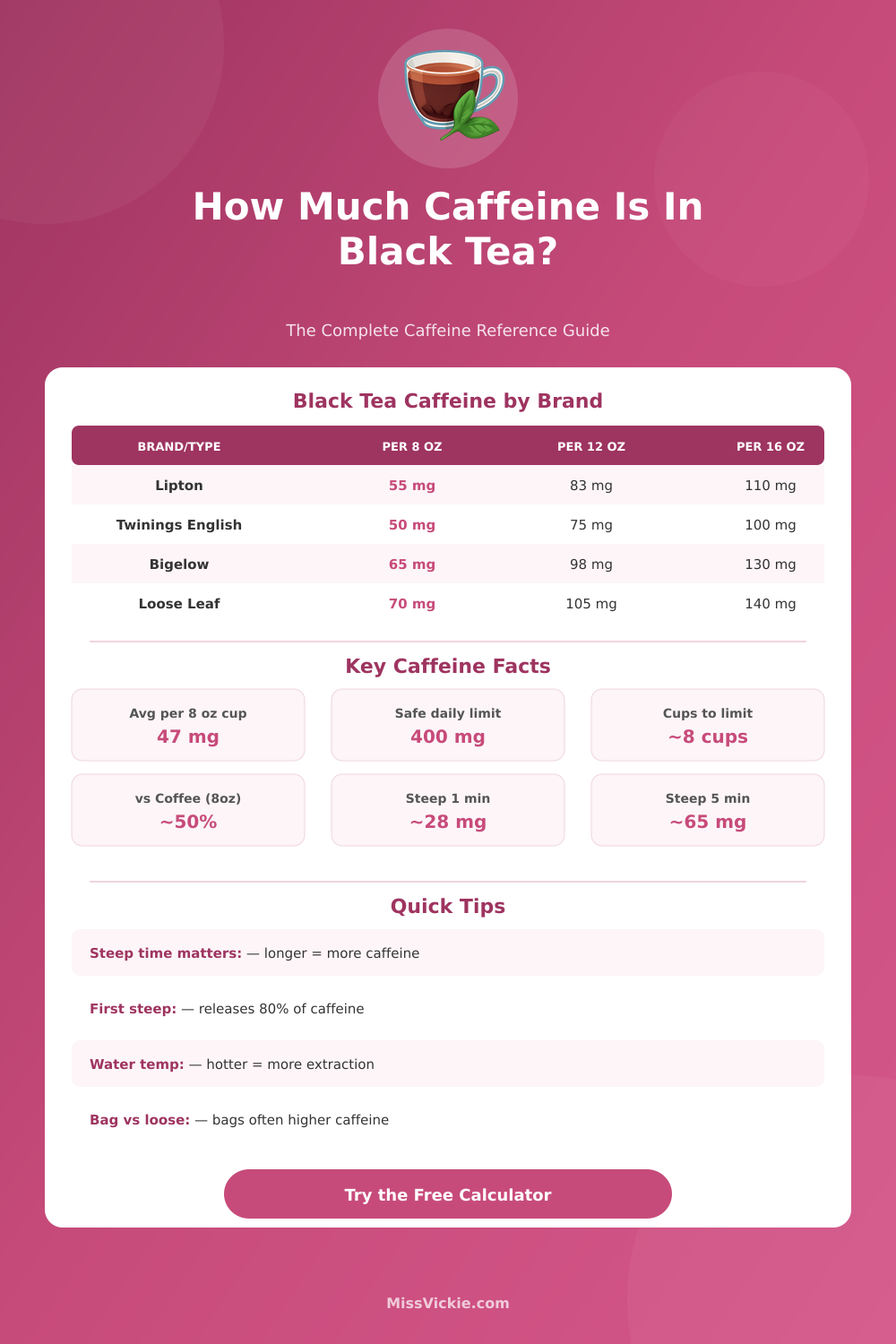
| Tea Type / Brand | 1 Min Steep | 3 Min Steep | 5 Min Steep | Level |
|---|---|---|---|---|
| Generic Black Tea | 28 mg | 47 mg | 65 mg | Medium |
| Lipton Tea Bag | 32 mg | 55 mg | 72 mg | Medium |
| Twinings English Breakfast | 30 mg | 50 mg | 68 mg | Medium |
| Bigelow Black Tea | 38 mg | 65 mg | 85 mg | High |
| Assam | 40 mg | 70 mg | 90 mg | High |
| Darjeeling | 25 mg | 42 mg | 58 mg | Medium |
| Earl Grey (Generic) | 28 mg | 45 mg | 62 mg | Medium |
| Yorkshire Tea | 35 mg | 60 mg | 78 mg | High |
| PG Tips | 34 mg | 58 mg | 76 mg | Medium |
| Premium Loose Leaf | 35 mg | 60 mg | 80 mg | High |
| Decaf Black Tea | 2 mg | 4 mg | 5 mg | Low |
| Group | Daily Limit | Equiv. Black Tea Cups (8oz) | Notes |
|---|---|---|---|
| Healthy Adults | 400 mg | ~8 cups | FDA guideline |
| Pregnant Individuals | 200 mg | ~4 cups | WHO recommendation |
| Adolescents (12–18) | 100 mg | ~2 cups | AAP recommendation |
| Children (<12) | Not recommended | — | Avoid caffeine |
| Caffeine-sensitive | 100 mg or less | ~2 cups | Individual tolerance varies |
| Drink | Caffeine (avg) | Caffeine Range | vs. Black Tea |
|---|---|---|---|
| Black Tea | 47 mg | 25–90 mg | — Baseline |
| Green Tea | 28 mg | 15–50 mg | ~60% of black tea |
| White Tea | 18 mg | 6–60 mg | ~38% of black tea |
| Oolong Tea | 37 mg | 12–55 mg | ~79% of black tea |
| Drip Coffee | 95 mg | 70–140 mg | ~2x black tea |
| Espresso (1 oz) | 63 mg | 47–75 mg | Similar per cup |
| Matcha (8 oz) | 70 mg | 38–89 mg | ~149% of black tea |
| Cola (12 oz) | 34 mg | 23–46 mg | ~72% of black tea |
In North America, black tea is the most common kind of tea. When one mentions tea in western societies, they usually mean black tea. One prepares sun tea, sweet tea, iced tea and afternoon tea using black tea.
Popular mixes, for example English Breakfast and Earl Grey are made up of leaves of black tea.
Black Tea: Types, How It Is Made and How to Use It
The leaves of the bush Camellia sinensis give black tea. It belongs to the real teas, that all come from that same plant. Among them is white tea, green tea, oolong tea and pu-erh tea.
One considers black tea one of the most strong among those.
The main difference of black tea is the level of oxidation. It oxidizes more than oolong, yellow, white and green teas. That strong oxidation makes the leaf and the drink darker.
Rather, it seriously changes the smell and the taste. For best black tea, one rolls withered leaves, leaves them to oxidize and dries them. The production passes through four stages: wilting, roll, oxidation and drying.
Those setps give strong taste.
Black tea has more caffeine than the less oxidized teas. For instance, a cup of English Breakfast, that is a mix of black tea, holds around 71 milligrams of caffeine. It also has other stimulants and antioxidants.
Many folks drink it warm or cold. The more oxidized is the leaf, the warmer must bee the water to infuse. Because of that, for black tea one uses hotter water than for white or green.
Many varieties deserve to be tried. Darjeeling has good smell and sometimes one calls it the champion among teas. Assam gives good everyday black tea.
Chinese black teas usually are more complex, less acidic and show various tastes compared to other origin lands. Vietnamese black teas can be wonderful. Ceylon is another well known kind.
Traditionally one adds milk to black tea, especially for breakfast. Teas of lower quality, sold in packets, could benefit from extra sugar or milk for more creamy taste. One prepares chai from black tea and spices.
Black tea is useful also in the kitchen. Infused tea works for cooking dishes in steam. Smoky Lapsang Souchong, a kind of black tea, works well for portobello mushrooms in steam.
More rugged black teas work more well in baking, because tender teas can fail. There is even a recipe for black tea citrus bread, that uses strong black teas inthe mass.
Although all black teas have some shared traits, many varieties exist, like the type, the size of leaves and the harvest seasons. There is no single rule for perfectly infusing it.