🍺 Beer Brewing Calculator
Calculate ABV, IBU, Original Gravity, grain bill & hop additions for your homebrew batch
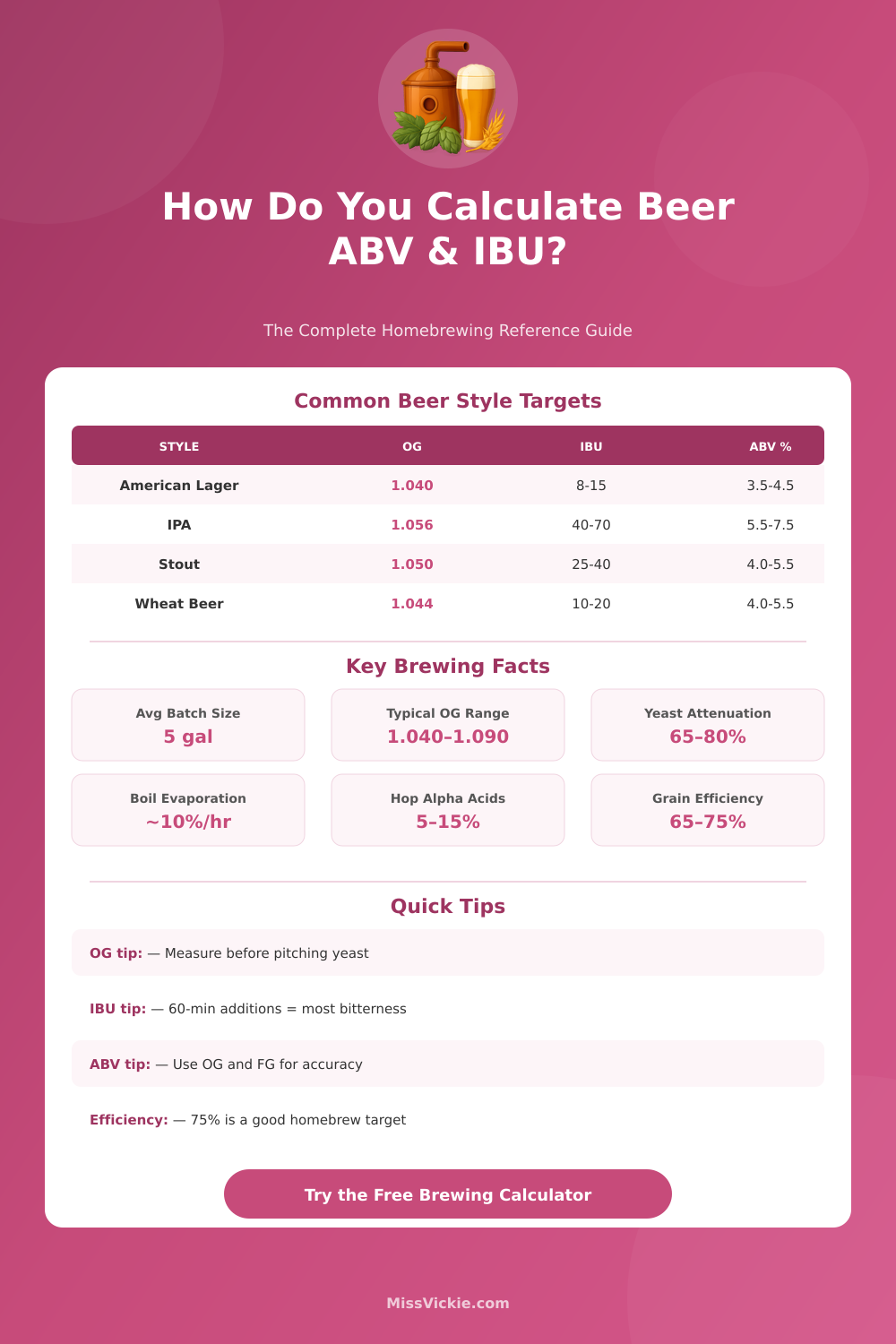
| Style | OG Range | FG Range | ABV % | IBU | SRM Color |
|---|---|---|---|---|---|
| American Lager | 1.040–1.050 | 1.004–1.010 | 3.5–4.5% | 8–15 | 2–4 |
| American Pale Ale | 1.045–1.060 | 1.010–1.015 | 4.5–6.2% | 30–50 | 5–14 |
| West Coast IPA | 1.056–1.075 | 1.008–1.014 | 5.5–7.5% | 40–70 | 6–14 |
| New England IPA | 1.060–1.085 | 1.010–1.020 | 6.0–8.0% | 25–60 | 3–7 |
| Dry Stout | 1.036–1.050 | 1.007–1.011 | 4.0–5.0% | 30–40 | 25–40 |
| Robust Porter | 1.048–1.065 | 1.012–1.016 | 4.8–6.5% | 25–40 | 20–30 |
| Wheat Beer | 1.044–1.052 | 1.010–1.014 | 4.3–5.6% | 10–20 | 2–8 |
| Saison | 1.048–1.065 | 1.002–1.012 | 5.0–7.0% | 20–35 | 5–14 |
| Barleywine | 1.080–1.120 | 1.016–1.030 | 8.0–12.0% | 50–100 | 10–19 |
| Amber Ale | 1.045–1.060 | 1.010–1.015 | 4.5–6.2% | 25–40 | 11–17 |
| Hop Variety | Alpha Acid % | Primary Use | Typical Flavor/Aroma |
|---|---|---|---|
| Cascade | 5.5–8.5% | Dual Purpose | Citrus, Floral, Grapefruit |
| Centennial | 9.5–11.5% | Dual Purpose | Floral, Citrus, Spicy |
| Chinook | 12–14% | Bittering | Piney, Spicy, Grapefruit |
| Citra | 11–13% | Aroma/Dry Hop | Tropical, Lime, Melon |
| Mosaic | 11.5–13.5% | Dual Purpose | Tropical, Berry, Herbal |
| Magnum | 12–14% | Bittering | Clean Bitter, Subtle Herbal |
| Saaz | 2–5% | Aroma | Spicy, Herbal, Earthy |
| Hallertau | 3.5–5.5% | Aroma | Floral, Herbal, Mild Spice |
| Simcoe | 12–14% | Dual Purpose | Piney, Passionfruit, Earthy |
| Columbus (CTZ) | 14–16% | Bittering | Dank, Citrus, Earthy |
| Grain / Adjunct | PPG (Points/Lb/Gal) | Lovibond (Color) | Notes |
|---|---|---|---|
| 2-Row Pale Malt | 37 | 1.8 – 2.0 | Most common base malt |
| Maris Otter | 38 | 2.5 – 3.5 | Rich, biscuity British base |
| Pilsner Malt | 37 | 1.5 – 2.0 | Very light; suits lagers |
| Munich Malt | 35 | 6 – 9 | Malty, bread flavor |
| Crystal/Caramel 60L | 34 | 60 | Sweetness, body, amber color |
| Crystal 20L | 35 | 20 | Light sweetness, gold color |
| Chocolate Malt | 28 | 350 | Dark roast, coffee notes |
| Roasted Barley | 25 | 500 | Dry roast, stout character |
| Wheat Malt | 39 | 2.5 | Haze, head retention |
| Flaked Corn | 37 | 0.5 | Lightens body, crisp finish |
Beer is simply the process of blending water, grains, yeast and hops to create Beer. It works by means of soaking a starch source, usually grain like barley, in water, later fermenting the sweet liquid that results from that, with yeast. Who manages to follow a simple recipe for instance for stew or pasta with cheese, that fits to prepare Beer at home.
The main stages are made up of cleaning, mashing, Brewing and bottling.
How Beer Is Made
Barley, the usual grain first gets malted. That means that one allows it to sprout and later dry it. Roasting the barley, the brewer gives the final Beer various shades and flavors.
The deeper the roasting, the fewer sugar stays for the yeast to consume. Hence many brewers mix three, four or even seven knids of malt to form their Beer.
The yeast causes the main difference between Beer styles. Lagers use yeast that works in cold temperatures, between 44 and 55 degrees Fahrenheit. That yeast gathers at the bottom of the fermenting tank.
Ale styles depend on upper yeast that stays and works upward in the mass. Only that detail alters the hole nature of the drink.
Start Brewing at home does not need to be hard. One can do it on a stovetop with an extract kit that includes everything needed for one recipe. That is the simplest way to produce Beer yourself.
All-grain batches simplify whole-grain work, but any such method needs more money for gear. Use a big jar for five gallons or more, together with a propane burner, to help. Plastic buckets from a homebrew store work for both work and fermenting, but a five-gallon bucket does not truly store five gallons of mass.
Home Brewing can be as simple or complex as some want. It depends mainly on the level that a person wants to improve their skills. It is key to follow clear rules about cleaning, cleaning and fermenting temperatures.
Control of temperature stays central for professionals also.
It almost always costs less to simply buy Beer than to prepare it yourself. Commercial breweries benefit from economy of scale. Home Brewing more works as a hobby than saving money, and it can get costly.
Even so it gives a lot of joy and teaches about physics, biology, math and chemistry during the process. Some homebrewers even open their own professional breweries, although that commonly means to end the fun part. Beer and bread use the same basic parts: grain, water, yeast andflavor.
Bread is solid Beer, while Beer is liquid bread.