🔥 BBQ Cooking Time Calculator
Get precise low-and-slow cooking times for any cut of meat — enter weight & type below
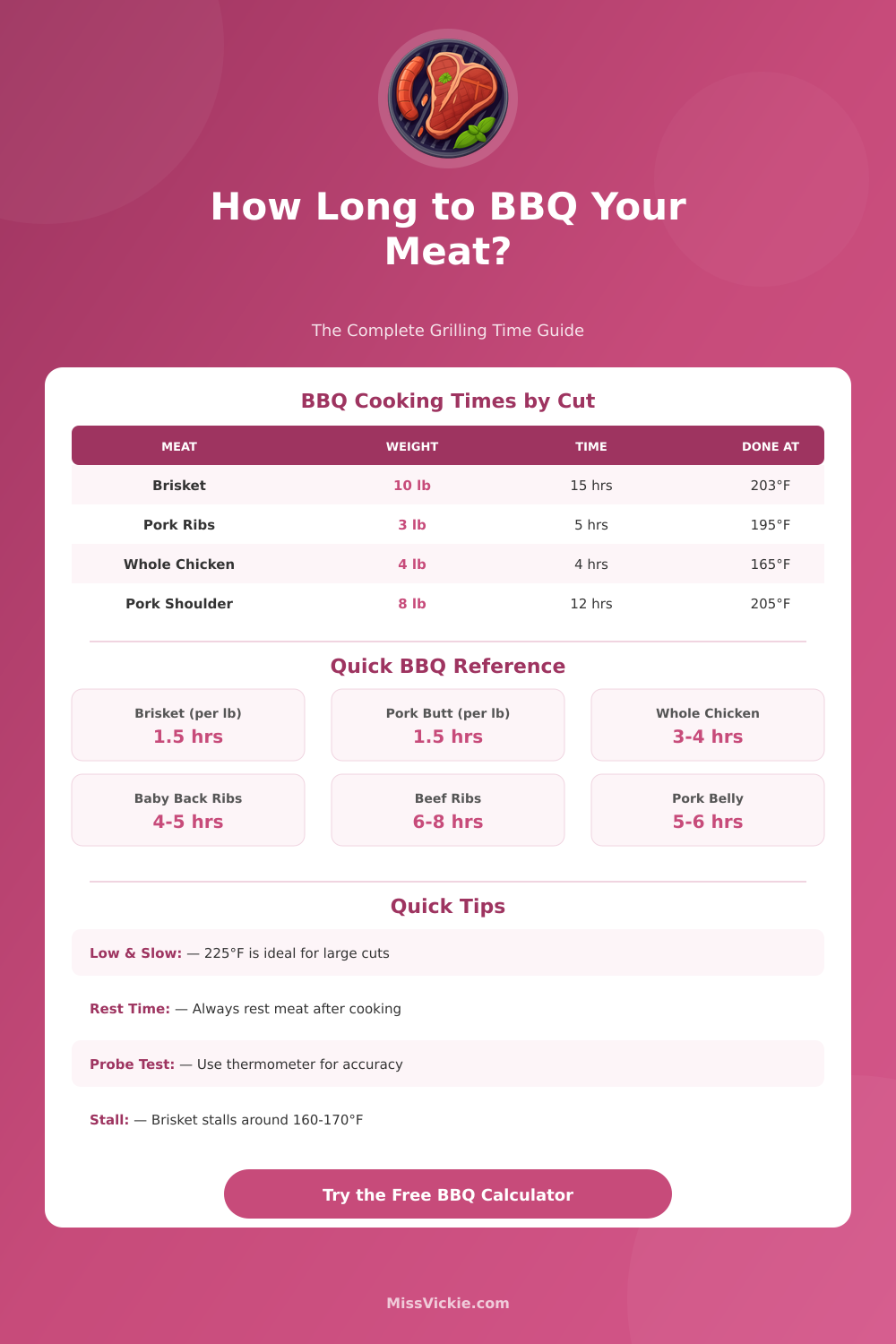
| Meat Cut | Weight | Est. Time | Target Temp | Hrs Per Lb |
|---|---|---|---|---|
| Beef Brisket (Flat) | 8–12 lb | 12–18 hrs | 203°F / 95°C | 1.5 hrs |
| Pork Shoulder / Butt | 6–10 lb | 10–16 hrs | 205°F / 96°C | 1.5 hrs |
| Baby Back Ribs | 2–3 lb | 4–5 hrs | 195°F / 91°C | 1.5 hrs |
| Spare Ribs | 3–4 lb | 5–6 hrs | 195°F / 91°C | 1.5 hrs |
| Beef Short Ribs | 4–6 lb | 8–10 hrs | 205°F / 96°C | 1.75 hrs |
| Whole Chicken | 3–5 lb | 3–4 hrs | 165°F / 74°C | 0.75 hrs |
| Whole Turkey | 10–14 lb | 6–9 hrs | 165°F / 74°C | 0.65 hrs |
| Pork Belly | 4–6 lb | 5–7 hrs | 200°F / 93°C | 1.2 hrs |
| Leg of Lamb | 5–7 lb | 5–8 hrs | 190°F / 88°C | 1.2 hrs |
| Chuck Roast | 3–5 lb | 5–8 hrs | 205°F / 96°C | 1.5 hrs |
| Meat | Target (°F) | Target (°C) | Notes |
|---|---|---|---|
| Beef Brisket | 200–205°F | 93–96°C | Probe should feel like butter |
| Pork Shoulder | 200–205°F | 93–96°C | Must pull apart easily |
| Pork Ribs | 190–203°F | 88–95°C | Bend test or toothpick test |
| Chicken (whole) | 165°F | 74°C | Thickest part of thigh |
| Turkey | 165°F | 74°C | Inner thigh, avoid bone |
| Beef Ribs | 200–205°F | 93–96°C | Probe slides in with no resistance |
| Lamb | 185–195°F | 85–91°C | For pull-apart tenderness |
| Pork Belly | 195–200°F | 91–93°C | Firm but jiggly |
| Salmon (whole) | 140°F | 60°C | Flakes easily |
| Smoker Temp | Time Multiplier | Best For | Notes |
|---|---|---|---|
| 225°F / 107°C | +20% longer | Brisket, Pork Butt | Maximum smoke ring, very tender |
| 250°F / 121°C | Baseline | All cuts | Most popular competition temp |
| 275°F / 135°C | –15% shorter | Chicken, Turkey | Crispier skin, good texture |
| 300°F / 149°C | –25% shorter | Ribs, Chicken | Hot & fast method |
| 325°F / 163°C | –35% shorter | Chicken, Fish | Minimal smoke penetration |
Barbecue is the full form of BBQ, and it has many other writings, for instance Bar-B-Q, BarBQ or Bar-B-Que. In the base it shows a cooking mode, that uses live flame and smoke to prepare foods. Even so, the exact meaning ranges according to the region.
In some areas of the world, the idea of barbecue is strongly discussed. In Australia, everything roasted on a grill or above open flame outside counts as bbq, or simply “roasted on the barbecue.” Sausages, steaks, chicken skewers, lamb chops and hamburgers all belong to typical Australian barbecue.
All About Barbecue
A difference exists between barbecue and simple grilling, and that confuses many folks. Some reckon, that without sauce, it does not deserve the name real bbq. Anyhow, now is not time for cooking outside.
About restaurants of barbecue, the usual menu items include beef brisket, pork ribs, beef ribs, chicken, pulled pork and hot dogs. All of them are smoked or cooked a bit slowly. Misia BBQ operates as a fast independent grill store, that perpares everything home and manually, without using a microwave or freezer.
Hometown Bar-B-Que started in Red Hook, Brooklyn, in September 2013 and focuses on pit-smoked meats, done by means of the traditional south method of smoke above oak wood.
Pulled pork ranks between the favorites of barbecue. One usually prepares it from pork butt or from pork shoulder, that commonly has bones. Normal pork butt weighs from seven to ten pounds and gives around fifty percent of its wait.
Like this, a ten-pound raw pork butt delivers around five pounds of pulled pork.
Planning of portions is really important. For one person, the good amount of raw meat is half to three-quarters of a pound. A child probably will eat around a quarter of a pound of meat.
Knowing the list of guests helps a lot. Big eaters require a bigger part, while little children and older folks usually take less. Around seven or eight ribs for one person are a safe portion.
Brisket loses around thirty to fifty percent of its weight during the smoking process. Sixteen to eighteen pounds of raw brisket requires around eighteen hours for good smoke. Twelve to fifteen pounds of Boston butt requires around twelve hours.
Also the side dishes matter. During big festivals, every guest will eat around one cup from every side. For a home meal, half a cup for a person is usual.
Good options are baked beans, coleslaw, potato salad, deviled eggs and pasta salad. Grilled corn on the cob with elote topping, melted butter and grilled rub go well with ribs and pulled pork. Keeping extra burger patties and hot dogs in the refrigerator is a smart idea for sudden incoming guests or picky children.
Ciabatta bread goes well with sandwiches from leftover grilled steak. Bakingbread above a bbq pit presents a funny challenge also.