🥓 Bacon Grease for Gravy Calculator
Calculate the perfect amount of bacon grease, flour, and liquid for rich, flavorful gravy
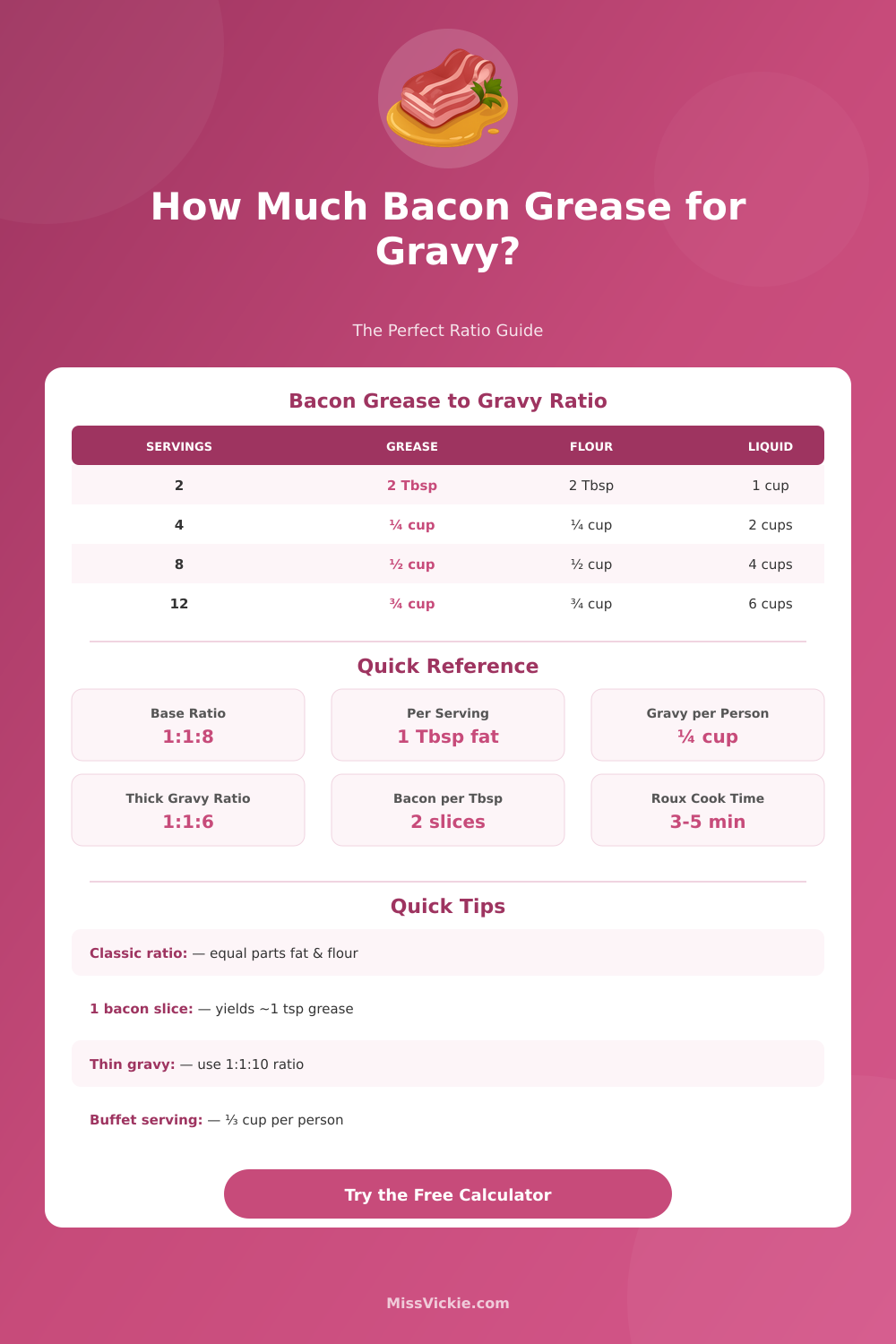
| Servings | Bacon Grease | Flour | Liquid | Total Gravy |
|---|---|---|---|---|
| 2 | 2 tbsp (28 g) | 2 tbsp (16 g) | 1 cup (240 ml) | ½ cup (120 ml) |
| 4 | ¼ cup (56 g) | ¼ cup (31 g) | 2 cups (480 ml) | 1 cup (240 ml) |
| 6 | 6 tbsp (84 g) | 6 tbsp (47 g) | 3 cups (720 ml) | 1½ cups (360 ml) |
| 8 | ½ cup (112 g) | ½ cup (63 g) | 4 cups (960 ml) | 2 cups (480 ml) |
| 12 | ¾ cup (168 g) | ¾ cup (94 g) | 6 cups (1440 ml) | 3 cups (720 ml) |
| 20 | 1¼ cups (280 g) | 1¼ cups (156 g) | 10 cups (2400 ml) | 5 cups (1200 ml) |
| 50 | 3¼ cups (700 g) | 3¼ cups (391 g) | 25 cups (6000 ml) | 12½ cups (3000 ml) |
| Bacon Slices | Grease Yield (tbsp) | Grease Yield (ml) | Grease Yield (g) |
|---|---|---|---|
| 2 slices | ~1.5–2 tbsp | 22–30 ml | 20–28 g |
| 4 slices | ~3–4 tbsp | 45–60 ml | 42–56 g |
| 6 slices | ~5–6 tbsp | 75–90 ml | 63–84 g |
| 8 slices | ~6–8 tbsp | 90–120 ml | 84–112 g |
| 12 slices | ~9–12 tbsp | 135–180 ml | 126–168 g |
| 1 lb (16 slices) | ~12–16 tbsp | 180–240 ml | 168–224 g |
| Measurement | Tbsp | Milliliters | Grams (grease) |
|---|---|---|---|
| 1 teaspoon | ⅓ tbsp | 5 ml | 4.7 g |
| 1 tablespoon | 1 tbsp | 15 ml | 14 g |
| ¼ cup | 4 tbsp | 60 ml | 56 g |
| ⅓ cup | 5.3 tbsp | 80 ml | 75 g |
| ½ cup | 8 tbsp | 120 ml | 112 g |
| 1 cup | 16 tbsp | 240 ml | 224 g |
| Thickness | Fat : Flour : Liquid | Use Case |
|---|---|---|
| Thin | 1 tbsp : 1 tbsp : 1.5 cups | Drizzle over mashed potatoes |
| Medium (standard) | 1 tbsp : 1 tbsp : 1 cup | All-purpose gravy |
| Thick | 1 tbsp : 1 tbsp : ¾ cup | Biscuits & gravy |
| Very Thick | 1 tbsp : 1 tbsp : ½ cup | Pot pie filling, casseroles |
At the base, gravy from bacon drippings uses an easy ratio of 1:1:8 by volume. So a tablespoon of drippings, a tablespoon of whole flour and a cup of liquid. Like this you get around one cup of medium thick gravy that is enough for four average servings of 60 ml (¼ cup) each.
Want it thicker and richer for biscuits? Use a ratio of one tablespoon of flour for three quarter cups of liquid. A more runny, pourable version calls for one tablespoon of flour to one and a half cups instead.
How to Make and Scale Bacon Gravy
A slice of usual thickness bacon; about 28 g raw that shrinks to 8–10 g after cooking, gives around one tablespoon of liquid fat. Slices of thicker cut that weigh almost 42 g raw each usually give 1.25–1.5 tablespoons each slice. Bacon from the middle part only makes around half a tablespoon each slice, because it has much less fat to start with.
From a typical package of 1 pound (454 g) with 16–18 slices of standard bacon, expect between three quarters and one whole cup of cooked drippings.
Most cookbooks set the standard serving of gravy to a quarter of cup for a person. When biscuits are the main part, though, the amounts grow to around a third of cup per person, because the biscuit soaks it up strongly. For lighter food, just 2–3 tablespoons each person is enough.
At buffet events plan widely for around three tablespoons each guest, so that each finds somthing according to his hunger at the table.
For a four-person family with standard servings, you need four tablespoons of the fat, four tablespoons of flour and two cups of milk or broth. This means cooking around four slices of usual bacon. For feeding of eight folks?
Simply double everything: half a cup fat, half a cup flour, four cups liquid and around eight slices of bacon to reach the target.
When preparing for bigger groups, the math stays simple. Twenty folks calls for one and a quarter cup of the drippings, one and a quarter cup of flour and ten cups of liquid, giving five cups (1.2 L) of gravy in total. Scaling up to fifty guests means almost three and a quarter cup of fat and three and a quarter cup of flour, plus twenty-six cups of liquid.
Just for the drippings alone at that scale, around 3.1 pounds of raw bacon must go on the list.
From a nutrition viewpoint a tablespoon of bacon fat holds 115–120 calories along with 12.8–13.5 g of total fat (split into 5.0 g saturated, 5.8 g monounsaturated and 1.6 g polyunsaturated), 19 mg of cholesterol and no carbohydrate or protein. A quarter cup serving of cream gravy, made with whole milk, has around 95–110 calories, 7–8.5 g fat, 5–6 g carbohydrates and 2–3 g protein.
Swapping the milk for meat broth drops the calories per serving to around 70–80 and the fat goes to 5–7 g.
In restaurants and catering events, gravy is usually served in 2–3 ounces (60–90 ml) per dish. Standard hotel serving containers hold around 5 liters of gravy, which is enough for any of 56 to 85
folks depending on how freely it is poured. Most suppliers also count on 10–15% extra reserve, so an eighty-person event really would prepare for 55–58 servings just to be safe.
Rendered bacon fat is made up of around 39.2% saturated, 45.1% monounsaturated and 11.2% polyunsaturated by weight. Butter, for comparison, has 63% saturated. The fat has a smoke point of
around 190–200°C (374–400°F), which far beats the 120–150°C (250–300°F) range needed for good roux.
Also, a cup of the drippings weighs around 224 g compared to butter at 227 g per cup, so they almost swap evenly by volume in roux recipes.
Big appetites or meals heavy in biscuits can easily grow the use of gravy by 30–40% above standard. Children between 4 and 10 years eat roughly 50–60% of what an adult would want.
At festive dinners, where gravy must be shared with many other dishes on the plate, the use usually drops by 15–20% compared to a simple biscuits-and-gravy breakfast.