🥛 Calcium in Almond Milk Calculator
Track your calcium intake from almond milk & see how it compares to your daily needs
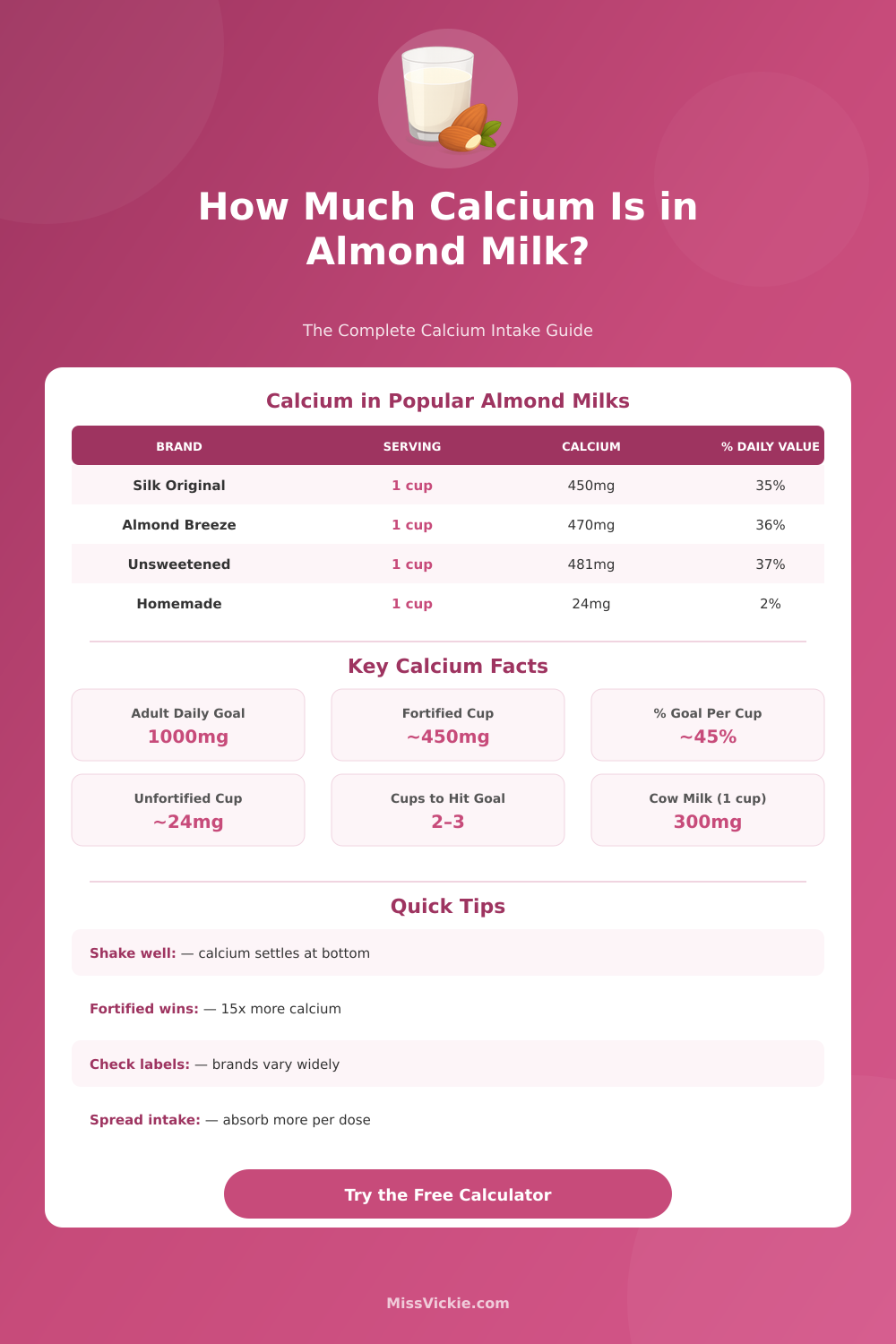
| Brand / Type | Serving | Calcium (mg) | % Daily Value | Fortified? |
|---|---|---|---|---|
| Silk Original Almond | 1 cup (240ml) | 450mg | 35% | Yes |
| Almond Breeze Original | 1 cup (240ml) | 470mg | 36% | Yes |
| Almond Breeze Unsweetened | 1 cup (240ml) | 481mg | 37% | Yes |
| Califia Farms Unsweetened | 1 cup (240ml) | 450mg | 35% | Yes |
| So Delicious Almond | 1 cup (240ml) | 100mg | 8% | Partial |
| Elmhurst Almond | 1 cup (240ml) | 20mg | 2% | No |
| Homemade Almond Milk | 1 cup (240ml) | 24mg | 2% | No |
| Barista Blend (Silk) | 1 cup (240ml) | 450mg | 35% | Yes |
| 365 Whole Foods Almond | 1 cup (240ml) | 450mg | 35% | Yes |
| Age / Life Stage | Daily Calcium Goal | Cups Fortified Milk | Cups Unfortified |
|---|---|---|---|
| Children 4–8 yrs | 800mg/day | ~2 cups | 33+ cups |
| Children 9–13 yrs | 1,300mg/day | ~3 cups | 54+ cups |
| Teens 14–18 yrs | 1,300mg/day | ~3 cups | 54+ cups |
| Adults 19–50 yrs | 1,000mg/day | ~2.2 cups | 42+ cups |
| Women 51–70 yrs | 1,200mg/day | ~2.7 cups | 50+ cups |
| Men 51–70 yrs | 1,000mg/day | ~2.2 cups | 42+ cups |
| Adults 71+ yrs | 1,200mg/day | ~2.7 cups | 50+ cups |
| Pregnant / Nursing | 1,000mg/day | ~2.2 cups | 42+ cups |
| Measurement | ml | fl oz | Cups |
|---|---|---|---|
| 1 tablespoon | 15ml | 0.5 fl oz | 0.063 cups |
| 1/4 cup | 60ml | 2 fl oz | 0.25 cups |
| 1/2 cup | 120ml | 4 fl oz | 0.5 cups |
| 1 cup (standard) | 240ml | 8 fl oz | 1 cup |
| Small glass (6 fl oz) | 177ml | 6 fl oz | 0.75 cups |
| Large glass (12 fl oz) | 355ml | 12 fl oz | 1.5 cups |
| Standard carton serving | 240ml | 8 fl oz | 1 cup |
| 1 liter | 1000ml | 33.8 fl oz | 4.17 cups |
| Milk Type | Calcium per Cup | % DV (1300mg ref) | Naturally Occurring? |
|---|---|---|---|
| Cow's Milk (whole) | 276–300mg | 21–23% | Yes (natural) |
| Fortified Almond Milk | 450–481mg | 35–37% | No (added) |
| Unfortified Almond Milk | ~24mg | ~2% | Minimal |
| Fortified Soy Milk | 300–340mg | 23–26% | Partial |
| Fortified Oat Milk | 350mg | 27% | No (added) |
| Fortified Rice Milk | 283mg | 22% | No (added) |
| Fortified Coconut Milk (bev.) | 450mg | 35% | No (added) |
Almond Milk is made from a plant base to replace real milk, prepared from almonds. The texture is like water while the taste reminds of nuts. It fully lacks cholesterol and lactose, and it stores only little packed fat.
One commonly drinks it if one suffers from lactose intolerance or follows a vegan lifestyle. Although almonds themselves are well known because of their health impact, a little amount of them passes nutritious value than a whole big glass of Almond Milk.
All About Almond Milk
Some brands stay at the base really simple. Some kinds of Almond Milk are made from only two basic elements: almonds with water. No extra gums, oils, fillers or thickeners in them.
Using more almonds than the competition, one reaches naturally smooth and creamy results without extra helpers. Moreover, other brands mix in himalayan pink salt togehter with organic almonds and purely filtered water.
About homemade Almond Milk, it is fairly simple work. You just need plain almonds, water and maybe some sweetener, for instance honey or agave syrup. One mixes the almonds with water, later pours the whole thing through cheesecloth or a nutty bag in a big bit.
By means of pressure one gets the most liquid. The whole process of blending and straining lasts only sum minutes. Homemade Almond Milk lasts in the refrigerator for around four until seven days.
From one batch one receives around two cups.
Almond Milk has little protein, but at the same time it stores only a little amount of carbs, so that it must have almost no effect on the level of sugar in blood. Without added sugar, it is gentle, nutty and a bit sweet naturally. Many sold versions store sugar, vanilla or stabilizers, that changes the original taste.
Usually one thickens commercial Almond Milk by means of gums.
In recipes for breads, Almond Milk can replace average water. It works well as an option without cow milk during baking, for instance for biscuits, crepes, cakes or sweet breads. If a recipe requires full or thin milk, commonly one-for-one change answers.
Even so, it stores only very little protein compared to cow milk. Here, where proteins from milk help with structure or browning, one receives a more wet result or more dark colour. Some foods, that require the physical and chemical traits of milk, like cheese or beaten cream, simply cannot be made with Almond Milk.
High heats or acids in ingredients can cause Almond Milk to split. Stirring or shaking it inside the mix helps to avoid that. Also for warm chocolate it answers as a cow-free option.
In cafes Almond Milk ranks among the most liked plant alternatives, although it sometimes does the coffee feel more watered down.
Because almonds are nuts, Almond Milk can cause allergies. Nuts tend to cause rough allergic reactions. Around one until two percent of the world population suffer from food allergies, so worth to recall that.
Moreover, Almond Milk usually costs more than soy milk or cow milk, and its food quality isweaker than that of both.