
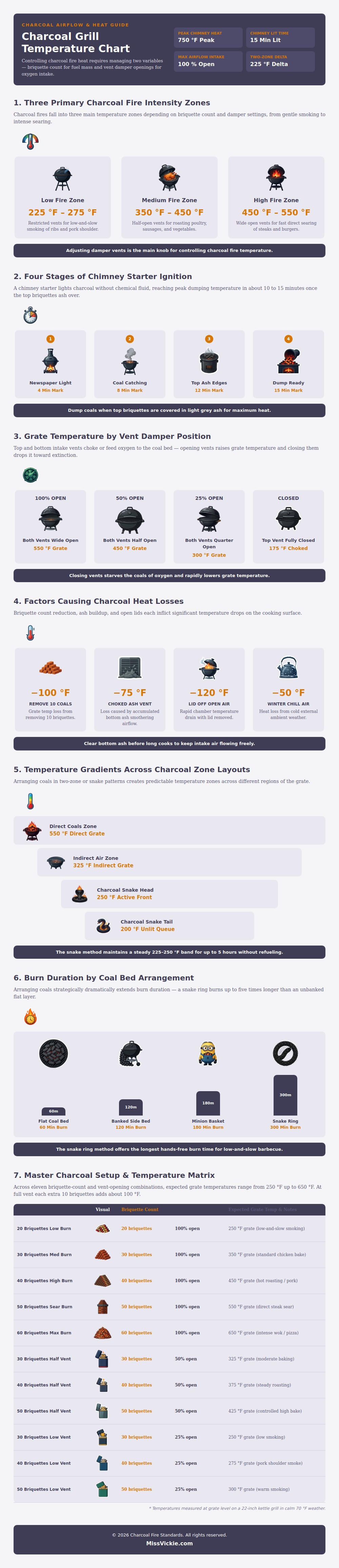
For novice grillers, charcoal can be intimidating. You pop open the cover only to find yourself staring down the barrel of a hot gun capable of ruining your meal in no time flat. That’s because controlling charcoal isn’t so much about fire as it is physics. On one side, you have mass of fuel; on the other, the supply of oxygen. And while everyone has an opinion regarding how to handle the former, few consider the latter. For controlling the heat, however, it’s all about the air.
Temperature and vent position is directly connected. Check out the infographic; you’ll notice the relationship right away. When both of the vents are wide open, the fire feeds, raising the temperature of the grate to five hundred fifty degrees Fahrenheit. When the vents is closed all the way down to a quarter, there’s not enough oxygen flowing through and the heat lowers to three hundred degrees. This is your primary control mechanism for temperature.
How to Control Charcoal Heat
For smoking a pork shoulder, you’re going to want to limit amount of air. For a steak, you’re going to want to open up the air and get it nice and hot to sear it. It’s a tiny tweak with big results.
Next, you set the temperature by lighting the coals right. A tempting shortcut: chemical lighter fluid… But that gives your food a nasty aftertaste. Better to start the coals using chimney starter, which ignites the briquettes without chemicals, with only oxygen and heat. Crumple some newsprint into the base, then add the coals on top. Let sit for approximately fifteen minutes until the coals goes from black to a dull grayish-black (a.k.a. It is ash-gray. They’re now hot enough to cook with.
Why wait? Because waiting makes the fire burn evenly, there won’t be any cooking problems down the road.
How coals are arranged is what dictates how the grill will cook. If you put them all on one side, you have two zone: One is indirect for roasting and one is direct for searing. You can do long cooks using the snake method (arranging the briquettes in a curve along the grill’s edge), which slowly uses up fuel and keeps your grill going at a low temp for hours. Flat piles of coal doesn’t last long enough.
Heat escapes when the lid is raised. When you lift the lid off your grill, it lets all that heat out of the chamber. In seconds, more than a hundred degrees can escape. Smart grillers know how to reduce this heat loss and plan to match. Only raise the lid when necessary: for instance, when turning meat, adding wood chips, or adjusting the vents.
Also, ash impedes air flow. After prolonged cooking sessions, ash will form on the grill floor. This limits airflow and cools fire. To maintain consistent airflow, clear away ash using an ash tool or shop vac.
Controlling the heat of your coals involve managing the airflow in relation to the fuel. While this chart is a starting place, real world conditions make those numbers change different than the humidity, the heat of the day, or the weather. As it gets colder, the fire cools quicker. And wind can fan the fire or extinguish it. Get to know how your charcoal reacts by watching how the ash and flames changes color. It’s a dance with the fire and once you get comfortablely doing it, the more predictable it becomes.
So begin with adjusting the vents, then observing the ash. Only open the lid when you have a purpose, like rotating meat, adding wood chips, or adjusting vents. If everything is cooking nicely, look back and see that you was controlling the air.