
There you are in the cookware aisle, a credit card in one hand and an anguished look in the other. You already have some pots that do exactly what these ones do… But they’re so shiny! Red enamel will make your food come out perfect, right? And will it fit into your oven, or even around your chicken? See, that’s where people go wrong. Capacity isn’t universal. It’s not a constant; it’s a starting place for a discussion. It’s a number on a box that people use to decide if they should buy the pot. In fact, they should of being asking how heavy it is. What size is its lid? Is it wide enough to hold a whole chicken stretched out flat?
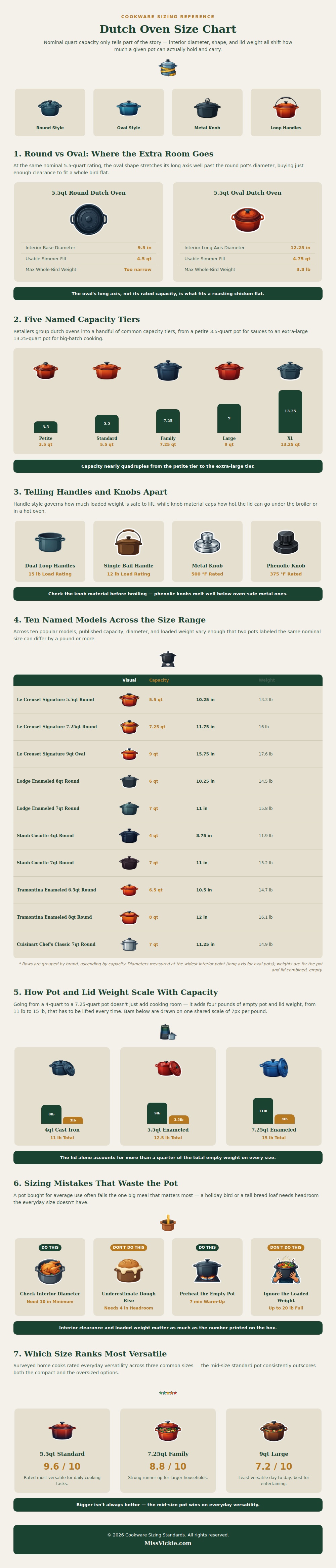
Diameter makes all the difference, as does weight. Interior size shifts functionality of a pot; the diagram above illustrates that. A five-and-a-half-quart oval pot are not the same thing as a five-and-a-half-quart round pot. The oval’s extra length allows it to fit a whole bird laid flat, which is more important then the slight difference in simmer volume.
How to Choose the Right Pot Size
First, consider form factor. The round pot’s interior base may be too narrow if you plan to roast poultry. You would either have to roast the bird upright, which is not ideal, or settle for partial fill. The oval allows you to gain enough clearance while only needing to upgrade to a larger (and therefore heavier) pot, which you’ll only use nine months out of the year. It is a small detail but it matters when you want to get a nice crispy skin on your Sunday dinner.
The visual comparison shows that usable fill level depends on shape, and you’re not merely trading width for volume; you’re trading one set of constraints for another.
Weight comes into play, too: It increases rapidly with increasing sizes. Going from a petite three-and-a-half-quart vessel to a standard five-and-a-half-quart model seem like a modest upgrade; after all, you’re adding significant mass to the mix. But that’s a substantial amount of extra weight in the mix. When you get to the seven-and-a-quarter-quart (family-size) range, an empty pot plus lid weigh fifteen pounds or more. Enough to give pause before hoisting what’s now a hefty hunk of metal out of the hot oven, particularly if it’s full of thick, stodgy stew.
And the numbers tells me that more than a quarter of that weight is in the lid. That means you’ll be lifting a pile of metal in order to peek at the seasoning. Know your margins for safety, specifically knob material and style. A single bail handle will hold less weight than dual loop handles, and if you purchase the biggest one offered, you’ll want to look at rating. If you have the plastic looking handle, you cannot put the lid back on and broil; phenolic knobs melt at a lower temperature than metal knobs. This is a simple rule that saves your cookware, but folks continue to melt their knobs all the time. Metal knobs can takes five hundred degrees according to the infographic, and allow you to finish things in the oven under the broiler without worrying about the lid.
The middle is often most versatile. And surveys indicate the middle, what I call “mid-size”, is the go-to standard for everyday cooking: It balances capacity with a manageable weight and storage footprint. The big guys are great when you’re expecting guests during the holidays, but they are awkward for something like a weeknight risotto. It feels awkward. You don’t want to haul a thirteen-quart behemoth around just for a simple sauce. Midsize pots is wide enough to cook meat in batches without crowding, but they aren’t so heavy that they’ll cause back trouble.
Don’t make the rookie mistake of not factoring in rise time for dough. When baking bread, you have to factor in how much room there will be for it to expand while still cooking (before the crust hardens). What appears to be plenty of room for your raw dough may no longer be big enough after it has risen, which means flat top bread. Another pro tip: Whichever model you go with, preheat the empty pot for a few minutes first. This ensures a proper sear on whatever it is you’re making.
In the end, the best size depends on what you’re actualy going to cook and how often you’ll do so. The goal is to find something that becomes part of your kitchen routine without calling attention to itself, after all, it’s all about the food. Eventually, you will make a decision.
Forget about stated capacity. How does it feel? Is the inside large enough? Does the lid weigh too much for you to lift? Do the handles suit you? And, most importantly, does it fit your stove? Ultimately, it’s not about getting cooking pots. It’s about having one pot that renders the rest of the kitchen obsolete. That’s when you know you’ve selected the correct size.