
Sous vide? You’re thinking: Sous vide means steak. Right? Okay, fair enough. It’s become shorthand on the internet for “fancy meat tenderizer,” which isn’t wrong, but it also isn’t realy right.
The truth is that sous vide is at its best with vegetables; once you get your head around nature of cell wall in plants. A muscle cell tends to tenderize under pressure; a plant cell does not. Plants have natural glue (pectin) between their cells, which doesn’t dissolve until the water bath exceeds some specific floor temperature. Anything below that, no matter how long you wait, is still raw. Above that, time are determined by density of what you’re cooking.
Sous Vide is Great for Vegetables
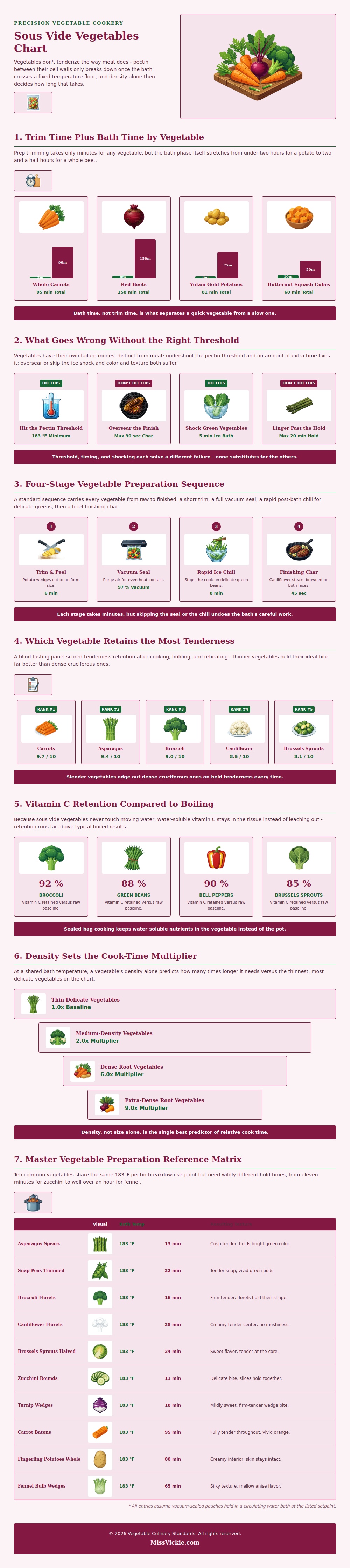
It sounds small, I know, but this one detail changes everything you thought you knew about cooking a root crop… Or any other green vegetable. This becomes clear if we look at the chart above, which makes clear that for most things, bath time outweighs any benefit from trim time. To cook a carrot fully tender, it’ll take you ninety minutes, while peeling and prepping it only takes five. Rush the process during prep? There is no penalty whatsoever. Rush the chemistry? That’s another story.
And that’s what frustrates people when they try to sous vide a complete beet within an hour. It won’t happen. The pectin requires time to break down at the proper temperature. Undercook and additional time won’t help. Overcook and you ruin all your effort to get right texture. It’s a narrow window, but a predictable one.
The problem with most home cooking is that we treat all vegetable like vegetables. There’s no such thing as “one size fits all” when it comes to cooking. Some have lots of water and air. Some are dense and starchy. Some cook in a minute, while others take more than an hour at the same heat. The infographic does a beautiful job illustrating what I call the multiplier effect: For every step up from delicate green to dense root veggie, expect 6x the time. That’s your cooking math to remember.
It doesn’t have to do with their size. A smallish beet is still denser than a big ol’ zucchini, which will therefore take longer. Cooking is not simply surface area, it’s cooking through mass.
And there’s a more practical argument here too (one we tend to underestimate). Boiling broccoli in particular cause you to lose vitamins. Water soluble nutrients escape from the vegetable and end up in the pot water, which ends up going down the drain. Sous vide maintains those nutrients within the sealed bag. Look at the chart: Ninety percent-plus of the nutrients remains intact with vegetables such as green beans and bell peppers. It’s not only about texture; it’s about keeping the actual food value. And that’s something real that goes beyond just how the food looks.
Four stages: trim, then seal, then cook, then finish, a process that seems like a ritual but turns out to be practical. And here’s the kicker: no exceptions with the seal. No air pockets. Cold spots forms wherever air collects. No even heat means no even cooking. That’s why steam is for chumps; your food is simply being steamed if it isn’t sealed properly.
As for finishing, there is a recipe for skipping the sear, but this one is wrong. Searing for mere seconds in a well-seasoned cast-iron pan delivers Maillard reaction flavor that water alone can’t bring. It takes under a minute and a half, max. You don’t need a hard crust; you do crave some color. With fragile green leaves, an ice bath after-cook shock ensures immediate stoppage of the cooking process, which keeps that tender yet still-bright bite.
The carrots and asparagus always score highest at blind tastings in terms of keeping tenderness when held and re-heated; dense vegetables such as Brussels sprouts and cauliflower fall off the texture-stability scale some. This can be important if you’re meal prepping. For instance, if you make a large batch on Sunday to have over for dinner Wednesday, those slender vegetable will retain their freshness. The denser ones may get mushy. You’ll want to consider the tradeoff.
And then there’s precision. Control instead of guessing. That is the ultimate objective. When you realize that temperature controls texture, and density control time, that fear goes away. No more worry about under cooking because the timer is doing the work. No more concern about over cooking because the water can’t go any hotter than its set point. The veggies emerge perfect every single time.
Why do you own an oven thermometer? You know you can rely on it to produce consistency. And that is what your vegetables want, consistency. They want consistency, don’t forget that when you pick up your next potato. This isn’t about the clock; this is about the pectin.