
Lean cuts like pork tenderloin are very susceptible to drying out if cooked incorrecty. You paid for the meat. You took the time to season it carefully. You want it to turn out well. Unfortunately, most cooks ends up with dried-out results when they roast it the old-fashioned way.
What’s the problem? Pork tenderloin contain almost no fat to buffer against heat. Two or three degrees make all the difference between juicy and chewy.
How to Cook Perfect Pork Tenderloin
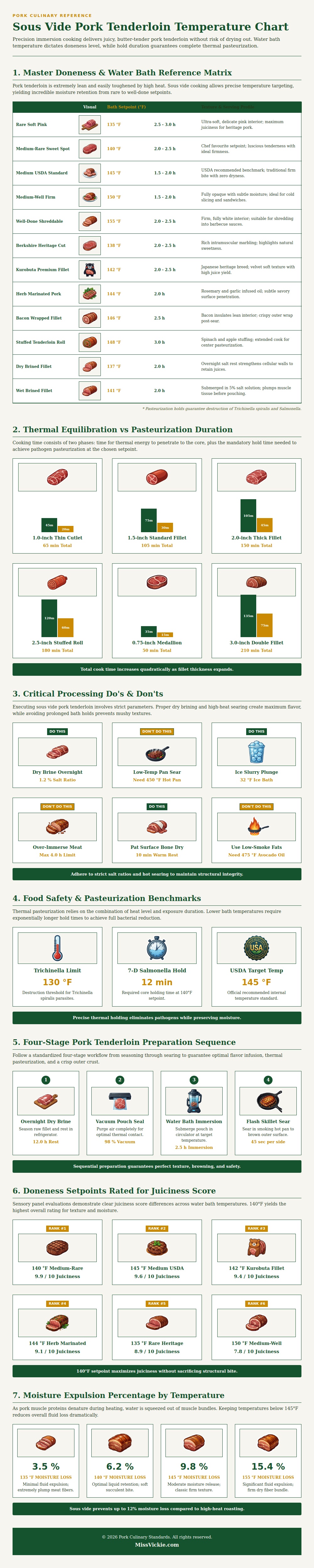
With precision cooking, there’s no guessing anymore. While precision cooking give you total control over how hot meat gets, you can still dry it out if you push temperature past 150 degrees Fahrenheit. As you can see from chart, different water bath temperatures translates to different textures.
But with today’s food science, we know that pork can be cooked safely to a medium rare (at 140 degrees Fahrenheit). And why not? It’s moist, tender and many cook select 140 degrees as their preferred temp. At that level, the meat will be fine as long as you hold it at that temperature long enough to pasteurize it.
For those who want something on the firm side but don’t want it all dried out, go ahead and bump up the temp to 145 degrees: Medium here. Anything over 150 degrees push too hard against moisture in the fibers, squeezing them out. You end up with dry, but firm, meat that is more suitable for shredding then roasting.
The thickness of the cut matter too. The cook time is related to amount of time needed for heat to get into food. If steak is rolled really thick it takes longer for the middle to get to desired temp than if it were sliced very thin. The thicker fillet require longer cook times. Notice in chart that as the fillet becomes fatter the time goes up. However this is not a straight line since heat penetrates more slowly the farther away from outside edge you are.
The target temperature has to be maintained through the entire interior of pork tenderloin. Holding correct temperature for enough time destroys any pathogens, making lower temperature safe.
The flavor of your cooked meat depends on preparation. One helpful tip is to use dry brine. By salting meat for at least eight hours (overnight is better), the salt penetrate into the muscle fibers. This will help keep the meat moist while cooking. In addition, it will season meat both inside and out.
Before vacuum sealing the tenderloin, try to get rid of as much air as possible. The more air there is in package, the less efficient it can transfer heat. For even cooking from edge to center, make sure you have a good seal on meat.
Now for the last step: the sear. This is where most people goes wrong. After the bath, the meat will be soft and pale, and requires high-heat finish. Use high-heat oil (high smoke point) and use a hot pan. Don’t crowd the pan. Don’t put cold meat into warm oil; you want to add the meat to the pan while it is still very hot. About 30 seconds to a minute each side should suffice.
There is no attempt here to cook it more inside; you’re simply building flavor on the exterior of the meat. Let it rest for a couple of minutes before cutting. It will allow juice to redistribute and the result is a tender, pink pork tenderloin without any dryness at all.
It could of been a simple change in technique, but one that always works.