
It will take five or ten minutes. Will that result in dinner or charcoal? That’s the question raised by how quickly this appliance work, and how many different things you can shove into it. It is crispy but not greasy.
The machine doesn’t care what goes into the basket; it simply emit hot air. Time on the chart is a starting point (not a law), but it will help you get a grip on your appliance so that your meals has the crispiness of deep-fried goodness without the grease; or worse yet, charred.
How to Use Your Air Fryer Correctly
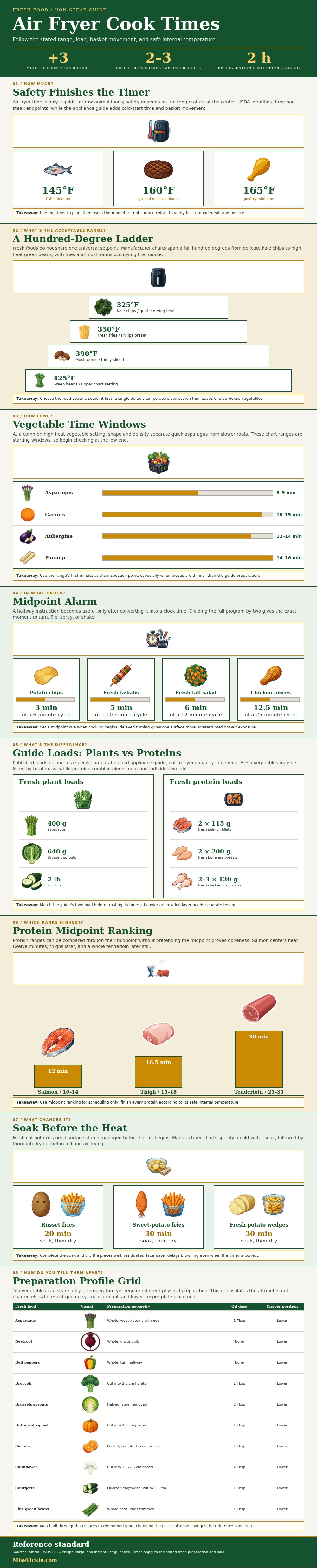
Trusting your eyes, more than your thermometer, is the most dangerous habit. Eyes deceives. Brown doesn’t mean done. Food can look browned on the outside while remaining raw in the center. That’s a risk with ground meats and poultry. Surface appearance isn’t the guide to safety; internal temperature is. And there are specific endpoints that must be reached to know it is safe: One-hundred-sixty five for poultry. Use the timer to gauge when to start checking, but always verify with a probe. The timer is a planning tool, not a verification tool. Set it as a gauge for when to begin checking, then always check with a probe. It is a small step that saves you from foodborne illness.
Time matters too: Temperature choice are key. Not all fresh stuff cooks the same way. Tossing delicate kale leaves into the oven on highest heat alongside thick green beans will result in crispy burned leaves, not crisped kale. As the chart illustrates, there is quite a range: low for tender greens that need gentle drying, and high for hearty veggies like roots that has enough fiber to withstand heat. Get the heat right based off the item’s nature. Thin-leaved things require lower temps so they don’t gets charred first; thick-rooted ones are tougher and want the heat up to soften them. Pick one default temperature for all and you’ll fail.
Your brain also isn’t very good at gauging when to check on things. For any cook time in the middle of your recipe, simply use an alarm clock and set it for half the amount of time. That way, when the alarm goes off, you can turn everything over or give the basket a shake without wasting time wondering if it’s been long enough. One side will have already cooked in peace; the other will be cooler now then it was before you started checking every so often. This lack of consistent exposure makes food unevenly textured. An alarm clock making a sound halfway through is an easy clue that transforms this into a well-planned-out task.
Most folks makes a mistake by loading the basket incorrectly. The chart details the proper loads for specific items. Some are denser (vegetables) than others (protein). Overfilling the basket keep steam from circulating, causing your food to not fry but rather steam. Leave some breathing room so the air can move around and do its thing. Pile on too much chicken and you’ll wait a long time for them all to crisp up. There just isn’t enough heat getting through to each piece. Stick with what’s suggested on the chart. Or plan on doing it in several batches. It takes more effort, but oh, that crunchy goodness.
Many times we gloss over preparation information because it occurs prior to turning on the machine. For example, if you want crispy fried potatoes, soaking prior to cooking is never optional. Removing the surface starch allow them to crisp up. Regardless of the duration of fry time, the presence of excess moisture will result in uneven browning and overall sogginess. How long should you soak what cut of potato? See the chart, note: It’s also important to completely dry the pieces after washing off the surface starch. The greatest cause for the failure of home-fried potatoes is skipping this prep.
The bottom line: The air fryer is forgiving if you fiddle a bit, but it rewards carefulness. These are guidelines for normal preparation, not hard-and-fast rules. Depending on how large you cut things and what kind of appliance you have, your timing may be different. Let these numbers serve as a starting point, then tweak them according to what you see happening. Follow the chart, watch your capacity limits, keep a thermometer nearby, and don’t skimp on dry potatoes. The more you follow the laws of hot air, the closer you’ll get to perfect repeatability.
You should of used the chart more often. Actually, it was more luxurios than I thought. One side will have already cooked in peace; the other will be cooler now then it was before you started checking every so often. This lack of consistent exposure makes food unevenly textured. An alarm clock making a sound halfway through is an easy clue that transforms this into a well-planned-out task. Actually, I think I’ll use more modernd appliances later. It would of been better if I knew.