
If you’ve ever found yourself standing in the middle of an aisle gazing at rows of pressure cookers, wondering how one pot differ from another, you’re not alone. There are pots made out of all kinds of metal. They come with labels like three-quart, six-quart, or eight-quart. Sounds straightforward, right? Pick your size, like a shirt. Not exactly.
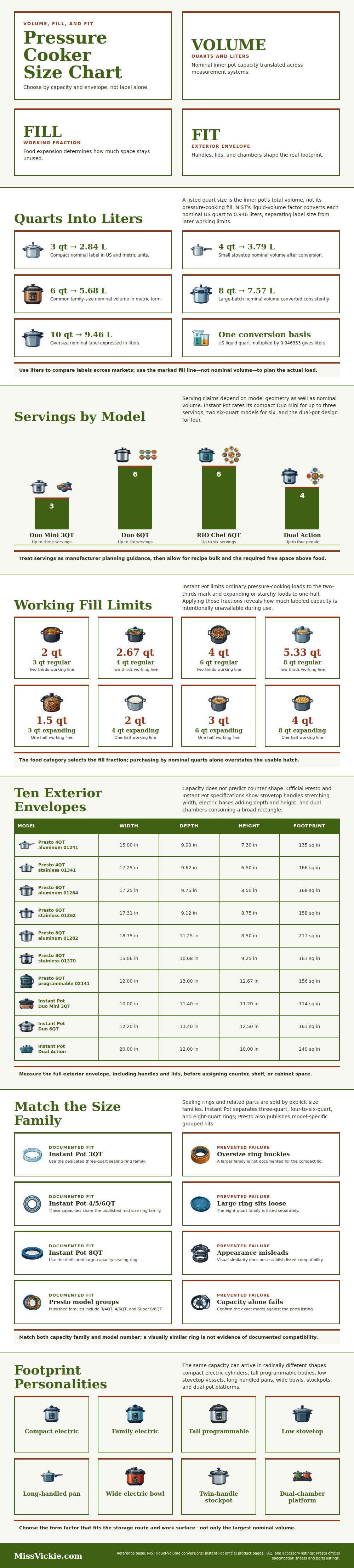
Cooking isn’t about numbers; it’s about science, spesifically physics and space. Knowing what’s on the package are just the start of getting a good meal and avoiding a burned mess. Nominal volume is actual capacity. The chart above convert nominal volume into usable capacity.
How to Choose the Right Pressure Cooker Size
If you purchase a six-quart pressure cooker, what are you purchasing? It is a container which can holds six quarts of water if filled to the brim. You won’t be filling it to the brim. You have to leave room for food to expand, and you need some empty space to allow steam to escape. Otherwise, you’ll break the seal or clog the vent.
The general rule is to not fill it more than two thirds full. If you’re making something that expands during cooking (e.g., rice, beans) then reduce the number by half. So, that six-quart cooker realy contains only four quarts of food. People makes this mistake all the time. They see “six-quart,” so they assume it’s a six-quart cooker, then complain when they cook up a batch that seem too small.
Then there is the seal, which is the rubber ring that ensures the lid stay locked down during cooking. That’s right: lid locked down. Not all seals are created equal. They are not one-size-fits-all. Even though two seals might look alike, they may not be interchangeable. For example, a six-quart cooker does not have a three-quart size seal. It simply won’t work.
And guess what? It is a safety issue and a failure. It is all because off a ring. The reason it doesn’t work should of been obvious from how it looks, except that it isn’t. So again, you need to go by model number to find your accessories.
It is a little thing, but it is worth noting as the pressure increase. The physical footprint of the appliance is also important. Appliances that holds the same amount can vary in shape. Your long handled stovetop pressure cooker might span two burners. It won’t fit into your regular cabinet. An electric multi-cooker may be a squat cylinder. It might look small until you try to store it upright.
The base, lid, and handles is all part of the outside. Don’t measure only the interior pot, but the entire width and depth. A big pot may be a waste if your kitchen counter space is minimal. Can you fit it on the stove? Open the lid?
Think of serving size as more of a suggestion then a rule. Manufacturers quote three servings for small pots and up to six for big ones. That’s if you’re ladling out stew or soup. If it’s thick chili, or even denser meat loaf, count on less. How food stacks in the pot depends also on its shape. Will a high narrow vessel layer items well for clean-up? Or a broad shallow bottom brown things better? That’s the one that suit your life, not necessarily your pantry.
Think about what kind of cooking you do. Do you regularly make large batches of chili on Sundays? Then you deserve the eight-quart and can spare the counter space. Do you mainly cook for yourself or another person? If so, you don’t really need to wash a giant pot for one meal, so go mini.
The chart does the math for you to help eliminate all the guessing. Plan your load according to the numbers, but judge the fit with your eyes. A pressure cooker is an efficiency tool. It will work as intended only when you respect its limitations.
Get the pot that fits the food you want to prepare. Make sure it also fits the space where you store it and how you will use it most often. That’s how you get this complex piece of kit working reliably for you: by making it a reliable friend.