
Microwave cooking is something you probably do frequentely. You’ve no doubt run into same problem we all have: scorching hot centers with icy cold edges.
While it isn’t necessarily a flaw in your microwave, nor is it something for which you should of feel bad, it typically boils down (pun intended) to difference between what the appliance can actualy do and what recipe assumes you’ll get. A typical recipe will be based on an assumed 1000-watt starting point. Your microwave may as high as 1200 watts or as low as 600. That means that amount of time you cook for need to adjust based off the watts of your machine.
How to Cook Better in the Microwave
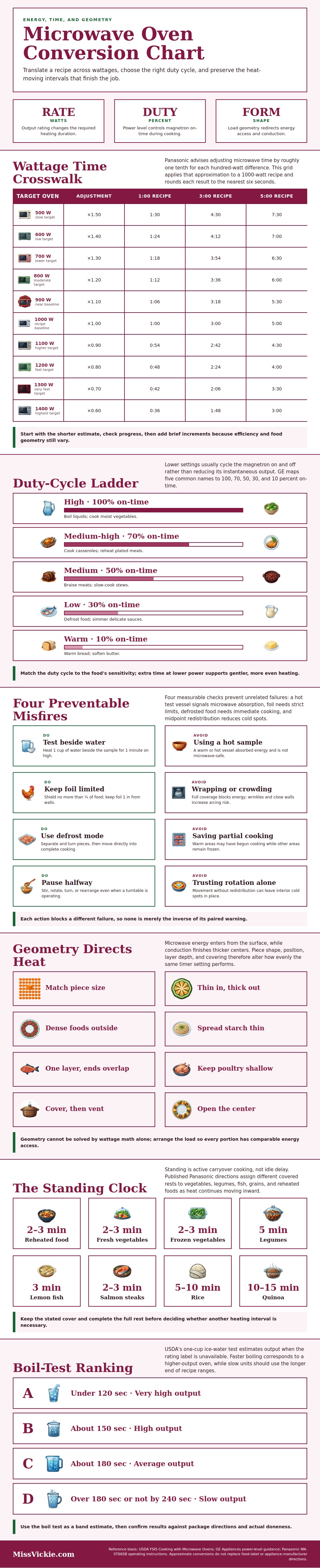
The table below show how changing watts affects your cooking time. It recommends adjusting to match by about one tenth for each hundred watts off from what was specified. This is a nifty trick that will keep your veggie tender but not rubbery; the hallmark of overly cooked veg. And it keeps your meat, well…not raw in the middle like it is when it’s too little done.
It’s a relatively straightforward application of the physics: More watts equals a greater amount of energy delivered faster. That said, if you cook a thousand-watt recipe in a 600-watt oven without adding time, you’re just going to end up with a lukewarm dissapearsment. Similarly, you probably don’t want to throw a low-wattage recipe at a high-power beast; that’s just going to lead to a steam explosion and a ruined dinner.
This visual guide make it easy to see how those adjustments work. Times is rounded up or down to the next couple of seconds for convenience. It prompts you to begin with smaller time estimate and to check things along the way. How long depends heavily on geometry and density of what you’re cooking.
But that’s only half the story. The second half is power level, also known as duty cycle. A lot of us think of microwave as an on/off switch. But lower settings will actualy cycle the magnetron on and off, which distributes heat more gently. And here’s what different percentages translate into: the infographic describes which tasks corresponds to each percentage. Ten percent can be used to warm up some bread without drying it out. Fifty percent is good for braising meats.
That’s where patience come in. Lowering the power setting allow the heat to move its way from outside in to the inside. This reduces the chance of creating cold spot. Microwaves don’t really penetrate too deep before energy dissipates; but it works for a reason.
While we’re on the topic of penetrating, did I mention that food shape also plays a role? What happens when heat penetrates? From where… the surface! If you heap the food up into a pile, it’ll cook unevenly because thicker portion remain cold while outer edges burn. Instead, lay it out in a ring for more uniform results.
You can’t get away with stirring or turning either (see chart). Standing time is frequentely ignored as wasted time, but it isn’t inactive at all; it’s active cooking. That’s right: Rest periods continues transferring heat deeper into food to complete the task, but no new energy is required. To assist this process, cover the food to hold in steam.
You can even eliminate the guessing game by testing what your own oven realy puts out. An easy ice-water boil test will tell you if you’ve got a strong or weak appliance on your hands. Use that to help you choose a time within the range recipe gives. For instance, if your water boils within two minutes or less, you’re dealing with a strong one and need to watch closely. If it takes longer, you’re working with a slower model that requires more time.
You’re good to go. Your appliance is slow so leave it be for longer. There is less chance of overcooking your food.
So if anything, microwaving well isn’t so much about nailing the exact timer as it is learning how your appliance work to cook certain types of foods with varying times and powers. You’re setting yourself up to account for your own appliance’s limits by respecting the standing time. This makes microwaving less of a trial-and-error reheating ordeal and more of a cooking technique.
Next time you find yourself staring at that door while it ticks away the seconds, keep in mind what’s going on inside there once you hit stop: that residual heat do all the work. That way you’ll ensure every bite is warm.