Meatballs Per Pound Calculator
Estimate how many meatballs come from each pound of raw meat by diameter or weight, then plan cooked yield, servings, sauce, and batch size.
🍝 Meatball Batch Presets
Choose a starting point for appetizers, pasta dinners, freezer trays, mini soup meatballs, subs, or party batches.
⚖ Meatball Size and Batch Details
Your Meatball Count
Enter a meat weight and meatball size to estimate count per pound.
Batch Math
Serving and Sauce
📊 Quick Count Cards
🍴 Meatball Count Per Pound Table
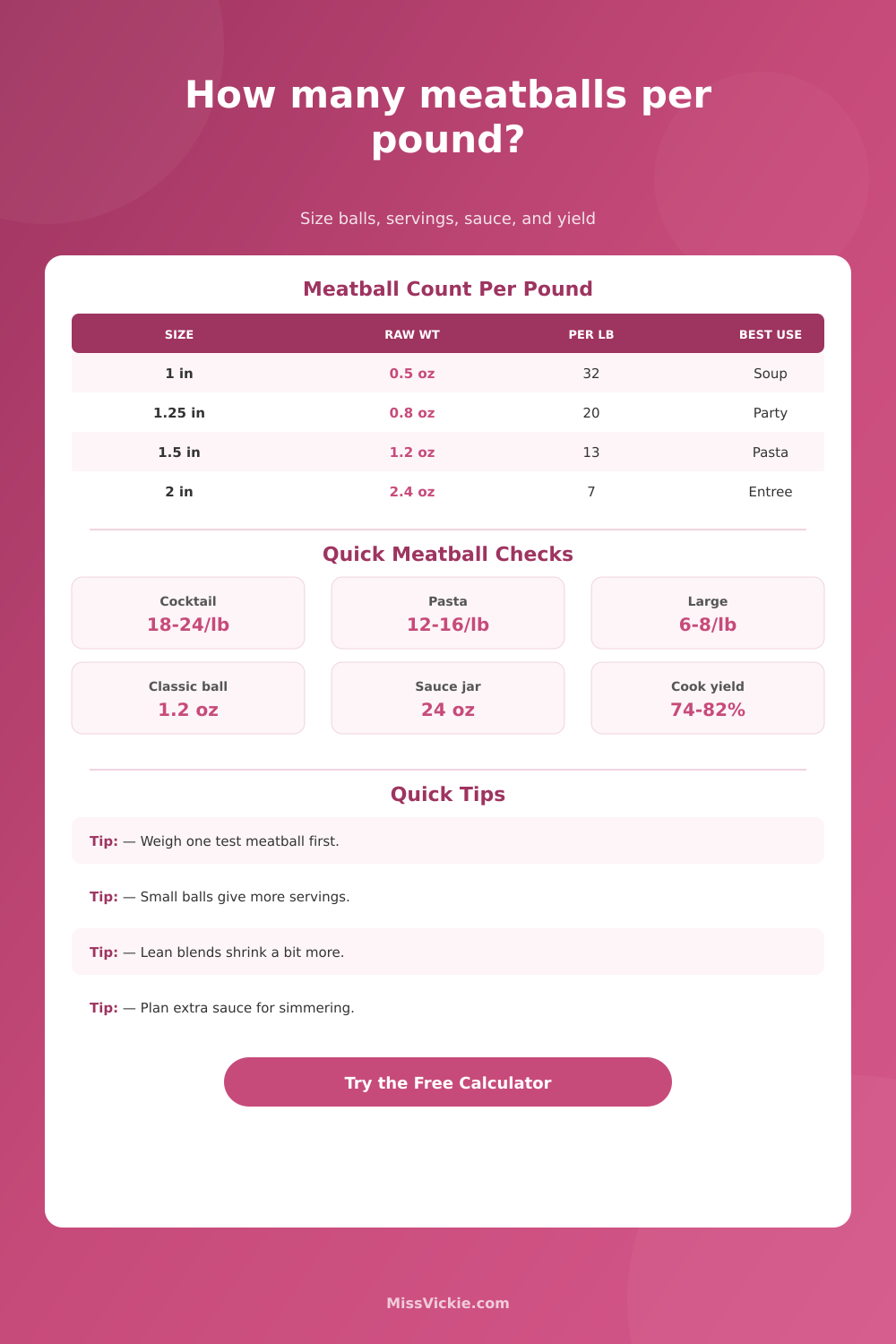
| Raw Diameter | Approx Raw Weight | Meatballs Per Pound | Best Use | Serving Note |
|---|---|---|---|---|
| 0.75 inch | 0.25 oz | 55 to 65 | Italian wedding soup, tiny bites | 8 to 10 minis per person |
| 1 inch | 0.45 to 0.55 oz | 29 to 36 | Soup, kids portions, tasting spoons | 6 to 8 per person |
| 1.25 inch | 0.75 to 0.9 oz | 18 to 22 | Cocktail parties, buffet trays | 4 to 6 per person |
| 1.5 inch | 1.1 to 1.3 oz | 12 to 15 | Spaghetti, Swedish meatballs | 3 to 5 per person |
| 1.75 inch | 1.6 to 1.9 oz | 8 to 10 | Entree plates, subs, meal prep | 3 to 4 per person |
| 2 inch | 2.2 to 2.6 oz | 6 to 8 | Large Italian meatballs | 2 to 3 per person |
| 2.5 inch | 4 to 4.8 oz | 3 to 4 | Oversized restaurant style | 1 to 2 per person |
Counts assume a classic meatball mix with crumbs and egg. Meat-only balls make fewer pieces per pound; wetter panade mixtures make slightly more.
🥘 Serving Style and Sauce Yield Table
| Serving Style | Typical Size | Meatballs Per Person | Sauce Allowance | Planning Use |
|---|---|---|---|---|
| Cocktail appetizer | 1 to 1.25 inch | 4 to 6 | 1.5 to 2.5 oz per person | Passed bites, toothpick platters |
| Buffet or potluck | 1.25 to 1.5 inch | 5 to 7 | 3 to 4 oz per person | Mixed dishes and second helpings |
| Pasta entree | 1.5 to 1.75 inch | 3 to 5 | 5 to 6 oz per person | Spaghetti, baked ziti, family meal |
| Meatball sub | 1.5 to 1.75 inch | 3 to 4 | 3 to 4 oz per person | Hoagie rolls or sandwich trays |
| Main dish plate | 1.75 to 2 inch | 2 to 4 | 2 to 4 oz per person | Mashed potatoes, rice, vegetables |
| Soup minis | 0.75 to 1 inch | 8 to 10 | Broth based | Wedding soup, ramen bowls, lunch |
🥩 Blend, Binder, and Shrinkage Guide
| Mix Factor | Typical Range | Effect on Count | Effect on Cooked Yield | Best Check |
|---|---|---|---|---|
| Beef pork blend | 75 to 82 percent yield | Standard density | Juicy, moderate shrink | Good baseline for pasta |
| Lean turkey or chicken | 74 to 78 percent yield | Slightly lighter balls | Can dry if overcooked | Add panade or extra moisture |
| Meat only mixture | No binder gain | Fewer balls per pound | Higher crumble risk | Roll firmly but do not pack hard |
| Classic crumb binder | About 14 percent added mix | More balls per pound meat | Better moisture retention | Rest 10 minutes before rolling |
| Tender milk panade | About 22 percent added mix | Highest count from meat | Soft, saucy texture | Chill before shaping large batches |
| Cheese stuffed | About 26 percent added mix | Count depends on filling size | Needs gentle cooking | Seal seams and simmer gently |
🧂 Planning Notes
Use when you know the scoop size or want to choose a style before rolling the batch.
Weigh one raw test meatball, then use that weight for the cleanest count per pound.
Egg, crumbs, milk, rice, oats, and fillings add mix weight beyond the raw meat weight.
A 24 oz jar gives about 3 cups. Large simmered batches often need more coverage.
💡 Meatball Counting Tips
What about cooked versus raw? How do you plan for a dish where the raw ingredients is going to cook down (e.g., how much is a pound of raw ground beef)? If you’re eyeballing portions, you’ll have trouble guessing the right size. Portions might also change from what’s in your hand to what appears on someone’s plate. Using the calculator, you specify a desired portion size and it calculates how many pounds of raw ingredient you’ll need. This is why the calculator allows you to specify a target portion size: So you don’t have to guess how many pounds of something will be necessary to feed your guests.
Ground meat is not a fixed ingredient; most home cooks assume that a pound of ground meat equal a pound of cooked ground meat. That’s wrong. Add-ons such as soaked bread or eggs will bind your mix, increasing its overall volume and not requiring any additional meat. Since you are working with leaner meats, such as a turkey blend, the mixture will shrink even further. This happens because there is less fat to hold onto moisture. You’ll have to start off with more raw meat to reach the same number of servings. These blends will be included in the tool to ensure no one is short-changed on their pasta.
Why You Should Measure Your Meatballs
One-inch mini vs. Two-inch entree ball: that’s the difference between an appetizer and a main course, a single bite vs. Several. For soup, minis tend to cook more evenly. They are easier to eat without a fork. They matter by number rather than texture. For subs or standalone plates, bigger balls retains heat longer. They also have more interior texture. And the choice boils down to what you want the meat to do. Party time? Smaller pieces is easier to eat without utensils and cook more evenly. Family time? Bigger feels like more and works better with heavy sauces. The calculator automatically scales your count-per-pound according to these geometric considerations, so you don’t end up rolling tiny things if you’re after hefty mains.
The main question is how much sauce will coat each bite. While many recipes expect floating meatballs in sauce, the reality is that a fair amount gets soaked up by the actual meat. The meat absorbs even more if it’s lean; bigger batches requires more surface area to be covered. Simmering them for an hour causes the sauce to reduce, as well as the meat to expand (ever-so-slightly) as it absorbs flavors. Estimate what size container of liquid you’ll want to have on hand in order to prevent the meat from drying up. Remember, you don’t need enough to account for the volume of meat alone, since most of your liquid will go directly into the meat. A can of store-bought sauce may stretch across four pasta servings, but when it comes to subs, you won’t want a single ball to be swimming in excess, given the bun will soak it all up. Get this balance incorrect and you’re looking at soupy plates or dry bites.
How you cook them affects their ultimate yield, too. If baking in large amounts, it’s very effective; however, care must be taken to avoid over-drying leaner cuts. More attention is needed during pan frying, which will add taste from browning, but that takes some babysitting. Simmering meat in a sauce is the least fussy approach, as long as you don’t boil it too fiercely and break down the more tender parts that hold it together. Depending on the technique (baking, simmering, etc.), the tool estimates a shrinkage rate to give you a real picture of what your cooked-to-order weight will end up being. So while yes, how many balls you make matters, it’s also about how many emerge intact after being heated.
If you have the time, I’d recommend weighing out a single test meatball first before committing yourself to all of them. There’s no guessing involved. Now you can say “this meatball weighs 1/8 pound in its uncooked state.” That means you know how many balls that translates to. Then it’s just basic division. Figure out the total weight of the raw meat mixture, divide by the weight of an individual ball, and account for shrinkage. With the tool, it happens in the blink of an eye. But the principle holds true.
Estimating gives way to measurement. Your process becomes more of a recipe and less of a wild scramble. You want to know how many food items you have at the end of cooking. Knowing what you’re counting is a great relief. You won’t have awkwardly thinned-out plates anymore. You won’t have to make last minute grocery runs. It is a proper meal for all those people involved. It may sound boring and dry on paper, but it means direct satisfaction in the kitchen. If the math holds up, so does the food.