Roasting Planner
Chicken Roasting Time Per Pound Calculator
Estimate oven time, minutes per pound, probe check windows, pull temperature, rest time, and USDA-safe final doneness for whole chickens and common chicken cuts.
🍽Choose a roasting preset
Presets fill the calculator with real kitchen scenarios. You can adjust every field before calculating.
⚖Chicken and oven details
Your roasting plan
Adjust the fields and calculate to estimate roasting time.
Timing breakdown
Temperature and safety
Roasting checkpoints
🌡USDA-safe poultry temperature table
| Food | Safe minimum internal temp | Where to measure | Calculator use |
|---|---|---|---|
| Whole chicken | 165 F / 74 C | Thickest breast, thigh, and wing area without touching bone | Uses 165 F as the minimum final target after rest. |
| Chicken pieces | 165 F / 74 C | Thickest part of the piece, away from bone and pan | Shows a probe check window before the estimated finish. |
| Ground chicken or sausage stuffing | 165 F / 74 C | Center of the mixture | Do not use visual color as the doneness test. |
| Bread stuffing inside poultry | 165 F / 74 C | Center of the stuffing | Stuffed mode slows the estimate and flags the stuffing check. |
USDA FSIS guidance lists 165 F / 74 C as the safe minimum internal temperature for all poultry, including whole chicken, chicken pieces, ground poultry, and stuffing cooked inside poultry. Time estimates are planning aids; use a food thermometer for the final decision.
⏲Roasting time per pound reference
| Chicken style | Classic oven baseline | Fast roast baseline | Best doneness cue |
|---|---|---|---|
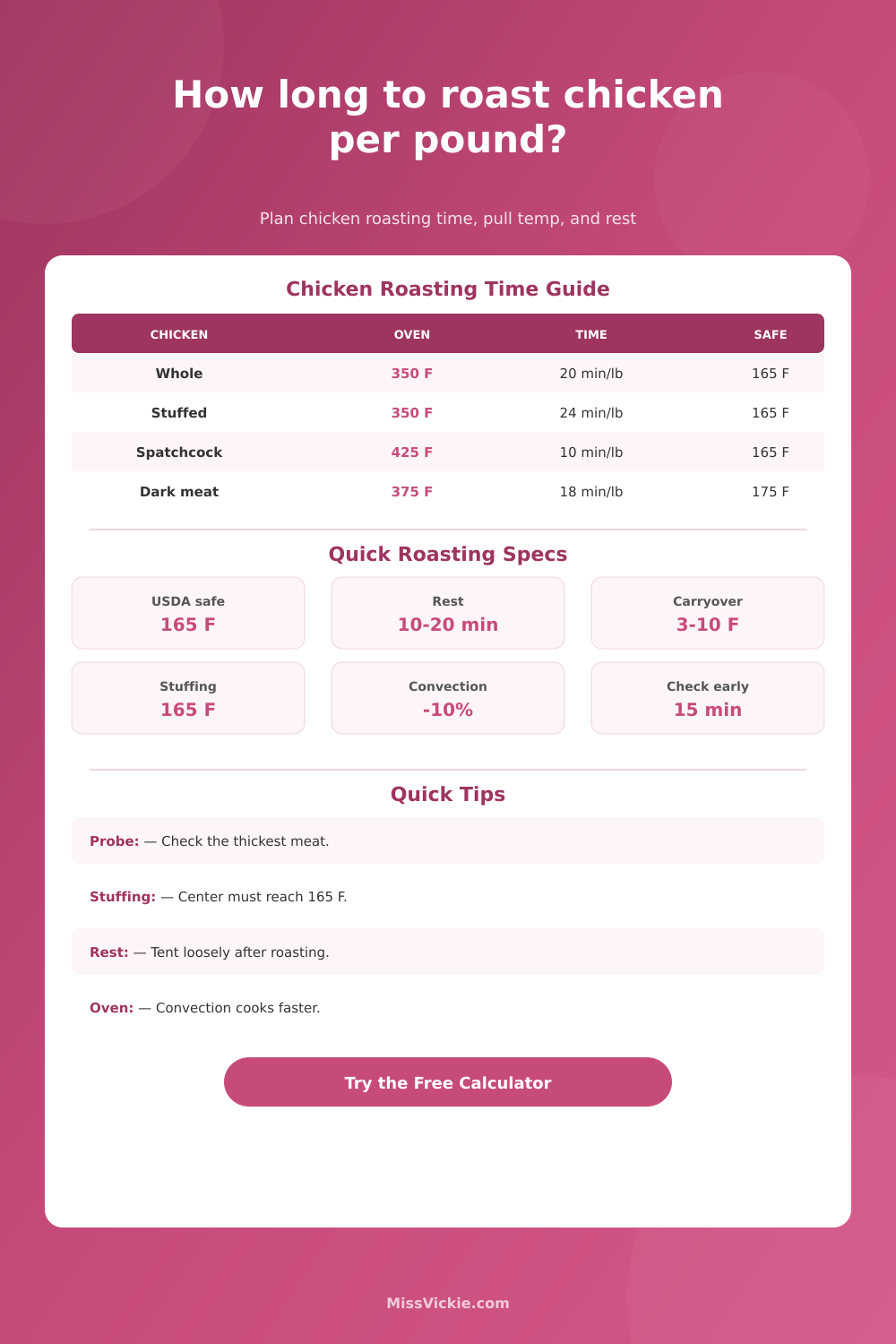
| Whole chicken, unstuffed | 18-22 min per lb at 350 F | 14-17 min per lb at 400 F | 165 F in breast and thigh; juices are not enough. |
| Whole chicken, stuffed | 22-26 min per lb at 350 F | Usually better roasted lower and longer | Stuffing center also reaches 165 F. |
| Spatchcock chicken | 13-16 min per lb at 375 F | 9-12 min per lb at 425 F | Breast and thigh finish closer together. |
| Bone-in breasts | 17-22 min per lb at 375 F | 13-17 min per lb at 400 F | Probe the deepest breast center. |
| Bone-in thighs, legs, or quarters | 18-23 min per lb at 375 F | 15-19 min per lb at 400 F | Safe at 165 F; many prefer 175-185 F. |
| Boneless chicken pieces | 14-18 min per lb at 375 F | 11-15 min per lb at 400 F | Pull smaller pieces as they finish. |
📌Carryover, rest, and probe planning
Final internal temperature for chicken and stuffing.
Common rest for a 3 to 5 lb whole chicken.
Typical rise after pulling from the oven.
Start probing before the estimate ends.
🧾Common chicken roasting scenarios
| Scenario | Weight | Setup | Planning notes |
|---|---|---|---|
| Weeknight whole chicken | 3.5-4.5 lb / 1.6-2 kg | 350-400 F, unstuffed | Plan a 10 minute rest and check the breast early. |
| Sunday dinner chicken | 5-6 lb / 2.3-2.7 kg | 350-375 F, rack | Add buffer for a larger center and more carving time. |
| Stuffed chicken | 4-6 lb / 1.8-2.7 kg | 325-350 F, cavity filled | Stuffing center must reach 165 F before serving. |
| Sheet-pan pieces | 2-8 lb / 0.9-3.6 kg | 375-425 F, single layer | Rotate tray and pull small pieces as they hit target. |
| Spatchcock roast | 3-5 lb / 1.4-2.3 kg | 400-425 F, flat bird | Fastest whole-bird option with crisp skin. |
💡Roasting notes
It’s time to eat: Your four-pound chicken is in the oven. How do you know if it’s ready? Do you worry that the thigh might be slightly undercooked while breast is completely cooked through? With the old rule-of-thumb approach (twenty minutes per pound at three hundred fifty degrees), you have a good place to start. However, that fails to take into account all of the other factors that is important in your home.
Once you enter settings of your oven, the weight of the bird, and its cut, the calculator on this page figures out the rest. You do not need to estimate conversions and coefficients. Simply use this tool to convert a vague cooking instruction into something certain. It is something you can plan around.
How to Cook Perfect Chicken
There are a lot of variables here (most obviously the weight of the bird), but perhaps most important is starting temperature, which can be disastrous if you take your chicken out of the refrigerator and immediately put it in the oven. Refrigerator-cold chicken has a cold center, which absorbs heat and will slow the whole process down considerabley. For this, the tool adjusts its estimate according to where the bird started: At room temperature? Refrigerated? Is it tempered?
It’s not magic, though; there’s a reason why it works. Cold meat transfers heat more slowly. So the clock must compensate for how long it takes simply to get the center warmed up before real roasting even starts.
And what about stuffing? Yes, yes, we stuff our poultry with bread and then cook it; it’s a great tradition. It’s also a heat problem. Bread insulates cavity. And it traps steam, which stops heat from moving efficientely into the meat inside. The calculator includes additional cooking time for stuffed poultry, but it will also alert you to most important safety consideration: That stuffing should get to one hundred sixty-five degrees at its center.
No eyeballing this. This requires a probe thermometer inserted deeply into the cavity. It is a small thing, but it matters.
And here’s where things get really interesting: The shape of the chicken matters more than what goes inside it. When cooking a whole bird, there’s always an “outside-in” effect, the thinner part (the breast) gets cooked at higher temperatures than the thicker parts (the thighs, which is protected by the cavity). Because thighs has more connective tissue to break down, they require longer to cook, while breasts risk drying out. That contrast gets eliminated when you flatten the bird out by spatchcocking it. Flattened on its back, the heat hits all the meat more evenly, so the tool knocks the minutes per pound down accordingly. It’s faster, sure, but it’s also less risky. The thigh and breast reaches doneness closer to each other, shortening the danger zone between overdone legs and dry breasts.
Here, it’s also important to consider the technology of your oven. Does it use convection? Because convection ovens move their hot air around, they cook faster, brown faster, and thus decrease total cooking time. If you choose one of those modes, convection, or air roast, the calculator give you a discount on your total cooking time. Not guessing; nope. It knows the ratio at which heat is transferred, so it takes that known amount off the top of typical oven cooking time. (So your bird doesn’t end up overcooked by the time the skin gets crispy.)
The last part of the equation is carryover cooking. When you remove a chicken from the oven, it’s still cooking. Depending on length of the rest period and the size of the bird, the chicken will rise in temperature another few to ten degrees as its heat redistributes throughout the meat. This tool factors in that carryover. It tells you the temperature to pull it based off your desired doneness and the amount of carryover you expect. For instance, if you plan for a final temp of one hundred sixty-five, then pull it sooner.
If you don’t feel like using the interactive tool, there’s a reference table on the page that lays it all out for different situations. If you don’t care about crispy skin and just want to cook a big ol’ bird at a gentler temperature, it will give you a starting point (three hundred twenty-five degrees vs). It could also be a nice blast of four hundred twenty-five degrees. But here’s where the interactive calculator shines: You can mix and match. Crisp up some chicken with high heat, but then let it rest so the juices can settle and the temperature can even out.
So how do you do it? You do it mostly by knowing what you’re measuring. It is not just “cooking time,” but also margin of safety, heat penetration, and moisture retention. The computer provides the window; your thermometer provides the answer. Set the timer using the estimate, and then pull out your probe for the final call.
Stop guessing, and start knowing. That’s the difference between a good chicken and a great one. Patience means waiting for the right number. Wisdom means trusting the tool that got you there. You should of prayed no more, just putting that bird in the oven with a plan. This is how you master the roast.