Brown Rice Water Calculator
Calculate brown rice water from cups or grams, cooking method, soak time, texture goal, lid evaporation, altitude, and expected cooked yield.
🍚 Brown Rice Presets
Pick a common brown rice scenario, then adjust the rice type, batch amount, soak time, cooking method, lid fit, altitude, and texture.
⚖ Rice, Water, and Method
Brown rice water plan
Your rice water estimate will appear here.
Water Breakdown
Yield Breakdown
Package directions, pan shape, burner strength, lid fit, and rice age can shift water needs. Use this as a practical starting point.
📏 Brown Rice Ratio Snapshot
📊 Water Ratio Tables
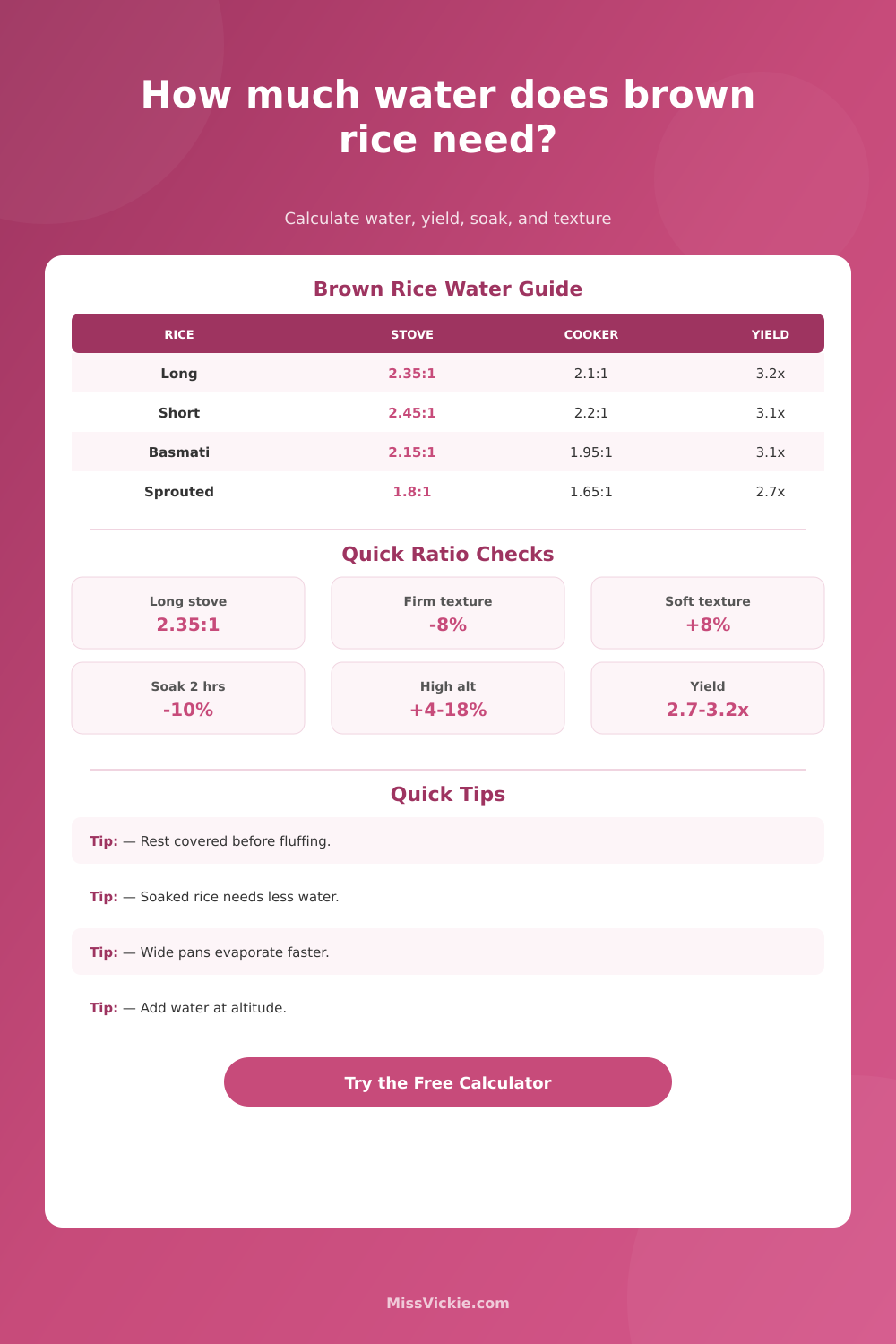
| Brown Rice Type | Dry Weight Per Cup | Stovetop Water | Rice Cooker Water | Cooked Yield |
|---|---|---|---|---|
| Long-grain brown rice | 195 g / 6.9 oz | 2.25 to 2.45 cups per cup dry | 2.0 to 2.2 cups per cup dry | About 3.2 cups cooked |
| Short-grain brown rice | 200 g / 7.1 oz | 2.35 to 2.55 cups per cup dry | 2.1 to 2.3 cups per cup dry | About 3.1 cups cooked |
| Medium-grain brown rice | 198 g / 7.0 oz | 2.30 to 2.50 cups per cup dry | 2.05 to 2.25 cups per cup dry | About 3.1 cups cooked |
| Brown basmati rice | 190 g / 6.7 oz | 2.05 to 2.25 cups per cup dry | 1.85 to 2.05 cups per cup dry | About 3.1 cups cooked |
| Brown jasmine rice | 190 g / 6.7 oz | 2.10 to 2.30 cups per cup dry | 1.9 to 2.1 cups per cup dry | About 3.0 cups cooked |
| Sprouted brown rice | 180 g / 6.3 oz | 1.70 to 1.90 cups per cup dry | 1.55 to 1.75 cups per cup dry | About 2.7 cups cooked |
| Quick-cooking brown rice | 170 g / 6.0 oz | 1.25 to 1.50 cups per cup dry | Follow package line | About 2.4 cups cooked |
| Brown and wild rice blend | 185 g / 6.5 oz | 2.50 to 2.85 cups per cup dry | 2.25 to 2.60 cups per cup dry | About 3.3 cups cooked |
These ratios estimate added cooking water after rinsing. Soaked rice, pressure cooking, and boil-drain cooking are adjusted separately in the calculator.
🍲 Method and Soak Adjustments
| Choice | Water Effect | Time Effect | Best For | Cooking Note |
|---|---|---|---|---|
| No soak, covered pot | Full baseline water | 40 to 50 minutes | Reliable weeknight cooking | Rest covered 10 to 15 minutes |
| 30 minute soak | Use about 5% less water | Shortens by 3 to 5 minutes | Firmer fluffy grains | Drain before adding measured water |
| 2 hour soak | Use about 10% less water | Shortens by 6 to 10 minutes | Evenly tender brown rice | Good for older rice |
| Overnight soak | Use about 15% less water | Shortens by 10 to 15 minutes | Soft bowls and meal prep | Keep soaked rice refrigerated |
| Rice cooker | Use about 8% less water | Automatic cycle | Hands-off batches | Fluff when cooker switches |
| Pressure cooker | Use much less water | About 22 to 28 minutes | Fast brown rice | Use natural release when possible |
🍽 Batch and Yield Guide
| Dry Brown Rice | Stovetop Water Range | Cooked Yield | Standard Servings | Meal Prep Servings |
|---|---|---|---|---|
| 1/2 cup dry | 1 1/8 to 1 1/4 cups water | About 1 1/2 cups cooked | 2 servings | 1 serving |
| 1 cup dry | 2 1/4 to 2 1/2 cups water | About 3 to 3 1/4 cups cooked | 4 servings | 2 to 3 servings |
| 1 1/2 cups dry | 3 1/2 to 3 3/4 cups water | About 4 1/2 to 5 cups cooked | 6 servings | 3 to 4 servings |
| 2 cups dry | 4 1/2 to 5 cups water | About 6 to 6 1/2 cups cooked | 8 servings | 5 servings |
| 3 cups dry | 6 3/4 to 7 1/2 cups water | About 9 to 10 cups cooked | 12 to 13 servings | 7 to 8 servings |
| 5 cups dry | 11 1/4 to 12 1/2 cups water | About 15 to 16 cups cooked | 20 to 21 servings | 12 to 13 servings |
🧮 Cooked Serving Sizes
Use when the meal has several sides, beans, bread, or another starch.
A common cooked brown rice serving for dinner plates and simple bowls.
Enough rice to support vegetables, protein, sauce, and toppings.
A hearty container portion that holds well for lunches.
🧪 Nutrition Estimate Per Cooked Cup
Nutrition values are approximate per cooked cup of plain brown rice. Added broth, oil, salt, or sauces change the final serving.
💡 Brown Rice Water Notes
Unlike white rice, brown rice has a bran layer that it holds onto like a shield. That means you need to supply proper level of heat and moisture to make it soft. Most recipes suggest a set water-to-rice ratio, but that’s not always the best way to go.
The amount of water you need depends on your pan and how well lid fits. It also depends on how long you soaked the rice, your altitude, and whether you want the rice softer or firmer. This calculator takes all those factors into account for you. No more guessing.
How to Cook Brown Rice Perfectly
First, consider what kind of rice you are using. Not all rice is created equal; long-grain varieties behaves different than short-grain, which differ from basmati and so on. Remember, you’re not merely cooking grain, but a particular plant part. Brown rice differ in structure from white. Sprouted brown rice begins to germinate before cooking, so it has more moisture inside and requires less water from the outside. Mush happens if you cook sprouted rice with same ratio as regular. Automatically, the tool makes up for these life-form variations.
It offers control over your cooking. By soaking, you can get a headstart on the cooking process: you’re hydrating the bran layer and swelling grains before adding heat. If you soak your rice, you need to cut down on your cooking water. Soaking for a couple hours will shave off 10 minutes of cooktime. Also, it’ll use about 10 percent less cooking water in the pot. The point of soaking is defeated if you forget to make up for that extra hydration. The calculator takes this into account.
Water boils differently at different altitudes. At higher elevations, water doesn’t boil as hot as it does at sea level. It can bubble vigorously, but it is just not boiling as hot. That means your rice will take longer to get up to temperature to start gelatinizing its starches. And because it cooks for longer, more of that water will evaporate. If you’re at high altitude, you’ll need additional water. This adjusts for that and avoids hard kernel.
How do you like your texture? That’s up to you; here’s how to quantify it: Do you prefer firmer grains for salads? Or softer rice for soup? It may be only a couple tablespoons of water-per-cup that makes all the difference between success and failure. With the click of the calculator button, you specify exactly how firm or how soft you want it. You will no longer wonder what “al dente” means.
In addition to ingredients, you have to consider how they’re cooked. Steam needs to be kept inside well (a rice cooker does this very effectively). Loose lids result in more evaporation, which means you’ll need more water. You also need to consider different variables: For example, brown rice cooks for 40-50 minutes. If the lid isn’t on tightly, that’s plenty of time for water to evaporate. You must consider the tightness of your lid and shape of the pan.
The last thing to do? Let it rest. After you turn off the heat, cover the pot and let it sit for ten to fifteen minutes so that moisture has time to spread throughout. If you don’t let it rest, the rice on the bottom of the pot will be wetter than the rice on top. Again: a tiny step that makes all the difference. Rest time is factored into the calculator’s estimates.
The rice is only ready to be eaten once all the water has been absorbed. Brown rice is about timing, temperature, and moisture, water management. It’s learning to master a series of variables that work together. Soaking, altitude, pot size (they all matter), but when you get it, you don’t have to guess anymore. Just enough moisture penetrates the grain just right. It doesn’t go gummy; it doesn’t burn. This is what happens when you do things by hand with care.