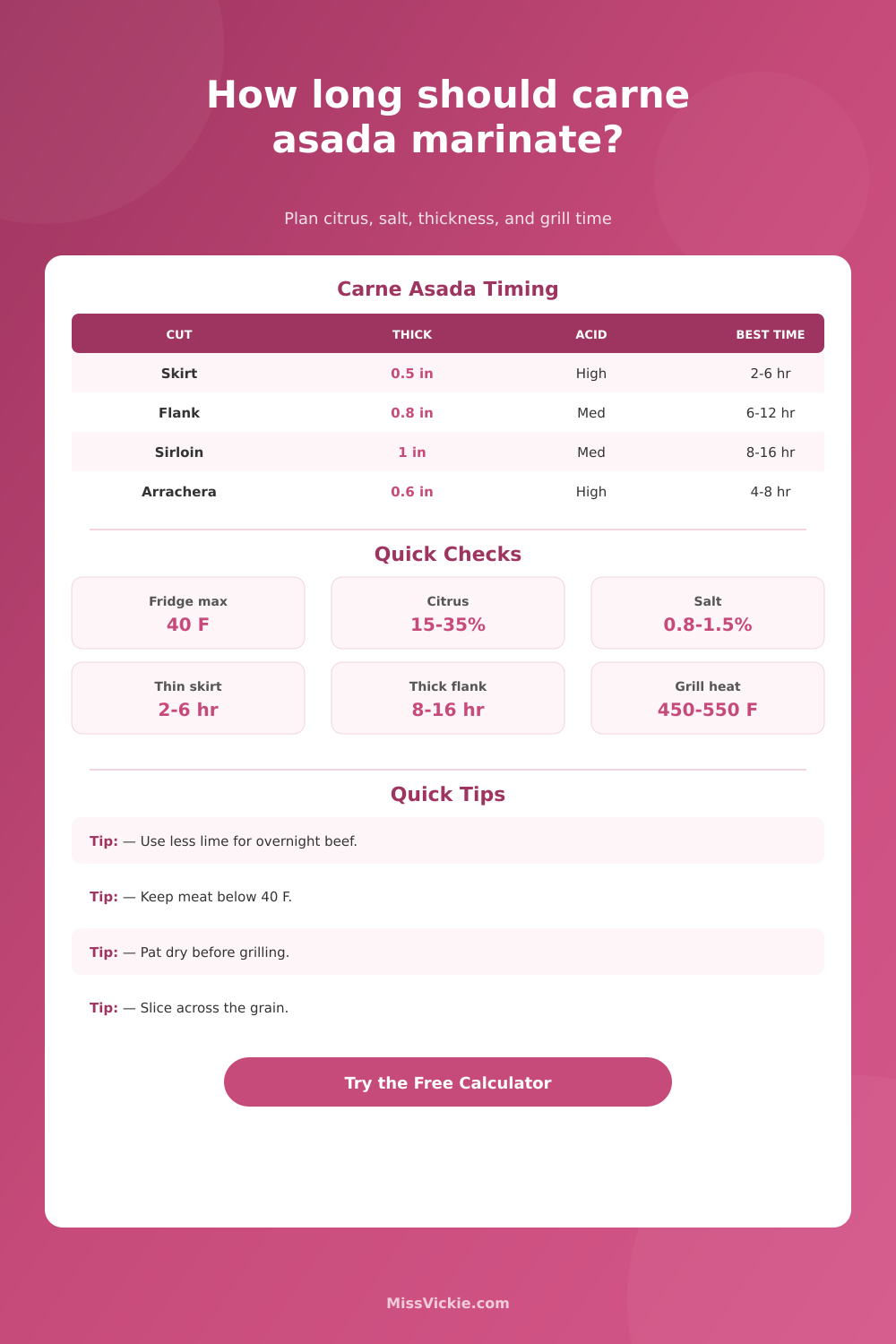
Cut thickness, citrus acid, salt percent, marinade volume, fridge temperature, rest time, and grill timing
Carne Asada Marinating Time Calculator
Estimate the best refrigerated carne asada marinating window from steak cut, thickness, citrus level, salt percentage, marinade depth, planned hold temperature, and hot-grill timing.
Start with a common carne asada setup, then adjust steak weight, thickness, citrus percentage, acid intensity, salt level, marinade volume, fridge temperature, and grill target.
Carne asada marinade plan
Enter your steak and marinade details to estimate timing.
Timing Breakdown
The cards below translate the timing inputs into practical marinade amounts, citrus split, salting, oil balance, and coverage checks for the current batch.
| Carne Asada Cut | Common Thickness | Best Acid Style | Typical Best Window |
|---|---|---|---|
| Skirt steak | 1/3 to 3/4 in / 0.8 to 1.9 cm | Balanced to bright citrus, short hold | 2 to 8 hours |
| Flank steak | 3/4 to 1 1/4 in / 1.9 to 3.2 cm | Balanced citrus with enough salt time | 6 to 16 hours |
| Flap meat or bavette | 1/2 to 1 in / 1.3 to 2.5 cm | Moderate citrus, chile, garlic, oil | 4 to 14 hours |
| Arrachera | 1/3 to 3/4 in / 0.8 to 1.9 cm | Bright citrus but avoid long enzyme holds | 3 to 8 hours |
| Thin ranchera | 1/4 to 1/2 in / 0.6 to 1.3 cm | Gentle to balanced, very short hold | 1 to 5 hours |
| Thin sirloin | 3/4 to 1 1/4 in / 1.9 to 3.2 cm | Gentle citrus or orange-forward marinade | 8 to 18 hours |
| Batch Size | Salt At 1.1% | Marinade Range | Citrus At 25% |
|---|---|---|---|
| 1 lb / 0.45 kg steak | 5 g salt | 1/2 to 3/4 cup / 120 to 180 ml | 2 to 3 Tbsp / 30 to 45 ml |
| 2 lb / 0.9 kg steak | 10 g salt | 1 to 1 1/2 cups / 240 to 360 ml | 1/4 to 3/8 cup / 60 to 90 ml |
| 3 lb / 1.4 kg steak | 15 g salt | 1 1/2 to 2 1/4 cups / 360 to 530 ml | 3/8 to 1/2 cup / 90 to 130 ml |
| 5 lb / 2.3 kg steak | 25 g salt | 2 1/2 to 3 1/2 cups / 590 to 830 ml | 2/3 to 7/8 cup / 160 to 210 ml |
| 8 lb / 3.6 kg steak | 40 g salt | 4 to 5 1/2 cups / 950 to 1300 ml | 1 to 1 1/3 cups / 240 to 325 ml |
| Thickness | Very Hot Grill | Medium Rare Pull | Rest And Slice |
|---|---|---|---|
| 1/4 to 1/3 in / 0.6 to 0.8 cm | 45 to 75 sec per side | 125 to 130 F / 52 to 54 C | 3 minutes, slice fast |
| 1/2 in / 1.3 cm | 1 1/2 to 2 min per side | 130 F / 54 C | 4 to 5 minutes |
| 3/4 in / 1.9 cm | 2 to 3 min per side | 130 F / 54 C | 5 minutes |
| 1 in / 2.5 cm | 3 to 4 min per side | 130 to 135 F / 54 to 57 C | 5 to 8 minutes |
| 1 1/4 in / 3.2 cm | 4 to 5 min per side | 130 to 135 F / 54 to 57 C | 8 minutes |
Use an instant-read thermometer for doneness. USDA guidance for whole cuts of beef uses a 145 F minimum with rest; many carne asada cooks choose lower pull temperatures for texture, so decide based on your household needs.
Raw marinated beef should stay at or below 40 F / 4 C until it is ready to grill.
Keep counter time short; use 1 hour as the ceiling when the room is above 90 F / 32 C.
Acid-heavy carne asada usually loses texture well before food-safety storage limits.
Thin carne asada benefits from very high heat, dry surfaces, and fast turning.
A marinade is like a magic rite where you mix a recipe with some juice and pray you got it right. More times then not, the result lands somewhere between bland leather and mushy pulp.
Carne asada isn’t a big mystery: It’s about using time. Use the calculator, enter your marinade strength and steak thickness. Let the math work its magic. No more wondering if your skirt steak is marinated to death.
The Science of Good Marinades
One of the variables that confuses folks are the cut of beef itself. Skirt steak, while flavorful, is tough with long strings of fibers that require softening over time. Then there’s flank, which is thicker and leaner and calls for a totally different treatment altogether.
Take a half-inch thick skirt steak, douse it in a heavy lime marinade for twelve hours, then toss it on the grill and you’ll have mushy meat on your hands. The acid breaks down the surface proteins. Over time this surface becomes a mealy, chalky mess that bears no resemblance to tenderness. It is wet, yet dry.
This brings us to acid percentage. A lot of recipes suggest marinating a pound of meat in half a cup of lime juice. That’s aggressive. With the calculator, you’ll be able to dial in how much citrus you’re bringing to the party. Want to go all-in on the bright? All lime? Go ahead, but keep it brief. Splash in some orange and toss in lots of herbs and oil? Go ahead, take your time.
Chemical breakdown isn’t what you want; you want flavor. But there’s that narrow margin: perfect or ruined.
With salt? Salt behaves differently. It doesn’t simply sit on top; it soaks in and actualy alters the muscle structure so it retains more moisture. The tool will even help you figure out how much salt to use based off its weight (game changer). Most folks just eyeball it. Sprinkle a pinch of kosher salt on a tiny piece of flank steak vs. A big ol’ skirt steak, and you get two very different outcomes. Knowing your meat’s weight and figuring out what one percent of that equals means every bite tastes like all the other bites: consistent. Sounds clinical, but it sure tastes consistent.
Beef Marinating: Temperature is the Silent Killer
We all know that you should store marinated beef in the fridge. But how many of us verify whether our fridge is cold? And I mean truly cold (below 40F). Once the temp rises above forty degrees Fahrenheit, the acid will be doing its work, but the bacteria will begin multiplying too. To account for this, the calculator use your fridge temperature and adjusts the safe time accordingly. Better to play it safe.
You can recover from a slightly less marinated steak by searing it on the grill. You can’t recover from a spoiled one; straight to the bin it goes.
Marinades work through acid denaturing proteins and salt penetrating muscle structure, that’s how cooking chemistry works: The physics of the marinade itself affects that process. Swimming in his own juice in a shallow dish? Pressed up against some liquid inside a flattened-out bag? The latter will be more effective because more surface area makes for better contact. This leads to shorter times. For example, you can halve your marinating time by using a bag rather than a bowl.
And when your plans for a weekend cookout suddenly turn into “Oh, crap, I forgot about the meat” on Friday night, those are the kinds of things that make a difference. The plan comes together… Or fails, at the grill.
For carne asada, you want high heat. A fast sear outside locks in the juices, while the quick charring forms the kind of crust that makes for good carne asada. Too-cool grill? The steak will steam itself inside its own rendered fat. Depending on how thin/thick and what doneness level you want your cut, the tool calculates an estimated grill time. Thinner cuts require just minutes, but thicker ones takes patience.
Once grilled, never skip the rest. Letting the meat sit gives the juices time to redistribute. No rest = no juiciness + a lot of good marinade flavor lost in the plate rather than in the taco. You should of rested it.
Once you master those variables, it’s not a guessing game anymore. It’s not about chance; it’s about chemistry. The flavor will be deep and the texture will be right. No more steaks that sulk. Now you’ll know what makes them sing. Timing is everything.