Diastatic Malt Powder For Pizza Dough Calculator
Calculate diastatic malt powder from flour weight, malt percentage, flour type, fermentation length, oven temperature, browning target, and teaspoon density.
🍕 Malted Pizza Dough Presets
Pick a common pizza dough situation, then adjust flour weight, malt percentage, flour type, fermentation time, oven heat, browning goal, and grams per teaspoon.
⚖ Flour Weight And Malt Dose
Malt dose plan
Your diastatic malt dose will appear here.
Dose Breakdown
Ferment And Browning
🧮 Current Malt Conversion Cards
📋 Diastatic Malt Powder Reference Tables
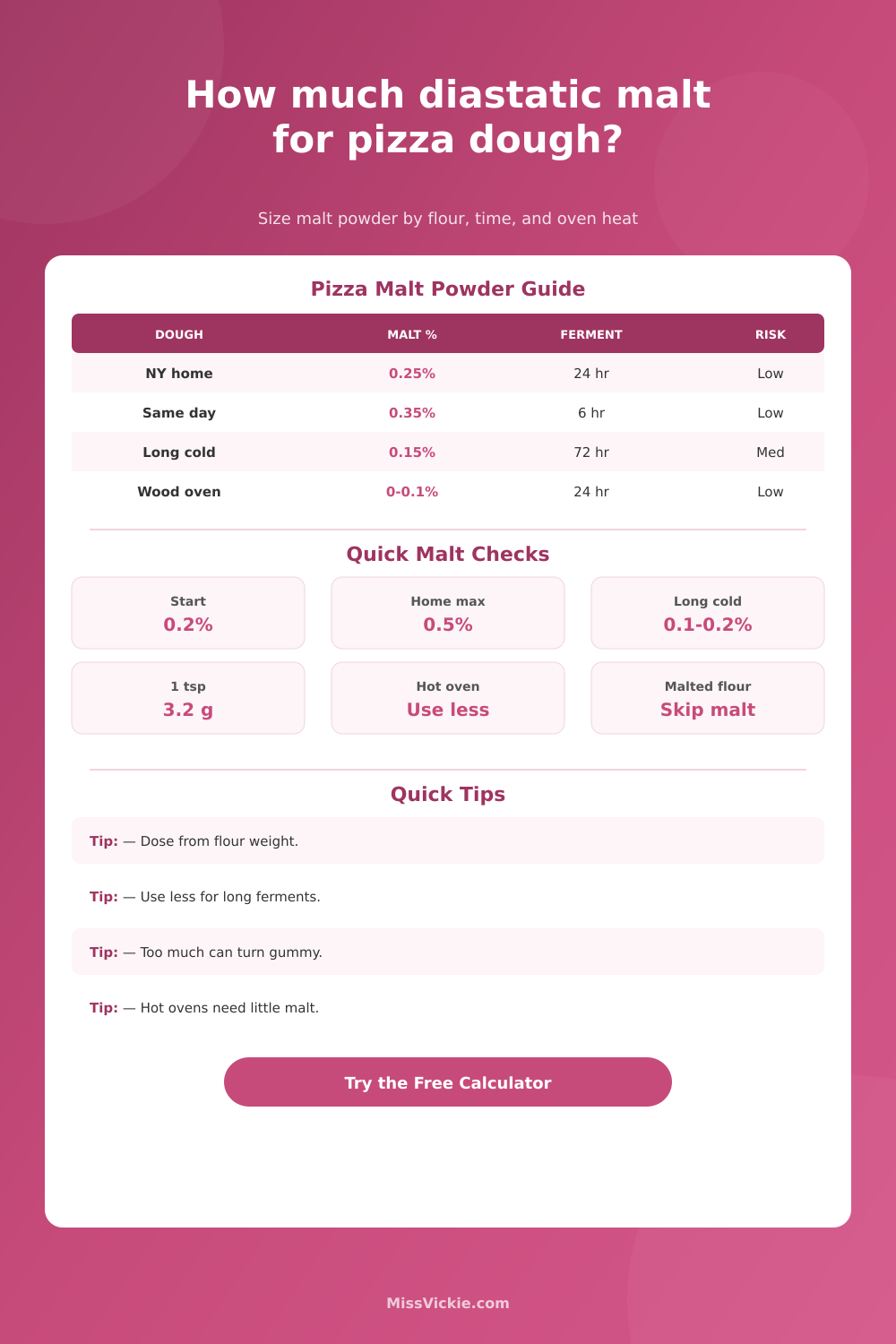
| Pizza Dough Situation | Typical Malt Range | Fermentation Fit | Oven Fit | Texture Watch |
|---|---|---|---|---|
| Lean home-oven New York dough | 0.15% to 0.35% | 8 to 48 hours | 475°F to 600°F | Useful when flour browns slowly. |
| Same-day pan or sheet pizza | 0.25% to 0.50% | 2 to 10 hours | 425°F to 550°F | Can help color a thicker crust. |
| Long cold ferment dough | 0.05% to 0.20% | 48 to 96 hours | 500°F to 650°F | Use less to avoid a sticky crumb. |
| Very hot steel or outdoor oven | 0% to 0.15% | 8 to 48 hours | 650°F to 900°F | High heat already browns fast. |
| Already malted commercial bread flour | 0% to 0.10% | Any length | Any oven | Extra malt is often unnecessary. |
| Flour Weight | 0.10% Malt | 0.25% Malt | 0.50% Malt | At 3.2 g Per Tsp |
|---|---|---|---|---|
| 500 g flour | 0.5 g | 1.25 g | 2.5 g | 0.16 to 0.78 tsp |
| 1000 g flour | 1 g | 2.5 g | 5 g | 0.31 to 1.56 tsp |
| 1500 g flour | 1.5 g | 3.75 g | 7.5 g | 0.47 to 2.34 tsp |
| 2500 g flour | 2.5 g | 6.25 g | 12.5 g | 0.78 to 3.91 tsp |
| 5000 g flour | 5 g | 12.5 g | 25 g | 1.56 to 7.81 tsp |
| Signal In The Dough | Likely Cause | Malt Adjustment | Ferment Adjustment | Oven Adjustment |
|---|---|---|---|---|
| Pale crust at normal bake time | Low sugar or cool oven | Try 0.1% more malt | Keep time steady | Preheat stone or steel longer |
| Dark bottom before top cooks | Too much sugar or hot deck | Reduce malt | Shorten warm proof | Move rack higher |
| Sticky or gummy crumb | Too much enzyme activity | Cut malt sharply | Shorten ferment | Bake a little longer |
| Weak extensible dough | Long time plus enzymes | Use 0% to 0.1% | Keep colder | Use normal pizza heat |
| Good color but bland crust | Flavor, not enzyme issue | Keep malt same | Use longer cold time | Do not chase color only |
📊 Flour Type And Enzyme Risk Grid
Good candidate for small malt additions in home ovens.
Check the label before adding more enzyme powder.
Enzymes keep working while dough rests, especially when warm.
High-heat pizza usually browns without extra malt.
💡 Malt Powder Calculation Notes
This calculator estimates kitchen-scale diastatic malt use for pizza dough. Flour brand, enzyme strength, dough temperature, fermentation schedule, deck heat, pan color, and bake time can change the best dose.
To most home bakers, crust color is just a matter of oven temperature: Crank it up; voilà, browned pizza. But when your dough remain pale despite having maxed out your oven to five-hundred degrees, something’s wrong, though it’s not usually the heat. It is sugar. And diastatic malt powder do two things: It feeds your yeast while also browning your crust without compromising texture with added sweeteners. How? It breaks down naturaly sugars in the starch of your flour.
Once you enter your flour weight and fermentation plan into the calculator (above), it takes care of the rest for you, keeping you informed about both conversions and ratios. The goal: just enough enzymatic activity to produce color without producing such an excess of gooeyness that your crumb become gummy. That’s where folks err. More malt = better crust… right? Nope. Malt produces enzyme that continue working indefinitely.
How to Use Malt Powder for Better Pizza Crust
That’s why using one-third as much (or even less) powder yields great results with a three day ferment vs. You can bake it immediately. The tool understands this and will adjust accordingly (recommending dosage amount to reflect your desired timeframe). A 24-hour cold ferment require less powder than same-day dough. And it matters, a lot.
There’s an exception: Flour matters. Malted Barley is used commercially in many bread flours and it’s included in the flour itself. Adding more powder to pre-enzymatic flour can lead to over-processing of the starch. Instead of stretching, it will tear and the dough will be weak and sticky. Read your bag label first. If malted barley is listed on the ingredient panel, begin at zero added powder.
The calculator helps with this too. When you select a combination of ingredients and settings where the calculator thinks there is a high risk for enzyme overload, it alerts you. This is great if you are working with fresh milled blends that has different levels of natural activity or high gluten flours. But moisture can also be a factor in browning. Moisture-rich doughs slow down cooking because their water content cools the surface area slowing the Maillard reaction time. Here’s where malt comes into play. It adds easily digestible sugars that quickly caramelize to aid in the browning process.
However, it won’t substitute for heat. No matter what your malt dosage is, if your oven isn’t hot enough, it won’t help. You want a hot stone/pan/whatever you use as a baking surface. That’s why the page includes a reference table explaining how malt dosage works with oven temperature. With a really hot Neapolitan oven, sometimes none at all is needed, the heat alone do all of the work. With a typical home oven, you may need just a little bit of assistance.
A note on teaspoons: They’re finicky. The density of the powder varies by brand and how tightly it’s packed in the container; a teaspoon is just a guess. A teaspoon is a guess. Grams, however, are grams. Weight makes for consistent batches; it gets rid of the variable that is a teaspoon. Switching brands will change things a bit. However, using weights takes out most of the error. This is nice when you want to try to replicate something perfectly, even a good crust.
Begin with small increments. For most home ovens half a percent will be more than enough. If you haven’t achieved color at higher hydrations or longer rises, go up from there. You should of used weights if you wants perfection. And remember that while it affects both flavor and texture, too much malt can impart a certain bitterness. That’s a flavor note, not just a texture note. The crust should taste like caramel and flour, not like anything added.
“Pizza dough is a balance between chemistry, heat, and time. Malt is merely a tool. Pull it gently. Is your crust pale? Look to your oven. Sticky? Your enzymes. Bland? Time. Your starting line is provided by the calculator. Your finishing line comes from your palate and oven. When you master the basics (hydration and heat), malt can become a refinement rather than a crutch. You’ll be rewarded with a crust that shapes, browns, and crackles.”