Masa yield, filling, wrapper size, hydration, and steamer batch planner
Tamales Per Pound Of Masa Calculator
Estimate how many tamales your masa will make by weighing the masa, choosing wrapper size, setting filling amount, controlling spread thickness, and checking steamer capacity.
📌Tamale Batch Presets
Start with a common tamale setup, then adjust masa form, husk size, filling, thickness, lard, broth, wrapper buffer, and steaming capacity.
⚖Masa, Filling, Wrapper, And Steamer Inputs
Tamale batch plan
Adjust the inputs to calculate masa yield, filling needs, wrapper count, and steamer batches.
Masa And Wrapper Math
Filling And Steamer Math
Batch Notes
🧺Current Batch Supply Grid
Final masa available after hydration, fat, and masa form settings.
Includes your selected sorting and spreading buffer.
Estimated liquid for dry masa planning or formula checking.
Estimated fat for texture, tenderness, and spreadability.
Drained filling weight needed for the calculated tamale count.
How many steaming rounds are needed at the chosen loading target.
Shows unused masa when filling limits the final yield.
Usable masa area per wrapper after fold clearance.
📊Masa Yield Tables
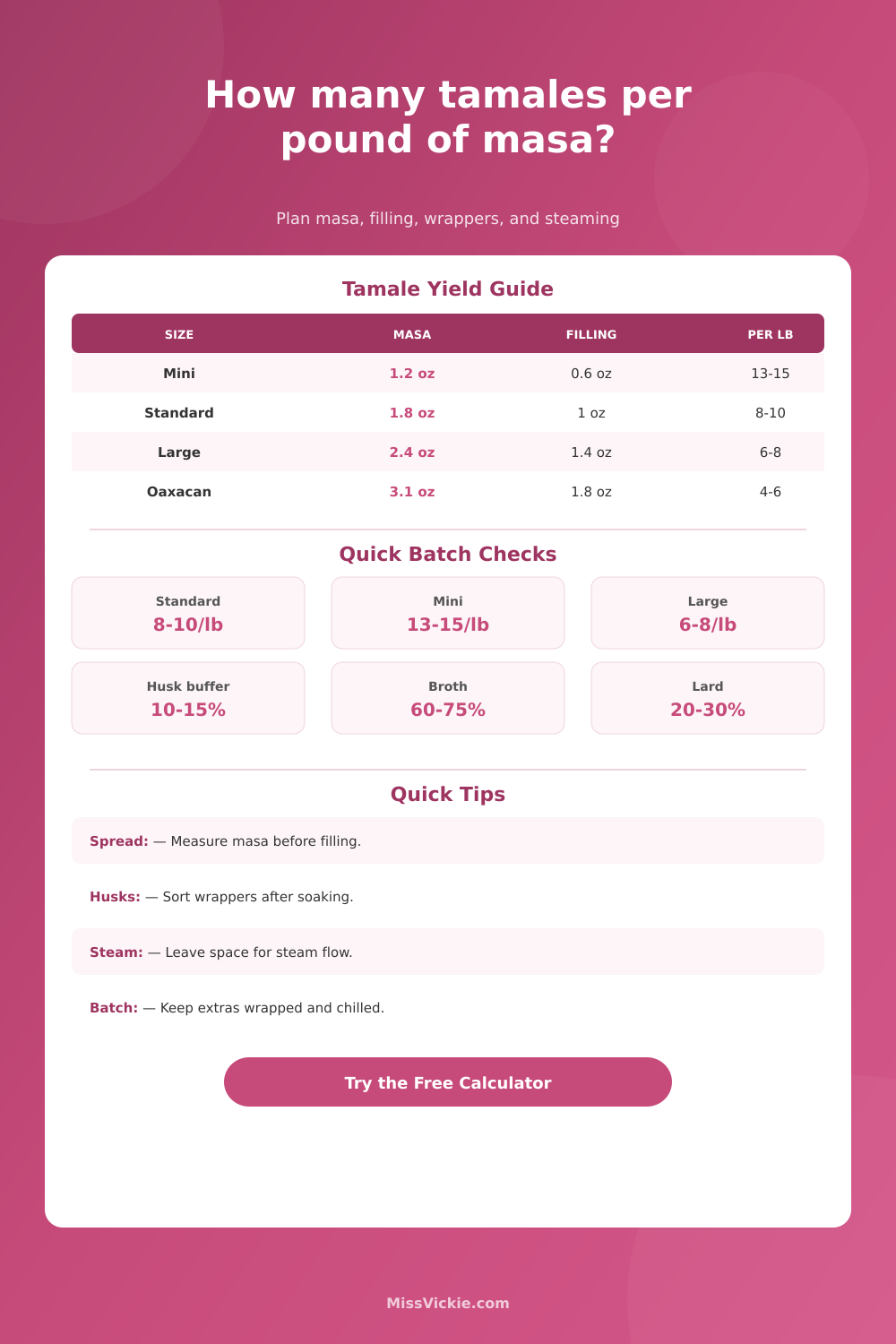
| Tamale Size | Typical Masa Per Tamale | Filling Per Tamale | Expected Yield Per 1 lb Prepared Masa | Best Use |
|---|---|---|---|---|
| Mini appetizer | 1.1 to 1.4 oz | 0.4 to 0.7 oz | 12 to 15 tamales | Party trays, tasting menus, mixed fillings. |
| Standard corn husk | 1.6 to 2.0 oz | 0.8 to 1.2 oz | 8 to 10 tamales | Most family tamale batches and holiday dozens. |
| Hearty dinner size | 2.1 to 2.6 oz | 1.2 to 1.6 oz | 6 to 8 tamales | Meal-size tamales with generous filling. |
| Large wrapped tamale | 2.6 to 3.2 oz | 1.5 to 2.0 oz | 5 to 6 tamales | Big corn husks or extra-thick masa spreads. |
| Oaxacan packet | 3.0 to 4.0 oz | 1.6 to 2.4 oz | 4 to 5 tamales | Banana leaf packets with a broader masa bed. |
| Wrapper Type | Usable Spread Zone | Fold Clearance | Masa Coverage | Planning Note |
|---|---|---|---|---|
| Small corn husk | 3.8 x 5.4 in | High | About 70% | Best for mini or slim tamales; sort out narrow husks. |
| Medium corn husk | 4.7 x 6.2 in | Medium | About 78% | Good default for standard tamales and one-ounce filling. |
| Large corn husk | 5.6 x 7.0 in | Medium | About 82% | Supports thicker masa or generous filling without bursting. |
| Wide restaurant husk | 6.4 x 7.5 in | Lower | About 85% | Efficient for dinner-size tamales and faster spreading. |
| Banana leaf square | 7.0 x 7.0 in | Medium | About 76% | Fold as a packet; masa can spread wider and thinner. |
| Oaxacan leaf packet | 8.0 x 8.5 in | Medium | About 80% | Use for larger packets, mole fillings, or softer masa. |
| Dry Masa Harina | Broth At 60% | Broth At 70% | Lard At 25% | Approx Prepared Masa |
|---|---|---|---|---|
| 1 lb dry masa | 9.6 oz broth | 11.2 oz broth | 4 oz lard | 1.85 to 1.95 lb prepared |
| 2 lb dry masa | 1.2 lb broth | 1.4 lb broth | 8 oz lard | 3.7 to 3.9 lb prepared |
| 5 lb dry masa | 3 lb broth | 3.5 lb broth | 1.25 lb lard | 9.25 to 9.75 lb prepared |
| 1 kg dry masa | 600 g broth | 700 g broth | 250 g lard | 1.85 to 1.95 kg prepared |
| Steamer Capacity | Comfortable Load | Full Load | Good Batch Size | Timing Note |
|---|---|---|---|---|
| 24 tamales | 18 to 21 tamales | 24 tamales | 1 to 2 dozen | Small pot; refill hot water between rounds. |
| 36 tamales | 28 to 32 tamales | 36 tamales | 3 dozen | Common home steamer or large stockpot insert. |
| 60 tamales | 48 to 54 tamales | 60 tamales | 5 dozen | Good for parties if tamales stand upright loosely. |
| 100 tamales | 80 to 90 tamales | 100 tamales | 8 dozen | Deep tamalera; rotate batches by filling type. |
💡Tamale Calculation Notes
Yield is an estimate because fresh masa density, soaking quality, husk width, and spread pressure vary. The calculator is most accurate after you weigh one assembled test tamale from your own batch.
Time cannot be fixed, but masa can. When you suddenlly find yourself with no more dough but plenty of seasoned pork sitting on the counter, panic ensues. If you cook holidays, you knows the scenario all to well.
To avoid it completly, just weigh your ingredients instead of guessing. Once you know precisely what ratio of masa to filling yields one tamale, suddenly the whole operation become a well-oiled assembly line, not a scramble. What was once a vague hope becomes a concrete plan.
How to Make Tamales Without Panic
Prepared dough vs. Dry masa harina are also not the same weight, which is the second thing most folks trip over. To make dry masa into something you can work with, it require liquid, which adds a lot of mass. You’ll under-estimate amount of dough you’ve got if you account for its weight as just weight of the dry flour. Plugging in your amounts of lard and broths into the calculator above will take care of that bit of chemistry for you, so you don’t have to do the math in your head.
A typical hydration level, which is how much water you’re adding per pound of dry flour… Hovers around sixty percent by weight. So if you weigh out a pound of dry flour, you’re going to add more then half a pound of liquid to that. That’s going to increase the yield, and cause the dough to expand. And then there’s the fact that you put in fat, usually another twenty percent or so. All that add up before you spread your first husk.
But that’s where the rubber meets the road, so to speak: The real control comes from spread thickness. Most recipes includes a visual clue like “about a quarter inch” thick. It’s good guidance for newbies, but if you’re scaling up, it doesn’t help at all. When you’re creating 200 tamales, trying to visually estimate is useless.
Instead, by measuring out how thinly or thickly you’re spreading it, you can accurately predict yield. If you go thin, you’ll have more tamales/pound, but you also run the risk of having the tamales tear while cooking. Go too thick, and you’ll end up with less tamales, but you’ll have a sturdy shell. The trick is finding your sweet spot: cover enough of the filling without wasting dough on an impenetrable brick.
Canvas size matter. How many tortillas can fit in a corn husk? Not as many as in a restaurant-size husk, even with twice the massa. The more usable area you have, the better you can cover it with fillings and the less thickly you has to do so. The chart on the page explain it all, illustrating how removing the clearance around the fold reduces the available work area.
There’s no such thing as working the full length of a husk. Always leave clearance for folding. Margin of error is here. When you forget about fold clearance, all bets are off, come wrap time.
Until it’s the last step, amount of weight you fill in doesn’t get thought about much. Payload is what really matters; it’s the filling. And the thing holding it all together is just the vessel (dough). Saucy pork tamales? That moisture makes for more weight/stress on the wrapper. Cheese/beans etc. They will be drier and different than. Think about how dense your filling is and adjust accordingly.
How much weight is this going to put on the husk? If you overload a small husk with too much filling, the seam burst. Wasting a good corn by underloading a large husk is no bueno either.
The last bottleneck is steaming capacity. Maybe you have the dough for 50 tamales. Maybe your pot can hold only 30. The calculator will help fill that gap, estimating the number of batches your steamer could handle, physically speaking.
Don’t skimp on leaving space for steam circulation! Too-tight packing trap moisture, leading to soggier dough. Better to do several rounds with good air flow than one giant round of soggy failures.
Planning beats improvising. A test tamale is the best decision you’ll ever make. Use it as a guide: How thick should I make these? That’s the answer; adjust the thickness setting to match and recalculate. How much masa do I need in each tamale? Answer: The math will tell you just how many wrappers to soak. It will also tell you exactly how much filling to prep. No more leftovers. No more last-minute panic attacks.
It is just a rhythmic process of folding and steaming until a table full of tamales sits in front of you. Start with a plan. Finish with a full table.