Beans Per Chili Calculator
Plan dry or canned beans for chili by servings, chili style, bean variety, meat ratio, pot size, cooked yield, heat level, simmer loss, and liquid balance.
🫘 Chili Bean Presets
Start with a common chili batch, then adjust the bean form, meat level, pot capacity, liquid style, heat, and expected cooked yield.
⚖ Batch and Bean Details
Balanced beef and bean chili plan
Your bean, meat, liquid, and pot-size plan will update as you adjust the chili batch.
Bean Breakdown
Chili Balance
📏 Serving Size Grid
📋 Bean-to-Liquid Tables
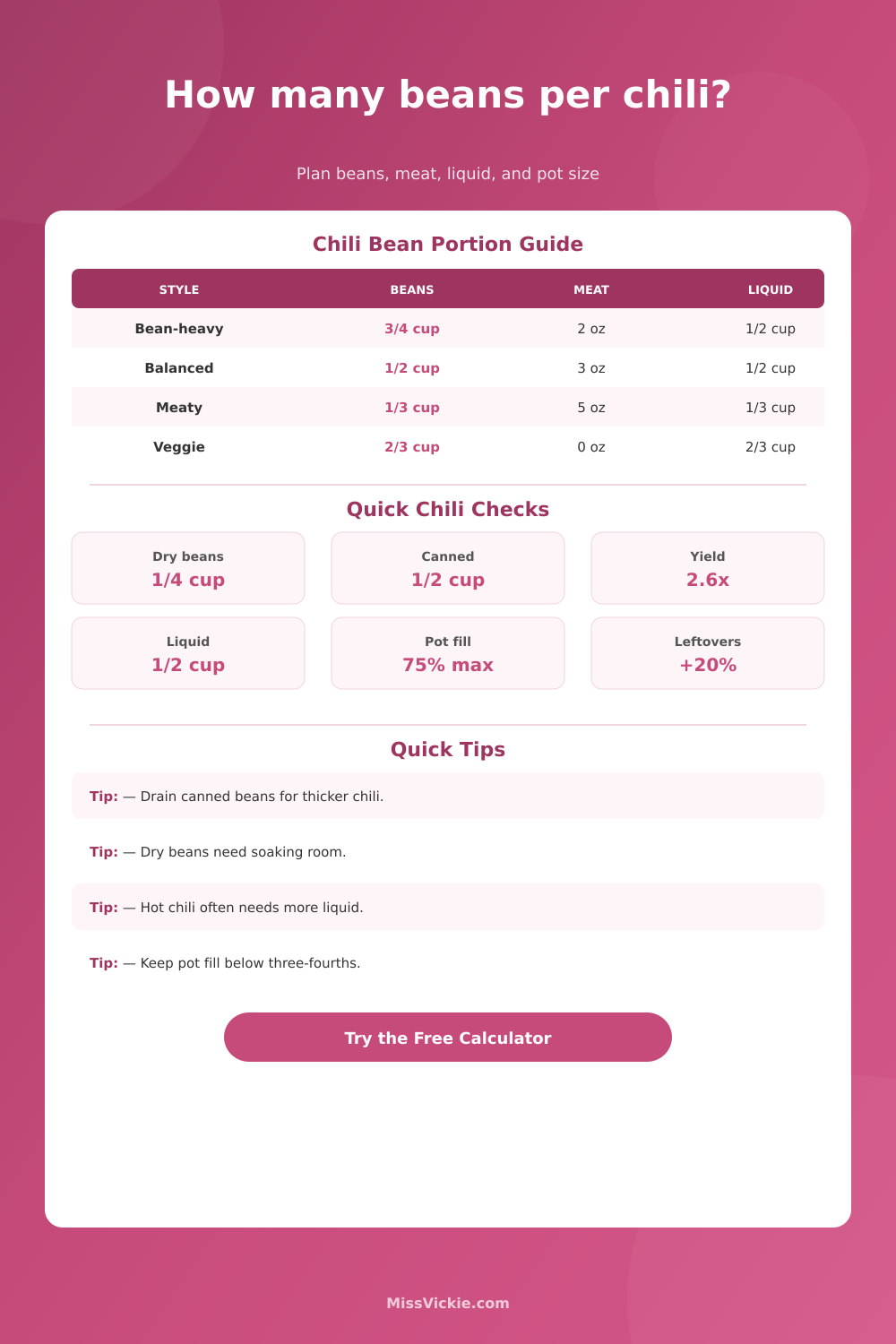
| Chili Style | Cooked Beans Per Serving | Meat Per Serving | Liquid Per Cup Beans | Best Texture |
|---|---|---|---|---|
| Balanced beef and bean chili | 1/2 cup | 3 oz cooked | 3/4 cup | Spoonable, not soupy |
| Bean-heavy pantry chili | 3/4 cup | 2 oz cooked | 2/3 cup | Thick with visible beans |
| Meaty chili with fewer beans | 1/3 cup | 5 oz cooked | 1/2 cup | Dense and meat-forward |
| Texas-style beans optional | 1/5 cup | 6 oz cooked | 1/3 cup | Chile gravy around meat |
| Vegetarian three-bean chili | 2/3 cup | 0 oz | 7/8 cup | Brothy enough for vegetables |
| White chicken chili | 1/2 cup | 3 oz chicken | 7/8 cup | Creamy and loose |
| Bean Type | Cooked Yield From 1 Cup Dry | Cooked Cup Weight | Cans Per 4 Cups Cooked | Liquid Behavior |
|---|---|---|---|---|
| Kidney beans | 2.6 cups | 6.1 oz | 3 cans | Holds shape well |
| Pinto beans | 2.7 cups | 6.0 oz | 3 cans | Thickens as it simmers |
| Black beans | 2.5 cups | 6.2 oz | 3 cans | Keeps a firm bite |
| Navy or great northern | 2.8 cups | 5.8 oz | 3 cans | Creamy with extra broth |
| Cannellini beans | 2.6 cups | 6.3 oz | 3 cans | Soft, rich texture |
| Lentils | 2.4 cups | 6.7 oz | Use cooked cups | Absorbs liquid quickly |
Liquid estimates assume tomatoes, stock, beer, or bean cooking liquid are added before the main simmer. Add small splashes near the end if beans continue absorbing liquid.
🫕 Batch Size and Pot Capacity
| Servings | Balanced Beans | Dry Bean Start | Canned Beans | Suggested Pot |
|---|---|---|---|---|
| 4 bowls | 2 cups cooked | 3/4 cup dry | 2 cans | 4 qt pot |
| 6 bowls | 3 cups cooked | 1 1/8 cups dry | 2 cans | 5 qt pot |
| 8 bowls | 4 cups cooked | 1 1/2 cups dry | 3 cans | 6 qt pot |
| 12 bowls | 6 cups cooked | 2 1/4 cups dry | 4 cans | 8 qt pot |
| 20 bowls | 10 cups cooked | 3 3/4 cups dry | 7 cans | 12 qt pot |
| 40 bowls | 20 cups cooked | 7 1/2 cups dry | 14 cans | 24 qt stockpot |
🔥 Heat, Simmer, and Thickness Reference
| Heat Level | Extra Liquid | Simmer Note | Bean Note | Texture Cue |
|---|---|---|---|---|
| Mild | 0 percent | Gentle simmer | Beans stay distinct | Glossy tomato base |
| Medium | 5 percent | Normal chili pace | Good balance | Slow spoon trail |
| Hot | 10 percent | Chile paste thickens | May need splashes | Coats beans evenly |
| Very hot | 15 percent | More pepper solids | Watch sticking | Loose before resting |
| Smoky dried chile | 12 percent | Chile puree absorbs | Best after resting | Sauce clings to ladle |
📊 Bean Nutrition Snapshot
💡 Chili Bean Notes
It’s possible that your chili will be either thicker or thinner than desired at some point in the cooking process. Chili is a volume problem that’s complicated by way ingredients change volume when simmered together. Tomatoes break down; the meat give off fat; and the beans takes up liquid. Without adjusting for those changes, the end result might be chunky or runny and hard to eat.
On this page, the calculator first recognizes that chili is a volume problem. Then, it helps you figure out how much (and what kind) to make to feed however many people you want, depending on whether your chili is more like soup or more like stew.
How to Fix Thick or Thin Chili
Does it have meat? Does it have no meat but lots of beans? Vegetarian bean chili are different than Texas-style meat chili. Also: What kind of beans are you preparing? Specify that. Are they dried beans? Canned? They is very different.
If you prepare with dry beans, pre-soak them, tomato acid doesn’t allow them to soften. Depending on which kind of bean you’re cooking, pinto vs. Kidney, the calculator calculates the yield actualy.
The chili’s texture are affected by the heat. Hotter chilies have more dried paste or solids so they soak up some additional liquid. If you choose hot or hotter heat levels, the calculator recommend increasing amount of liquid.
Also simmer time will affect how much liquid there is at the end. If you simmer for only a short period, not a lot is lost but if you let it undergo a two-hour uncovered bubble, you’ll have a lot less than expected.
It’s important to know how big your finished product will be so that you don’t go beyond your pot size. Boil-overs results from overfilling. The tool compares the projected volume against capacity of your pot and alerts you if you’re getting too close to the safe line.
Home cooking is mostly intuitive, which doesn’t easily apply to big-batch cooking. You don’t double water when doubling the recipe. How much liquid are those beans holding? Are there beans or no beans in that soup? Does the pot have a small surface or a large one making the broth evaporate faster or slower?
By putting a structure around your cooking you learn to control for those factors. If you like beans but want more meat, up the meat-to-liquid ratio to match. If you prefer a meatier chili, then reduce liquids because the meat hold the mixture together. If you go heavy on the beans, increase liquid to avoid gloop.
Common Scenarios: Tables provides benchmarks for common scenarios. These give a benchmark in terms of how much liquid is required per cup of beans for various textures: brothy chili soup versus spoonable chili. Tables also offer comparisons between canned and dried bean yields. This will help you determine if you should make your own from scratch or use canned beans.
Canned beans saves time but add salt and starch, which thickens the dish rapidy. Dried beans tend to taste better, and cost less, but take planning; convenience foods such as cans of beans costs more, but don’t need planning.
One consideration is nutrition. Meat contain fat; beans provide protein and fiber without that same fat content. One-half cup of beans can be a large source of nutritional benefits. Knowing this would of guide you in creating a hearty yet not-too-hefty meal.
You can use the calculator to start with, but ultimately trust your taste buds to tell you when something tastes right. Tasting the chili throughout the cooking process will tell you if you need more liquid (if it is too thick) or a longer time to simmer (if it is too thin).
When making chili, proportions matter. If the proportions are right, it will improve over time. It will rest well and taste better the following day. The liquid will thicken up naturaly as the beans soak in the flavor.
There’s no need to be trained as a pro chef to make good chili. Just follow the amounts and respect them.
After getting a feel for how the ingredients work together, you won’t fear messing up that big pot quite so much. You’ll know what you’re doing. You can plan. And let the math take care of the details while you concentrate on spices and heat.
Begin with the numbers but end with adjustment for taste.