Tomato jar acidification, bottled lemon equivalent, altitude, and process reminders
Citric Acid Per Quart Tomatoes Calculator
Calculate the required acid for canned tomatoes by jar size, jar count, tomato style, acid source, product pack, altitude band, and process method using tested home-canning reference amounts.
📌Tomato Acid Presets
Choose a common tomato canning batch, then adjust jar size, tomato style, acid source, altitude, process method, and rounding. Acid is sized per jar, not mixed once into the pot.
⚖Jar, Tomato, Acid, And Process Inputs
Tomato Acid Plan
The calculator will size acid per jar and batch.
Acid Breakdown
Process And Safety Notes
Jar Guidance
🧮Acidification Reference Cards
Use 1/4 teaspoon per pint.
Use 1 tablespoon per pint.
Use 2 tablespoons per pint.
Tomatoes are acidified for safety.
📋Tomato Acid Source Table
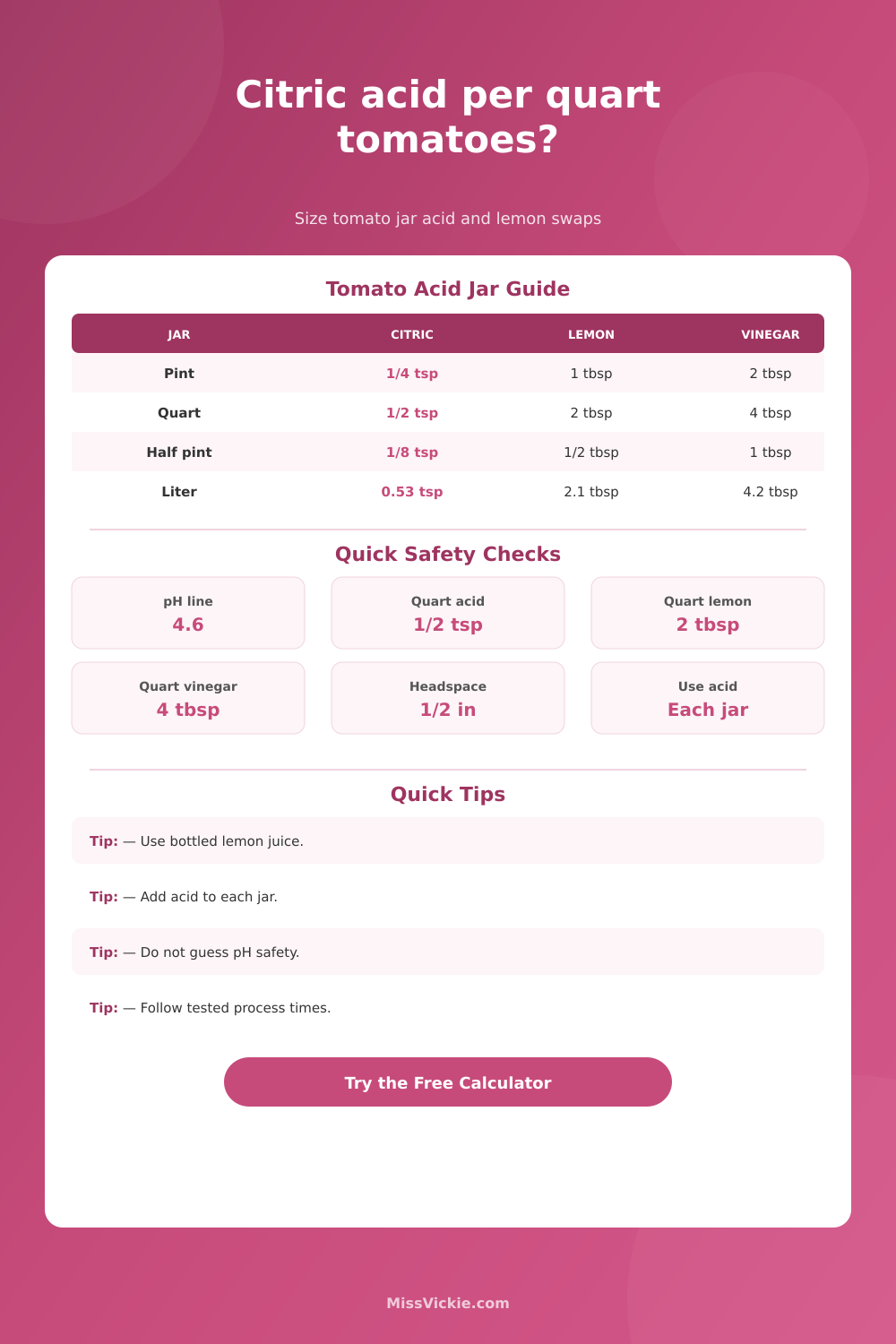
| Jar Size | Citric Acid | Bottled Lemon Juice | 5% Vinegar | Use Note |
|---|---|---|---|---|
| Half-pint | 1/8 teaspoon | 1/2 tablespoon | 1 tablespoon | Scaled from pint directions for small jars. |
| Pint | 1/4 teaspoon | 1 tablespoon | 2 tablespoons | Add acid directly to each jar before filling. |
| Quart | 1/2 teaspoon | 2 tablespoons | 4 tablespoons | Standard per-quart tomato acidification amount. |
| Liter | 0.53 teaspoon | 2.1 tablespoons | 4.2 tablespoons | Metric jars are slightly larger than a quart. |
⏱Boiling-Water Tomato Process Table
| Tomato Product | Headspace | Pint Minutes | Quart Minutes | Altitude Bands |
|---|---|---|---|---|
| Tomato juice | 1/2 inch | 35, 40, 45, 50 | 40, 45, 50, 55 | 0-1000, 1001-3000, 3001-6000, above 6000 ft |
| Crushed tomatoes | 1/2 inch | 35, 40, 45, 50 | 45, 50, 55, 60 | Use the jar-size table for altitude. |
| Standard tomato sauce | 1/4 inch | 35, 40, 45, 50 | 40, 45, 50, 55 | Hot pack sauce only. |
| Whole or halved in water | 1/2 inch | 40, 45, 50, 55 | 45, 50, 55, 60 | Hot or raw pack. |
| Whole in juice or no liquid | 1/2 inch | 85, 90, 95, 100 | 85, 90, 95, 100 | Long boiling-water process. |
🌡Altitude And pH Safety Table
| Check | Reference Value | Calculator Use | Safety Note |
|---|---|---|---|
| Acid versus low-acid line | pH 4.6 | Displays caution status. | Tomatoes are acidified because natural acidity varies. |
| Boiling-water altitude | 4 bands | Selects listed tomato minutes. | Higher elevation needs longer boiling-water process time. |
| Weighted gauge pressure | 10 or 15 PSI | Shows altitude pressure reminder. | Above 1,000 ft usually moves to 15 PSI. |
| Dial gauge pressure | 11-14 PSI | Shows altitude pressure reminder. | Dial gauges increase by altitude band. |
| Source references | USDA and NCHFP | Used for acid amounts and tables. | Use current tested recipe details for the exact product. |
💡Tomato Acid Tips
This calculator is a planning aid for plain tomato products. It does not validate salsa, meat sauce, thickened sauce, added vegetables beyond tested tomato-vegetable juice, or any untested recipe.
Canning season is always a little messy in my kitchen, sticky counters, boiling pots of water, all those tomatoes needing to be peeled. Your arms probably ache, and your energy levels might be low. There’s a full rack of quart jars, waiting for the right acid level to ensure safety of their contents.
Unfortunately, some folks skip that step. Rather than measuring out the right amount of lemon juice and adding it directly to the jar, they throw it in the big pot with everything else; or worse yet, they estimate how much is needed. A great year’s worth of hard work go down the drain.
How to Keep Your Canned Tomatoes Safe
Plug in how many batches of tomatoes you have, or want to put up, and what size your jars are, and the calculator does the rest for you (above). No more converting and no more messing around with coefficients.
Because here’s the deal: We’re not talking about taste. We’re talking about getting that pH down into the safe zone. Why? Because even though we think all tomatoes is acidic, they really aren’t, and certainly not equally so. A bright red supermarket tomato has different acid levels then a soft, heirloom plum tomato pulled from a hot vine. In fact, the USDA defines a safe line at a pH of 4.6. Beyond that those botulism spores will love to take up shop in there.
Using bottled lemon juice, or citric acid, isn’t a matter of style. It’s chemistry. The tool let you switch back and forth among vinegar, lemon juice (bottled) and citric acid powder. Why? Because maybe you have some of each on hand, so it doesn’t matter which you use.
If you only want to get super-precise, then go with citric acid, which is a dry powder that dissolves right away, takes up no space in your jar, etc. If you don’t care about being quite that precise, or if you are out of citric acid, use lemon juice, which has been made into bottles and made consistent for its content.
Then there’s always fresh lemon juice, but we can never realy know how acidic any particular lemon is. Some lemons can be twice as acidic as others! So the calculator plays it safe and assumes bottled.
And finally, yes, you could of also use vinegar, though keep in mind that you’d have to use double the amount by volume compared to using lemon juice to achieve the same acid.
Beyond the acid source, there are other input fields. There’s altitude adjustment. Novices frequentlly overlook a critical variable: at higher elevations, water doesn’t boil as hot. What takes 10 minutes to cook your tomatoes on the stove in Miami? Not so fast up in Denver. The tool will make necessary minute adjustments.
It separates by product type. Juice alone? Crushed tomato? Whole with juice? Those are all different products and alter way the heat enters the jar.
The other thing that is so critical is the per-jar math. Can’t do this one in a big pot. Have to add your acid to the jar. Add the acid to the jar and then fill it up. How will it get mixed evenly throughout the pot? Then you’ve got one jar that’s under-acidified. That’s the weak link in the chain.
Calculator tells you how much to use overall. But the directions remind you to measure out enough acid for each jar separately. This avoids the pitfall of thinking that because you hit the right average, the entire pot was also OK.
Sugar’s optional. Salt’s optional. Acid isn’t. You can turn on or off salt with this tool, while keeping the safety level separate. Salt does not preserve. Salt will enhance the flavor of your tomatoes when you open the jar six months from now.
Sugar might moderate tartness. But sugar doesn’t decrease pH. Don’t get carried away and sacrifice the chemistry to satisfy a sweet tooth.
This is a process reminder. Note the process part when you read the results. It will tell you length of time to process according to size of your jars and your altitude. For those with a pressure canner, it will indicate the appropriate PSI. For just straight-up tomatoes (with proper acid), a boiling-water bath should do the trick.
You want the water hot enough to destroy the yeast and mold that spoil your food. The acid keeps bad bacteria from making you ill. The science has to hold up for all those months in storage.
It’s up to you to do the work, but the calculator at top will run the numbers. Fill with the acid. Leave the headspace. Process as long as recipe says. Wait until they’re cool. Sit back and listen for the click of a seal.