Pot diameter, jar footprint, rack clearance, water cover, and batch size
Quart Jars Per Water Bath Canner Calculator
Estimate how many quart jars fit in a boiling-water canner, then check whether the pot is deep enough for the rack, jar height, water cover, and boil-over headspace.
Load a common home-canning setup, then adjust the actual inside measurements from your pot and rack.
| Pot / Canner Check | Planning Value | Calculator Use | Safety Note |
|---|---|---|---|
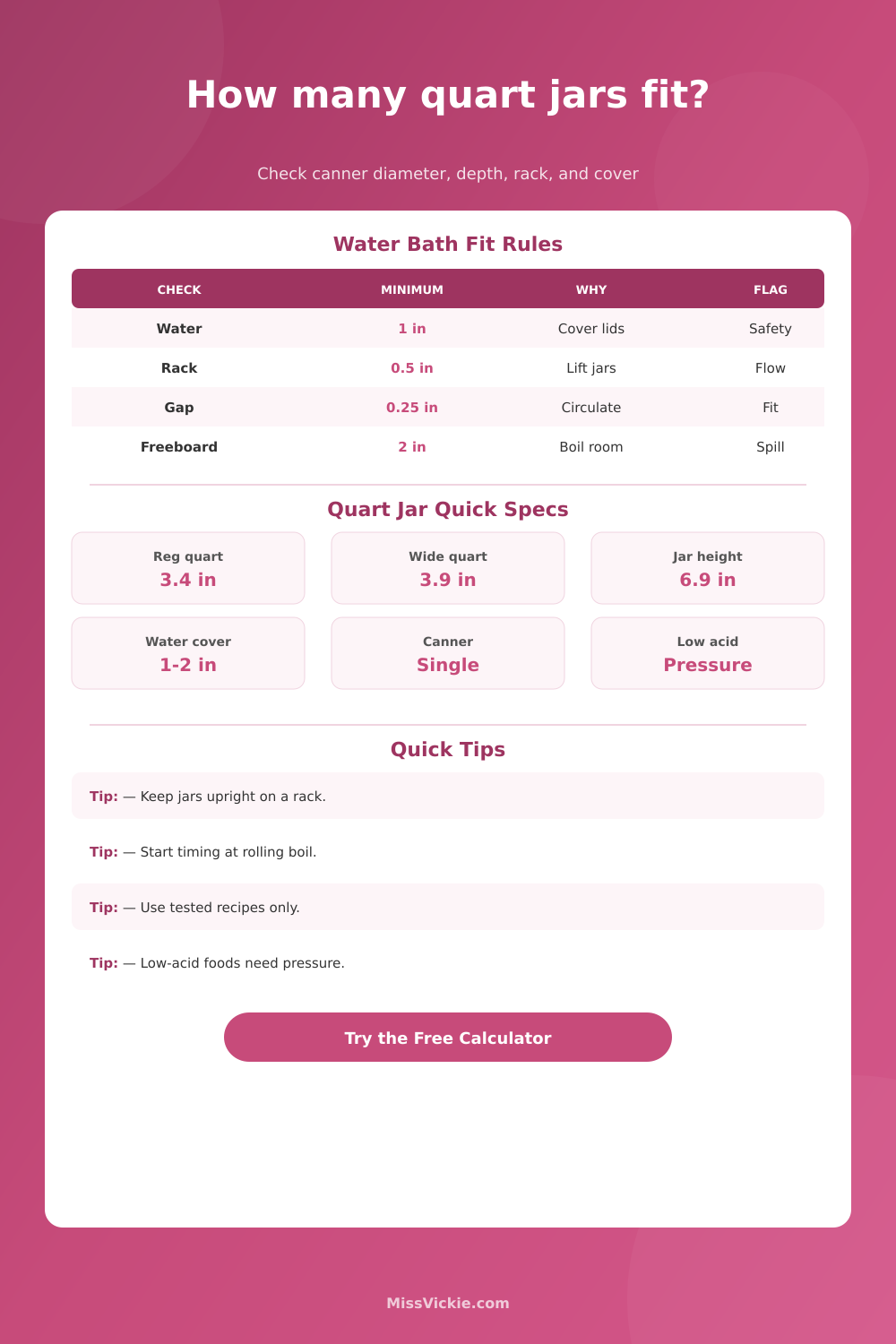
| Jar rack clearance | About 1/2 inch or more | Added under jar height | Jars should not sit directly on the pot bottom. |
| Water above jar lids | At least 1 inch | Added over jar height | Use 1 to 2 inches for active boiling and long processes. |
| Boil-over freeboard | About 2 inches | Kept above water line | Wide pots still need vertical room for a rolling boil. |
| Jar spacing | 1/4 inch planning gap | Added to jar footprint | Water should circulate around every jar. |
| Layer count | One quart layer | Capacity is single-layer | Do not stack quarts unless using a rack and tested canner instructions. |
| Jar Type | Typical Outside Diameter | Typical Filled Height | Capacity Effect |
|---|---|---|---|
| Regular-mouth quart | About 3.38 inches | About 6.9 inches | Usually the best fit in classic round canners. |
| Wide-mouth quart | About 3.9 inches | About 6.65 inches | Shorter but wider; diameter may reduce jar count. |
| Shoulderless quart-style jar | About 3.55 inches | About 7 inches | Measure the actual jar before relying on a count. |
| Custom quart jar | User entered | User entered | Use the widest point, including decorative shoulders. |
| Altitude Range | Typical Water-Bath Time Add | Fit Impact | Reminder |
|---|---|---|---|
| 0 to 1,000 ft | Add 0 minutes | Normal water cover | Use the tested recipe time for the jar size. |
| 1,001 to 3,000 ft | Add 5 minutes | More boil-off | Start with enough water to stay over lids. |
| 3,001 to 6,000 ft | Add 10 minutes | More boil-off | Keep extra boiling water ready if needed. |
| 6,001 to 8,000 ft | Add 15 minutes | Longer rolling boil | Confirm the burner maintains a vigorous boil. |
| 8,001 to 10,000 ft | Add 20 minutes | Longest boil-off | Use local Extension guidance above 10,000 ft. |
| Food Category | Water-Bath Status | What to Check | Calculator Response |
|---|---|---|---|
| Jam, jelly, fruit spread | Allowed when tested | Jar size, headspace, altitude | Shows capacity and altitude reminder. |
| Fruit, pickles, acidified tomatoes | Allowed when tested | Acid, jar size, pack style, process time | Shows canner fit and water-cover warning. |
| Unknown home recipe | Not suitable for guessing | Use a tested source | Flags method before batch planning. |
| Vegetables, meats, beans, soups | Pressure canner required | Pressure process and jar size | Blocks water-bath safety status. |
This guide explains how to do water bath canning and manage the necessary space to keep it safe in the kitchen. Sometimes what you think will fit (a certain number of jars) doesn’t actualy work with your canner. Will it all fit? Here’s a canner calculator. Enter dimensions of your jars and it tell you for sure whether or not your jar size will fit in your pot so you don’t try to can with one that won’t keep them safely submerged.
What’s Printed on Your Pot Can Be Wrong: It’s usually measured from the top and sometimes the width of handles. For example, a label may indicate 15 quarts, which doesn’t count the volume of air above the water. You need true depth plus usable interior diameter. How deep? How wide (where the rack would be)? That will tell you how many jars fits in there. Sometimes a big-looking pot lack enough vertical clearance to be safe. Typically, depth limits what you can do.
How to Fit Jars in Your Canner Safely
How deep are the jars? Typically a quart size jar is approximately 7″ high. Add 1/2″ for the rack that holds the jars from direct contact with the heat. Then account for one or maybe one and a half inches of water over the lid. More than a foot vertical clearance. If your pot is just ten inches deep, there’s nowhere to spare.
That’s what the calculator checks, how much vertical space does it have to work with based off what you enter. Does it say yes, the water will cover the lids? Lids must not be exposed. Uneven cooking and spoiled food are the result.
It’s also critical that you don’t crowd your jars, since proper circulation prevents spoilage and makes product shelf-stable. Make sure the water boils evenly so it can move freely around all the jar. Don’t touch them; this creates cold spots. That tiny distance adds up if you have too many jars in your pot, so don’t of it!
Water Boils at Different Temperatures Depending on Altitude At higher elevation, water boils at a different temperature than normal. For example, at 5,000 feet, water reaches boiling point (roughly) at 205 degrees Fahrenheit. And if you’re curious…at sea level, water boils at 212 degrees Fahrenheit.
Why is this important? Because it impacts food safety. If you’re cooking at a higher altitude, you must cook your food longer. The food safety calculator alerts you when you should adjust your time. For instance, maybe at sea level something takes ten minutes to cook. In the mountains, it might take twenty.
You must use a pressure canner for low-acid foods. High temperatures destroys the spores of the deadly bacterium that causes botulism. These include beans, meats, and vegetables. To safely process, you must reach very high temps, and a water bath isn’t hot enough. The calculator will flag such food so that no one accidently tries to boil them. They’re safe to make into things like jams, jellies, pickles or other foods with acid.
What’s the Size of Your Pot? To understand what will fit, it’s best to measure your pot first. How deep is it? How wide is it at its smallest point? Measure from the bottom of the rack up to the maximum safe fill mark. Enter that information in this tool. It’ll tell you how many jars to expect and how much water to use.
If you plan ahead, you can prevent overflowing by knowing where your limits are before you start. Good planning lead to a successful canning season.