Personal Pizza Dough Calculator
Plan individual pizza dough balls by adult portions, kid portions, diameter, style, hydration, baker percentages, and small-batch ingredient weights.
🍕 Personal Pizza Presets
Pick a pizza-night scenario, then adjust adult pizzas, kid pizzas, diameter, crust style, appetite, dough ball target, hydration, salt, yeast, and batch buffer.
⚖ Individual Pizza Details
Personal pizza dough plan
Your dough plan will appear here.
Portion Breakdown
Baker Percentage Ingredients
🧮 Current Small-Batch Ingredient Cards
📋 Personal Pizza Dough Ball Table
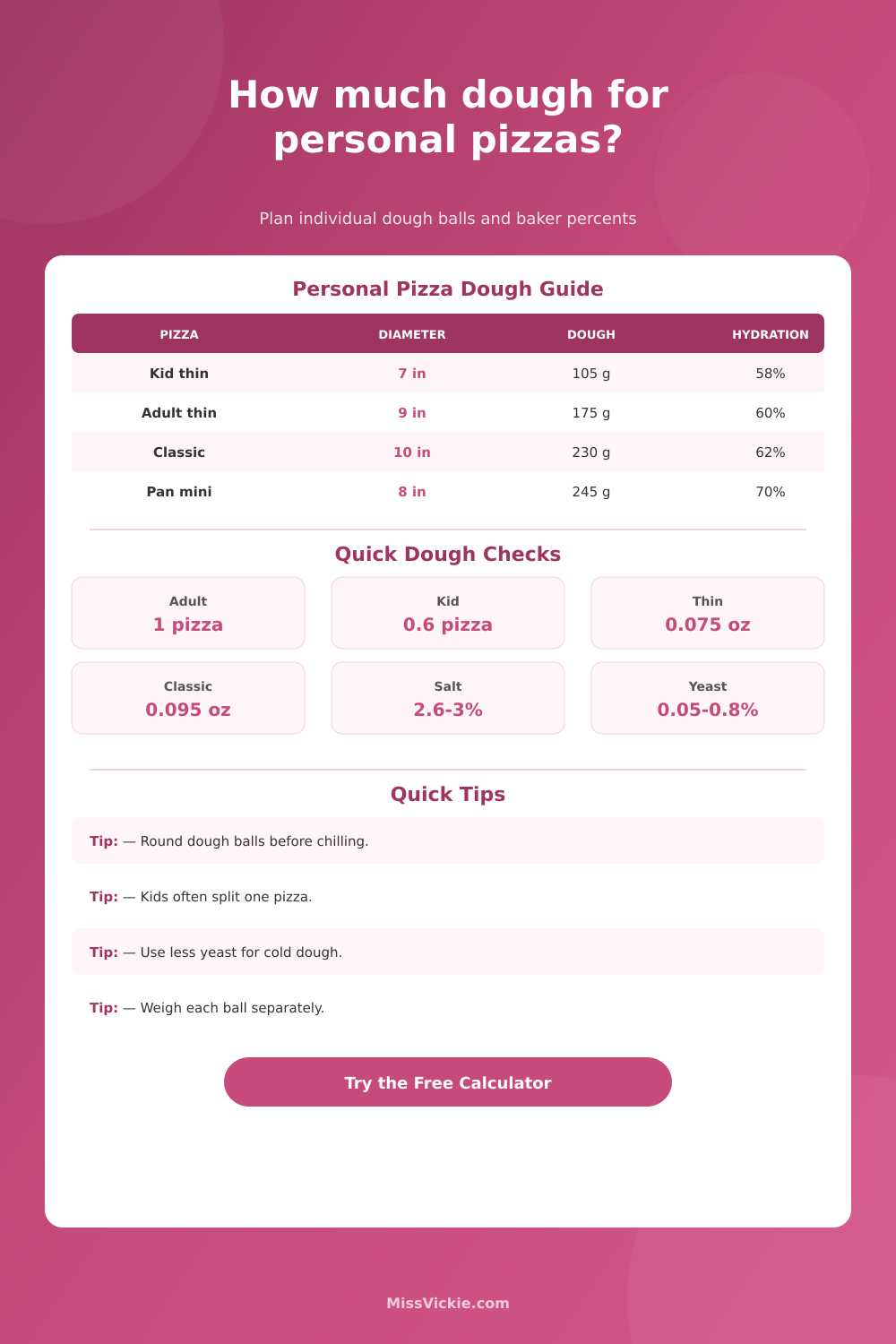
| Personal Pizza Type | Diameter | Typical Dough Ball | Best Hydration | Portion Note |
|---|---|---|---|---|
| Small kid thin crust | 6 to 7 in | 85 to 120 g | 56% to 60% | Good for younger kids or snack pizzas. |
| Standard kid pizza | 7 to 8 in | 115 to 155 g | 58% to 62% | Plan one for two very small kids or one older kid. |
| Classic adult personal | 9 to 10 in | 175 to 245 g | 60% to 65% | The everyday individual pizza-night size. |
| Hungry adult personal | 10 to 11 in | 230 to 315 g | 62% to 66% | Useful for hearty toppings or bigger appetites. |
| Mini pan pizza | 7 to 9 in | 190 to 310 g | 68% to 74% | Needs more dough because the pan crust is thicker. |
| Batch Size | 60% Hydration | 65% Hydration | 70% Hydration | Good For |
|---|---|---|---|---|
| 400 g dough | 247 g flour, 148 g water | 238 g flour, 155 g water | 229 g flour, 160 g water | Two small personal pizzas. |
| 800 g dough | 494 g flour, 296 g water | 475 g flour, 309 g water | 457 g flour, 320 g water | Four kid or three adult pizzas. |
| 1200 g dough | 741 g flour, 444 g water | 713 g flour, 463 g water | 686 g flour, 480 g water | Family pizza night with a spare ball. |
| 1800 g dough | 1111 g flour, 667 g water | 1069 g flour, 695 g water | 1029 g flour, 720 g water | Small party or freeze-ahead dough. |
📊 Style And Hydration Reference
Lower hydration is easy to roll thin and bake crisp.
Balanced handling for 8 to 10 inch home-oven pizzas.
More water keeps thicker individual pan crusts tender.
Use tiny yeast percentages for 48 to 72 hour dough.
💡 Personal Pizza Dough Notes
Ingredient weights are practical baker-percentage estimates. Flour absorption, oven heat, pan depth, dough temperature, and topping load can change the best dough ball size.
Treating dough as A precise formula (instead of just a vague suggestion) lets you make pizza at home better then ever. The dough will no longer stick to counter or stretch out in odd directions.
Simply use calculator on the page, which does all math for you: Input your style preference(s) and number of guests, then it’s a go. You will no longer has to guess at conversions and coefficients.
How to Make Perfect Pizza Dough
The secret to managing consistency of your crust is hydration. Simply put, hydration are the ratio of water to flour measured as a percentage. For a traditional personal pizza, this will be approximately sixty-two percent. It’s high enough to give it strength to support toppings but low enough not to get sticky and fight against you when trying to stretch it out.
To achieve a realy crispy, thin crust, decrease the hydration to say fifty-eight percent. Lower hydration doughs tends to be firm and more easily rolled out.
On the other hand, if you’re making mini pan pizzas, you’ll want to increase the hydration to at least seventy percent. Since the crust is going to be on thick side, the excess water will keep it tender and less dense. And that makes all difference because while a flat crust may work with a particular dough ball, it won’t work at all in deep pan.
The other tricky one is percent of yeast. More isn’t always better. In fact, it almost never is when trying to achieve good dough.
On day doughs, you’ll want some yeast to get a fast rise. If it is cold fermented overnight, you don’t want much at all. Based off your fermentation plans, the tool will adjust that automatically. If you’re chilling it in the fridge for a long time, it will recommend super low percentages. This prevents the dough from over-proofing and getting too alcoholic in taste, which would ruin it.
You’re sacrificing flavor for time. Letting the dough sit lets enzymes work on breaking down the starches into sugars, which gives you better taste with more depth and also a nice color for the crust.
Home cooks tend to overestimate their appetites and, in turn, overestimate their meal portions. A nine-to-ten-inch personal pizza is typically plenty for an adult, while a kid’s appetite rarely matches that. To account for this, the calculator allow you to modify amount of food per kid. Typically it assumes that two kids equals one adult pizza.
And there’s no need to fret about shaping losses; a little bit of this extra goes a long way. Whenever you divide a batch of dough, some always stick to the bowl or the counter. Five to ten percent is all you need to add so that you’ll have enough material to create all of them with equal ease. No need to fear falling short.
To get an idea of how much dough you want to use for various styles, check out this chart from site. For example, if I’m making a hungry adult’s classic personal pizza, that’ll run about two hundred and thirty grams. A thin crust might only go up to a hundred or so for small kid’s size.
Consistent results are non-negotiable, which means weighing your dough balls individually. Slight variations in weight lead to uneven baking times, and since visual estimation is notoriously inaccurate, you might end up with one ball that’s burnt and another that’s undercooked. Take five seconds and use a simple kitchen scale, you’ll guarantee all pizzas bake uniformly.
The last tuning knobs are salt and oil. Salt enhances taste. It also strengthens the gluten network, which is typically about three percent of flour weight. Oil increases tenderness and aids browning, especially because home ovens do not gets as hot as commercial ones. Some sugar goes a long way toward deepening color of your bread’s golden crust as you’ve seen in pictures. By weight these are minor components, but their impact is major.
That’s all fine until you mix the dough, at which point the actual labor starts. If your hydration level is high, make sure to cover balls to avoid drying out. Give it time to rest; that’s when the gluten will relax.
Stretch a rested ball of dough, and it will stretch perfectly into a round. Stretch a tight ball of dough, and it’ll spring right back up in your face, all rubber-band-like. Those little details are key to avoiding a frustrated kitchen evening instead of an awesome pizza night. They are also little details where patience matter.
Plan the math. Treat your ingredients with respect. Let the dough do its thing and wait. Then enjoy.