Cheese for Mac and Cheese Calculator
Calculate pasta weight, cheese blend, sauce thickness, evaporated milk or roux, serving count, finished yield, and melt quality for creamy mac and cheese.
🧀 Mac and Cheese Presets
Pick a real kitchen scenario, then adjust pasta weight, sauce style, cheese blend, thickness, milk base, topping, and serving count.
⚖ Pasta and Sauce Details
Mac and cheese plan
The calculator will size cheese, pasta, liquid, and thickener.
Cheese and Sauce Breakdown
Liquid, Roux, and Serving Math
🍲 Serving and Yield Cards
📋 Cheese Blend Reference
| Blend | Good Ratio | Melt Quality | Flavor | Best Sauce Style |
|---|---|---|---|---|
| Classic cheddar and jack | 70% cheddar, 30% jack | High | Balanced and familiar | Stovetop, baked, or roux |
| Sharp cheddar forward | 85% sharp cheddar, 15% jack | Medium-high | Tangy and bold | Baked or roux sauce |
| Creamy mild blend | Cheddar, fontina, monterey jack | Very high | Mild and creamy | Stovetop or evaporated milk |
| Gooey mozzarella blend | Cheddar, mozzarella, provolone | Medium | Stretchy and mild | Baked or party trays |
| Aged cheddar and gruyere | Aged cheddar, gruyere, jack | Medium | Nutty and strong | Roux or sodium citrate base |
| American-style smooth | Cheddar plus American cheese | Very high | Salty and smooth | Evaporated milk or stovetop |
🥛 Sauce Thickness, Roux, and Liquid Table
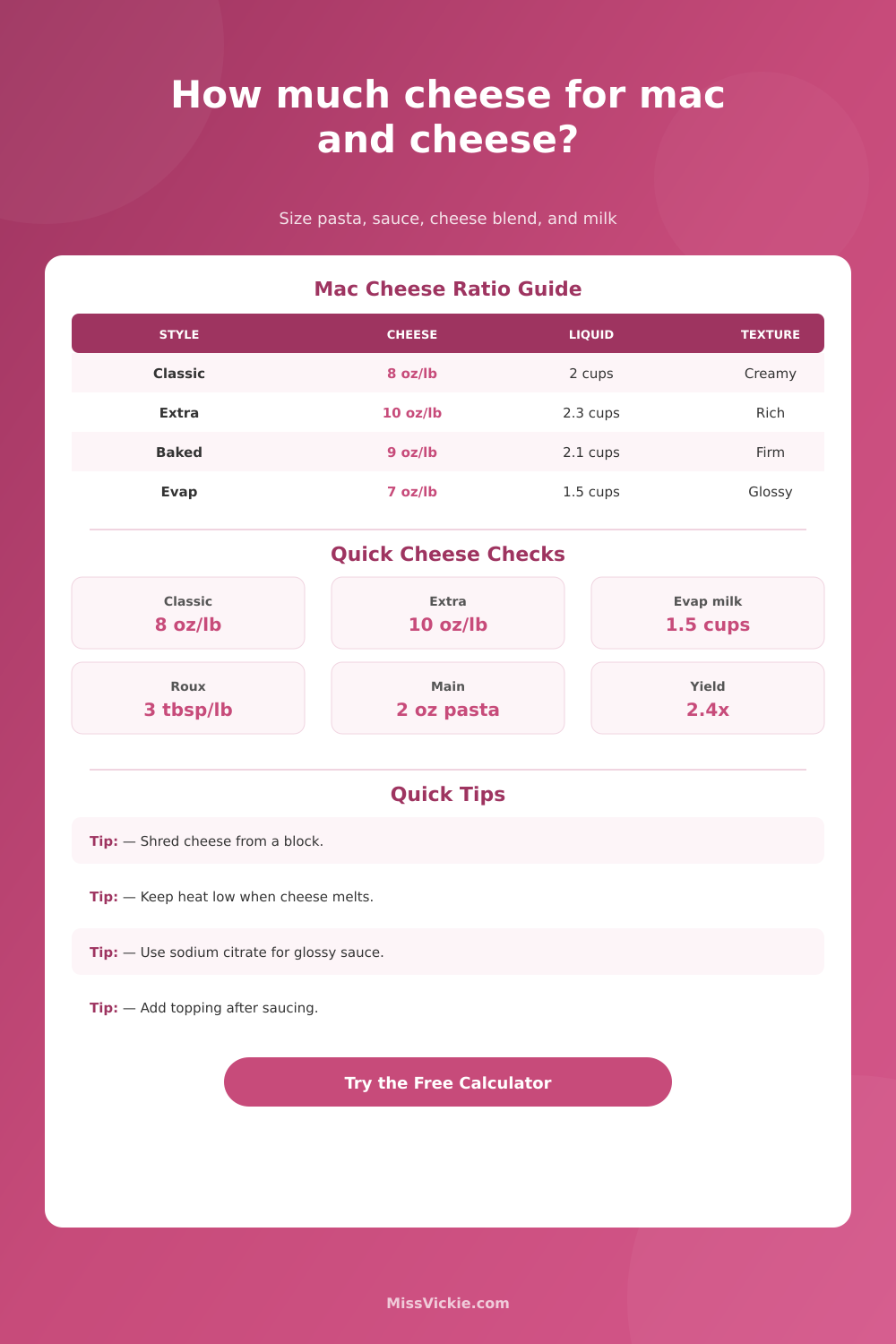
| Dry Pasta | Light Sauce | Classic Sauce | Extra Cheesy | Roux Baseline |
|---|---|---|---|---|
| 8 oz / 225 g | 3.5 oz cheese, 1 cup milk | 4 oz cheese, 1.1 cups milk | 5 oz cheese, 1.2 cups milk | 1.5 tbsp butter + flour |
| 12 oz / 340 g | 5.3 oz cheese, 1.5 cups milk | 6 oz cheese, 1.7 cups milk | 7.5 oz cheese, 1.8 cups milk | 2.25 tbsp butter + flour |
| 16 oz / 454 g | 7 oz cheese, 2 cups milk | 8 oz cheese, 2.2 cups milk | 10 oz cheese, 2.4 cups milk | 3 tbsp butter + flour |
| 32 oz / 907 g | 14 oz cheese, 4 cups milk | 16 oz cheese, 4.4 cups milk | 20 oz cheese, 4.8 cups milk | 6 tbsp butter + flour |
🔬 Melt Quality and Sauce Base Notes
| Base | What It Adds | Cheese Risk | Use When | Calculator Adjustment |
|---|---|---|---|---|
| Butter and flour roux | Body and stability | Low if simmered smooth | Baked pans and classic sauce | Adds equal butter and flour |
| Evaporated milk | Protein and glossy texture | Low with gentle heat | Fast stovetop mac | Less liquid, little flour |
| Sodium citrate | Emulsifying power | Very low | Aged or bold cheeses | Adds 2% of cheese weight |
| Egg custard | Firm sliceable set | Medium if overheated | Southern baked mac | Adds egg and milk binder |
| Pasta water and butter | Starch and shine | Medium-high | Small saucy batches | Uses less milk, more butter |
💪 Cheese Nutrition Estimate
💡 Mac and Cheese Calculation Notes
Cheese moisture, pasta brand, shred size, sauce heat, baked pan depth, and holding time can change thickness. Use the calculator as a planning baseline, then loosen with warm milk if needed.
You are standing in your kitchen with a block of sharp cheddar and a box of elbow macaroni. Will it be enough cheese? Too much cheese? How can it not end up all dried out? It’s something that worries most home-cooks when they thinks about cooking a batch of macaroni and cheese.
Instead of thinking about it as a structural engineering problem, they approach it as an afterthought. The truth is, there are specific ratios of liquid, starch, and fat required to make good macaroni and cheese. There’s even a calculator to take the guesswork out of it.
How to Make Perfect Mac and Cheese
The problem with most recipes is they’re off by just a little bit. And that makes the difference between a creamy sauce and a greasy separation. Usually ingredients aren’t bad. It’s just about the balance.
Once you enter number of servings, it do the math for you (above). And then you choose what kind of sauce you want it to make. No need to convert from ounces to cups! It will help you guess how much the pasta expands during cooking! If it’s a baked casserole, it takes that into account because some of the moisture cook away.
Pots on the stovetop hold onto moisture different than others. A little milk goes a long way to get same consistency. Just pick your situation. Is this a big holiday platter of goodness for 20 people? It could also be a simple weeknight meal for four.
The system know how to adjust the ratio of liquid and cheese based off that information. Because if you’re making a smaller batch, you don’t use as much milk than you do if you were making a larger portion. And that can mean watery results.
You can’t just measure the cheese. You also have to understand it. Sharp cheddar is delicious. But it melt poorly by itself. When melted, sharp cheddar will often become oily and/or grainy.
The calculator recommends pairings that combine the taste of an aged cheese (which has lots of flavor) with another cheese that melts well. Examples include Fontina or Monterey Jack. Why? You still achieve desired taste. You don’t lose the texture, which is what messes up your sauce. It’s a little compromise, but it makes a difference.
The page explains this using a handy-dandy chart of cheese pairings. And it helps explain why something like seventy-percent cheddar to thirty-percent jack might produce best result. Don’t worry; you’re not going to need to be a dairy scientist. Just mix a high-melt cheese with a high-flavor cheese and you’ll get better result.
The architecture of the dish depends on sauce base choices too. For example: A traditional roux will add body and stability. It is flour and butter. It is absolutely necessary when making baked versions that must be set under high heat.
Evaporated milk adds a silkier, glossier texture. Fewer ingredients, less cook time. Choose this option and the calculator factor in the proper amount of liquid so as not to find yourself with something like soup if you use evaporated milk (or something closer to paste if sticking with the thicker roux).
The calculator takes into account the loss of shredding. To avoid ending up short, purchase slightly more block cheese than the recipe calls for. Some cheese always stick to the bowl or grater.
The amount of sauce left on your pasta depends on its shape too, surprisingly. Hollow-center pastas (think: rigatoni) can carry more sauce within them. Smaller elbows (like elbow macaroni) has less surface area, which means you’ll use more sauce to get the same “coated” feel. When determining how much food you’ll end up with at the table, the tool takes into account those variations in surface area. This allows you to adjust to match if you’re looking to feed more than expected or save some for later.
That’s the gap between a good meal and an under-seasoned, dry meal, something casual chefs tend to ignore. Last, but certainly not least: don’t forget that your bigger party means you should of added a buffer for servings. When you’re feeding a group, some sauce inevitably goes to the bottom of the pan. Some goes down the sides of the serving spoon and some goes down the throats of those taking second helpings. A ten or fifteen percent buffer accounts for all this and assures that each person has enough to eat.
Fear of the empty cheese block dissapears. Enjoy the meal. Know that you won’t run out. There’s no need to fret over the math anymore.