Paste dilution, sauce and puree replacement, reduction, cans, tubes, acidity, and sugar planner
Tomato Paste Ratio Calculator
Calculate tomato paste and water ratios for sauce, puree, soup, stew, chili, pizza sauce, and braises while sizing cans or tubes and balancing reduction, acidity, and sugar.
📌Tomato Paste Ratio Presets
Start with a common kitchen swap, then adjust recipe type, target tomato base, paste on hand, water dilution, reduction intensity, can or tube size, acidity, and sugar.
⚖Paste, Water, Sauce Type, And Replacement Inputs
Tomato paste dilution plan
Your tomato paste ratio will appear here.
Ratio Breakdown
Can, Tube, And Flavor Notes
Cooking Guidance
🍅Paste Dilution Reference
Spreadable sauce when the paste is cooked with oil, salt, herbs, and a small splash of water.
Thick tomato puree replacement for casseroles, quick sauces, and tomato-forward pan sauces.
Balanced tomato sauce substitute when paste needs enough water to loosen but still taste concentrated.
Thin tomato liquid for soups, stews, chili, and braises where other ingredients add body.
📊Sauce, Puree, Soup, And Stew Tables
Replacement Ratios
| Replacement Target | Paste Ratio | Water Ratio | Best For |
|---|---|---|---|
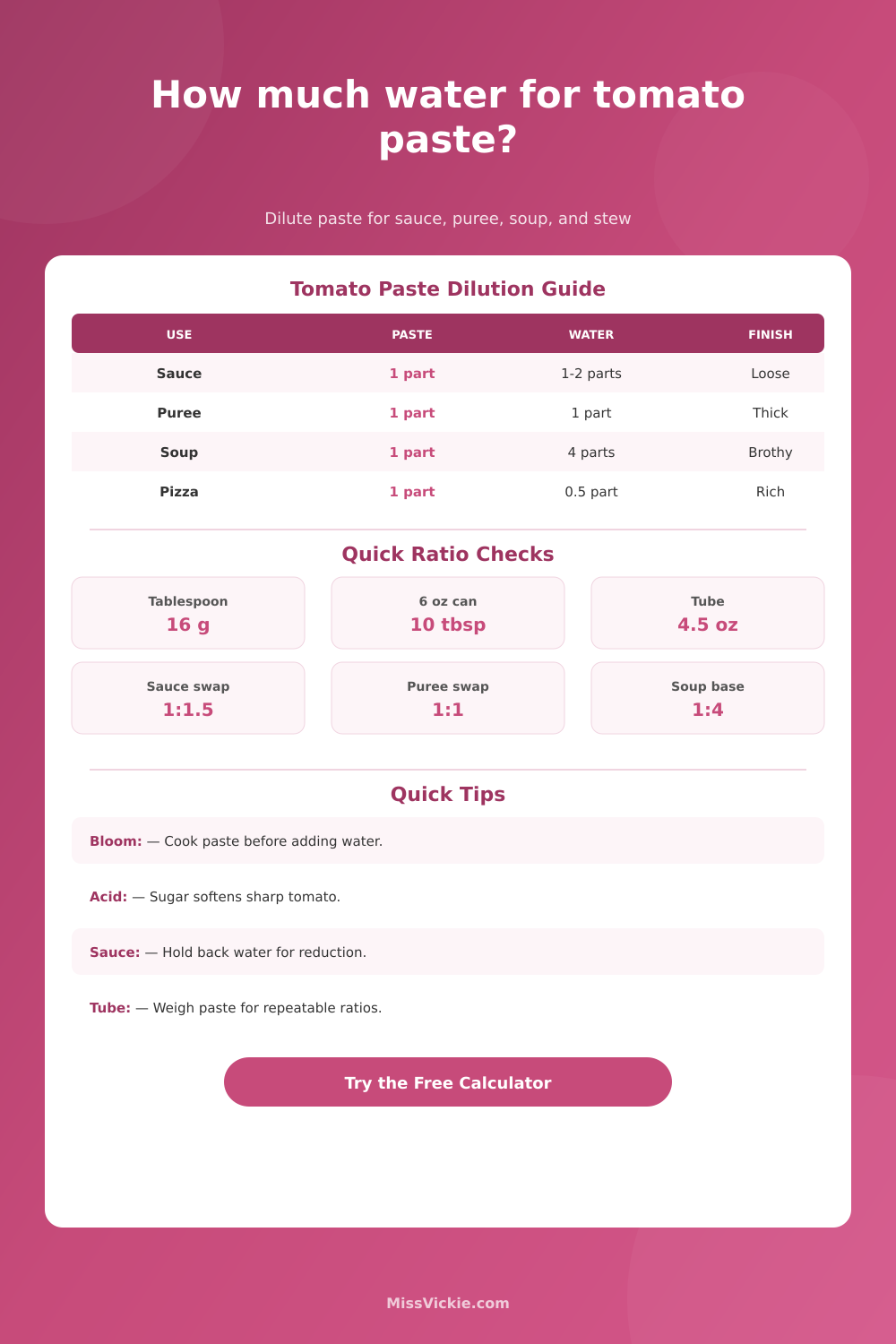
| Tomato puree | 1 part paste | 1 part water | Baked pasta, thick sauces, casseroles, quick braises |
| Tomato sauce | 1 part paste | 1 1/2 parts water | Pasta sauce, skillet sauce, meatball sauce, enchilada sauce |
| Passata style | 1 part paste | 1 1/4 parts water | Smooth sauces where texture should stay fine |
| Crushed tomato style | 1 part paste | 2 to 3 parts water | Chili, rustic sauce, stew base, slow cooker dishes |
| Pizza sauce | 1 part paste | 1/2 part water | Thick spreadable sauce that will cook again on dough |
| Soup base | 1 part paste | 4 parts water | Tomato soup, vegetable soup, beans, braises, curry |
Can And Tube Yield
| Container | Approx Paste | At 1:1 | At 1:1.5 |
|---|---|---|---|
| 3 oz mini can | 5 tablespoons | 10 tablespoons puree | 12 1/2 tablespoons sauce |
| 4.5 oz tube | 7 1/2 tablespoons | 15 tablespoons puree | 18 3/4 tablespoons sauce |
| 6 oz can | 10 tablespoons | 1 1/4 cups puree | 1 1/2 cups plus 1 tablespoon sauce |
| 12 oz can | 20 tablespoons | 2 1/2 cups puree | 3 cups plus 2 tablespoons sauce |
| 1 tablespoon paste | 16 grams | 2 tablespoons puree | 2 1/2 tablespoons sauce |
| 1 teaspoon paste | 5.3 grams | 2 teaspoons puree | 2 1/2 teaspoons sauce |
Tomato paste density varies by brand and how firmly it is spooned. The default of 16 grams per tablespoon is a practical kitchen average.
🔬Reduction, Acidity, And Sugar Reference
| Cooking Situation | Water Move | Sugar Cue | Flavor Cue | Practical Note |
|---|---|---|---|---|
| Quick pasta sauce | Use most water | 1/4 tsp per cup | Bright and saucy | Bloom paste in oil for one to two minutes before diluting. |
| Long simmer sauce | Hold back 10 to 20 percent | Taste after simmer | Deep and round | Add reserved water only if the sauce thickens too quickly. |
| Pizza sauce | Hold back 40 to 50 percent | Little or none | Thick and savory | A thick sauce protects dough from sogginess. |
| Tomato soup | Use full water or stock | 1/2 tsp per cup | Gentle acidity | Dairy, broth, or vegetables can soften the paste flavor. |
| Chili or stew | Hold back 20 to 35 percent | Optional pinch | Background tomato | Beans, meat, onions, and spices add body as the pot cooks. |
| Wine or vinegar base | Use staged water | Small increase | Sharp until cooked | Cook acid down before judging sweetness. |
🍲Common Tomato Paste Conversions
| Finished Amount Needed | Puree Style 1:1 | Sauce Style 1:1.5 | Soup Style 1:4 | Use Case |
|---|---|---|---|---|
| 1/2 cup tomato base | 4 tbsp paste + 4 tbsp water | 3 1/4 tbsp paste + 4 3/4 tbsp water | 1 1/2 tbsp paste + 6 1/2 tbsp water | Small skillet sauce |
| 1 cup tomato base | 1/2 cup paste + 1/2 cup water | 6 1/2 tbsp paste + 9 1/2 tbsp water | 3 tbsp paste + 13 tbsp water | Recipe swap |
| 2 cups tomato base | 1 cup paste + 1 cup water | 13 tbsp paste + 19 tbsp water | 6 1/2 tbsp paste + 25 1/2 tbsp water | Family sauce |
| 4 cups tomato base | 2 cups paste + 2 cups water | 1 3/5 cups paste + 2 2/5 cups water | 13 tbsp paste + 3 1/5 cups water | Soup or chili pot |
| 6 oz can paste | About 1 1/4 cups puree | About 1 9/16 cups sauce | About 3 1/8 cups soup base | Whole can planning |
💡Tomato Paste Ratio Notes
The other trick was tomato paste: it is a concentrated mix of acid, sweetness, and salt. It’s the kind of ingredient most home cook use as a way to add color to their stew; no good. Water is what activates the paste but too much water will dilute its desired depth. That balance are the secret to giving your sauce real structure and keeping it out of processed-ketchupy-land.
All the calculator do is figure out the number for you, input your desired thickness and your target volume, and it crunches the numbers. You won’t have to wonder if that is a cup or half a cup of sauce. How many tablespoon of water? But it works like this: It’s just some ratio math.
How to Use Tomato Paste
So if you’re making something to replace pureed food, then you combine paste with water in equal parts. If you want something slightly thinner than the puree (like a loose pasta sauce), go one to one and a half. With soup bases, you could even go up to one to four. Why those numbers? Because they correspond to the water that gets sucked out during industrial canning. Diluting a paste reverse that evaporation step and lets you reach the right thickness.
Now here’s the tricky part: When do you add the water? If you’re making something that requires a long simmer, and you toss it all at once, you’ll end up with a watery, thin mush long before those onions gets tender. By default, the tool assumes that you want some of the liquid to evaporate. You can set an estimate of how intense the reduction will be. And then it recommends holding some water back until the final volume is where you want it.
Everyone seems to overlook this. They dilute themselves to the finish line before ever taking their first step.
The other variable is acidity. Fresh tomatoes are milder than tomato paste, which is sharper. Sharp can cut across fats, such as oil or a rich meat. But it can overpower subtle flavors of herbs. Depending on your chosen acidity profile, the calculator will adjust the amount of sugar recommended for balance. A tomato soup that’s heavy on dairy require just a bit more to soften the edges. A tomato sauce with lots of wine already in it requires less because the wine helps balance the flavors. Sugar doesn’t make the sauce taste like dessert. It brings the natural sweetness of the tomato into harmony with what was added to the pan: acid and fat.
Don’t skip on the paste. You’ve got to bloom it. You want your finished product to have good flavor, right? Then cook the concentrated tomato in fat for a minute or two, before adding water. The tomato’s glutamates (that’s what gives it umami) are released as the heat breaks down some of its raw, metallic notes. When you just dump paste in cold water, you end up with a separate, muddy texture that never really integrates. The difference when you cook it in fat is that the chemistry change, and the finished sauce is richer and smoother.
And then there’s storage. If you’ve got a can of sauce and open it up, how much do you actualy use? You don’t usually use all six ounces of it. What’s left solidifies to form a brick that won’t easily be scooped away. Get at what you want right away, pressing plastic wrap down on the exposed paste first, then closing the lid. You’ll have weeks of no-mold, no-drying-out freshness in your fridge.
Other cooks freeze leftover paste in tablespoon portions, so they can simply defrost what they need to dilute. This is a little trick that saves time later on.
The weight of the paste itself aids in accuracy. For example, a tablespoon of paste weighs about sixteen grams (a standard measure). When you’re doubling a recipe to serve a crowd, it’s infinitely better to weigh your ingredients than to guess-scoop them and end up wildly over- or under-saucing something. And the tables on this page help to tell you what volume to expect based off a typical can or tube, at various ratios. It turns the vague ingredient into a specific amount, like a variable.
The point of all this, in the end, is that tomato paste doesn’t only replace fresh tomatoes; it’s also a way to give them more. It provides a concentrated backbone that they don’t have on their own. That’s what you want with a slow-cooked braise or a quick weeknight sauce: The tomato flavor to be there, but not dominate the dish. It should be integrated, not just added on.
So begin with the matching ratio to achieve the desired texture. Then adjust for simmer time. Bloom the paste over fat. Taste; add sugar or salt accordingly. It is a little thing. But it makes all the difference.
This is a sauce you feel was done intentionally; one that lets the tomato enhance the dish without completely defining it. That’s what being a good cook means. Following the steps isn’t enough. You must understand why the paste should be cooked first and why it should of so much water.