Water volume, salt density, pasta weight, sauce salinity, and dietary adjustment planner
Pasta Salt Per Liter Calculator
Calculate pasta water salt by liter or quart, choose table salt, sea salt, or kosher salt density, then adjust for pasta amount, sauce saltiness, and lower-sodium preferences.
📌Pasta Salt Presets
Start with a common pasta night, then fine-tune water, pasta weight, salt type, salinity target, sauce saltiness, dietary level, and measurement rounding.
⚖Water, Salt, Pasta, And Sauce Inputs
Pasta water salt estimate
Your result will appear here.
Salt And Water Breakdown
Pasta, Sauce, And Sodium Notes
Cooking Guidance
🧂Salt Density Quick Cards
Fine crystals pack densely, so spoon measures are smaller.
Often close to table salt, but varies by brand and moisture.
Large flakes need nearly twice the tablespoon volume.
Denser kosher crystals measure closer to fine sea salt.
📊Pasta Water Salinity Tables
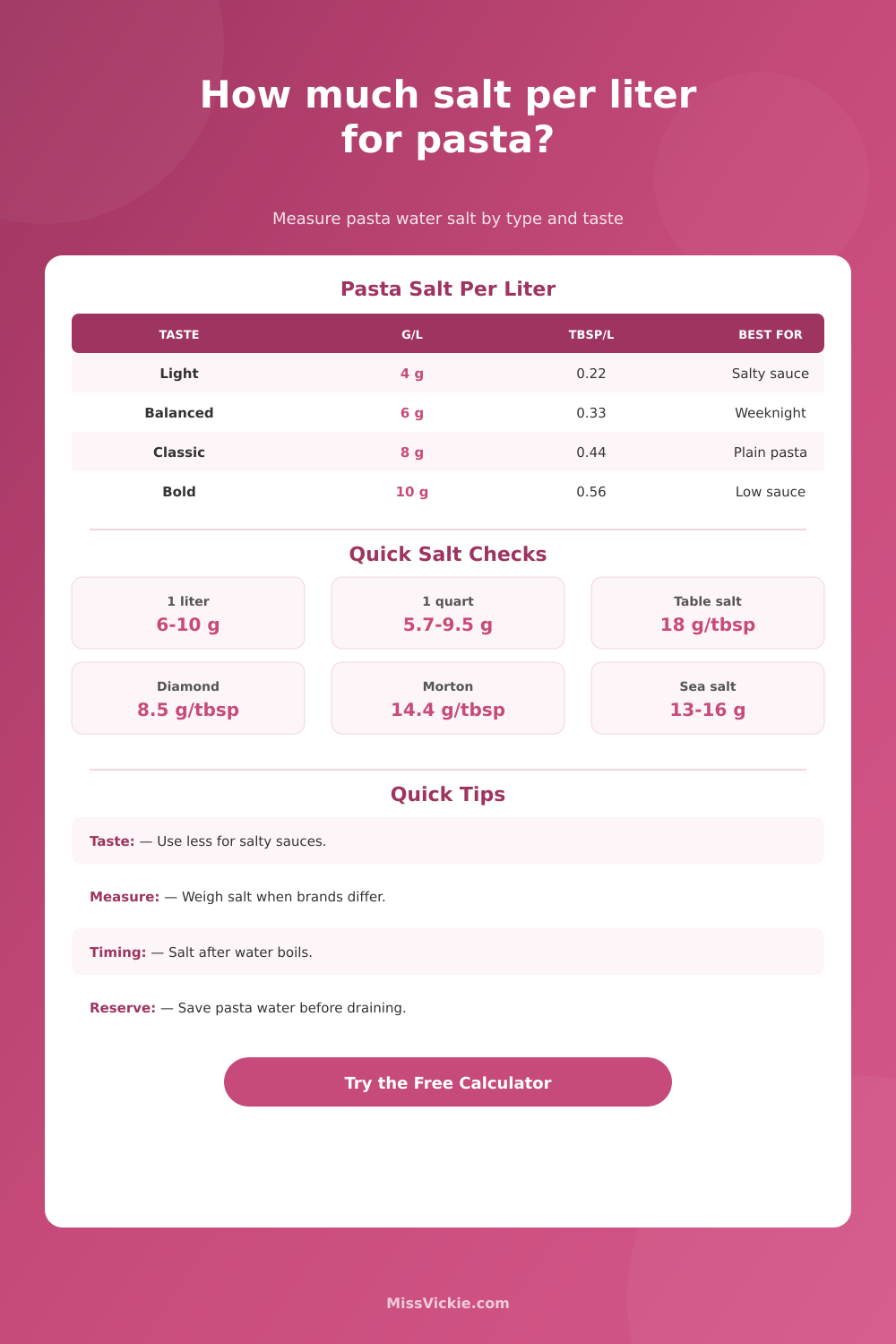
| Target | Salt Per Liter | Salt Per Quart | Water Salinity | Best Kitchen Use |
|---|---|---|---|---|
| Very light | 3 to 4 g/L | 2.8 to 3.8 g/qt | 0.3% to 0.4% | For salty sauces, kids, or medically reduced sodium cooking. |
| Balanced | 5 to 6 g/L | 4.7 to 5.7 g/qt | 0.5% to 0.6% | Good everyday target for jarred sauce, pesto, cheese, or cured meats. |
| Classic | 7 to 8 g/L | 6.6 to 7.6 g/qt | 0.7% to 0.8% | Useful for plain tomato sauce, butter sauces, or oil-based pasta. |
| Bold | 9 to 10 g/L | 8.5 to 9.5 g/qt | 0.9% to 1.0% | For very plain pasta where the noodle itself needs to taste seasoned. |
| Restaurant-style | 11 to 12 g/L | 10.4 to 11.4 g/qt | 1.1% to 1.2% | Use cautiously when sauce, cheese, or reserved water will concentrate. |
| Salt Type | Approx g Per Tbsp | Approx g Per Tsp | Tablespoons For 24 g | Measurement Note |
|---|---|---|---|---|
| Fine table salt | 18 g | 6 g | 1.33 tbsp | Dense and consistent; easy to oversalt by volume. |
| Canning or pickling salt | 18.5 g | 6.2 g | 1.30 tbsp | Fine, additive-free crystals that pack tightly in a spoon. |
| Fine sea salt | 15 g | 5 g | 1.60 tbsp | Varies by grind, but usually denser than flaky kosher salt. |
| Coarse sea salt | 13 g | 4.3 g | 1.85 tbsp | Large crystals leave air gaps, so volume measures increase. |
| Morton kosher salt | 14.4 g | 4.8 g | 1.67 tbsp | Compact kosher crystals are much denser than Diamond Crystal. |
| Diamond Crystal kosher salt | 8.5 g | 2.8 g | 2.82 tbsp | Light flakes require the largest spoon volume for the same grams. |
| Flaky finishing salt | 6 g | 2 g | 4.00 tbsp | Better for finishing than salting a pot because it measures loosely. |
| Dry Pasta Amount | Minimum Water | Comfortable Water | Salt At 6 g/L | Salt At 8 g/L |
|---|---|---|---|---|
| 100 g or 3.5 oz | 1 liter, 1.1 qt | 1.5 liters, 1.6 qt | 9 g for 1.5 L | 12 g for 1.5 L |
| 225 g or 8 oz | 2 liters, 2.1 qt | 2.5 liters, 2.6 qt | 15 g for 2.5 L | 20 g for 2.5 L |
| 450 g or 1 lb | 3 liters, 3.2 qt | 4 liters, 4.2 qt | 24 g for 4 L | 32 g for 4 L |
| 900 g or 2 lb | 6 liters, 6.3 qt | 8 liters, 8.5 qt | 48 g for 8 L | 64 g for 8 L |
| 2.25 kg or 5 lb | 15 liters, 15.9 qt | 20 liters, 21.1 qt | 120 g for 20 L | 160 g for 20 L |
💡Pasta Salt Measuring Tips
This calculator estimates water salinity and seasoning direction. It is not medical advice; follow clinician guidance for sodium-restricted diets.
Have you ever heard people say, “the water for your pasta should be as salty as the sea?” While it’s an accurate statement, it’s not very practical. How do you use a teaspoon to measure how salty ocean is?
To begin with, even within the same brand and type of salt, there will be some variation in saltiness (salt doesn’t have a standard density). For example, 1 tbsp of Table Salt has almost double weight than 1 tbsp of Kosher Flakes. If you get this wrong, you’ll either end up with mouthful of bland or overly-salty pasta.
How to Salt Your Pasta
Why guess at conversions when the calculator above can do the math for you? All you have to do is input volume of water you’re cooking and the kind of salt you prefer. Volume measures is convenient (just scoop it with a spoon), and that is how most people cook at home. It’s fine as long as you’re cooking in the same pot with the same salt all the time. But what happens when you get some special fancy sea salt in the mail? Or you might switch brands of salt. Suddenly everything is hit-or-miss seasoning.
Weight makes this variable go away. Air gaps and crystal size don’t matter when using grams. If something weighs 6g it will weigh 6g. The tool translates that target number of grams into equivalent spoon amount for the salt you have. That closes gap between precision and how we work in kitchens.
Don’t underestimate the importance of having sufficient water when cooking pasta. Too small a pot means too much starch, which result in the pasta sticking. There’s simply not enough water to keep it from doing so. Have enough water that the pasta can move around freely while being kept at a boil. When you add more water, use more salt to compensate for the increased volume and ensure the same degree of flavor. A set quantity of salt per pound of pasta isn’t going to cut it here; you want to increase salt proportionally to the water.
The seasoning will stay balanced like this: The type of sauce you’re serving also matters here. Some sauces, like a sharp cheese sauce or a heavy pre-salted tomato sauce, won’t require overly salty pasta. The two will balance each other in the end. A simple sauce like olive oil and garlic will demand more flavor from noodle alone.
You can make those adjustments too (along with any dietary preferences) through the calculator, it adjusts the target depending on the rest of your plate. Cooking has so many moving parts.
One other thing: think about set-aside pasta cooking water. This starchy water comes in handy when making sauce. Boiling water is salted. Add a cup of this later and you’ve added too much salt to your dish. The smart cook estimates their set aside amount. Then they account for it up front. In terms of seasoning. It is a little thing, sure, but it makes flavor.
There are no hard and fast rules; there are variables that change the seasoning of pasta. What can you taste while the water boils? You cannot safely taste the water while its boiling.
As the pasta cooks, how much salt do you lose to the cooking water? Start by using the math. Calculate amount of salt you want in relation to the water’s volume and type of salt you’re using. When the pasta is al dente, take a bite. Is it seasoned correcty? Add more or less to match, but lean on the math as a guide to get you there, which turns a guess into a reasonable launching pad.
Then you must cook what you have. But now you begin with confidence… Not fear. The sea is salty, but that doesn’t mean your pot has to be an ocean. It just needs to be the right one for the noodle.