Jar quarts, brine percent, vinegar ratio, salt density, and ferment scaling
Pickling Salt Per Quart Calculator
Calculate pickling salt by jar volume, vegetable pack, vinegar-to-water ratio, salt grain density, and vinegar or fermented pickle method, with batch scaling and safety reference checks.
📌Pickle Batch Presets
Start with a common jar setup, then adjust the jar count, fill level, brine percent, vegetable type, vinegar strength, and salt density.
⚖Jar, Brine, Salt, And Safety Inputs
Pickling salt estimate
Adjust jar size, method, and salt type to update the batch.
Batch Math
Method And Safety Checks
Brine Guidance
🧂Salt Density Reference
Fine, additive-free salt dissolves quickly and measures densely by volume.
Large flakes are much lighter, so spoon swaps need weight conversion.
Denser than Diamond but still lighter than fine pickling salt.
A practical kitchen estimate for level teaspoons of fine pickling salt.
📘Safe Pickling Reference Tables
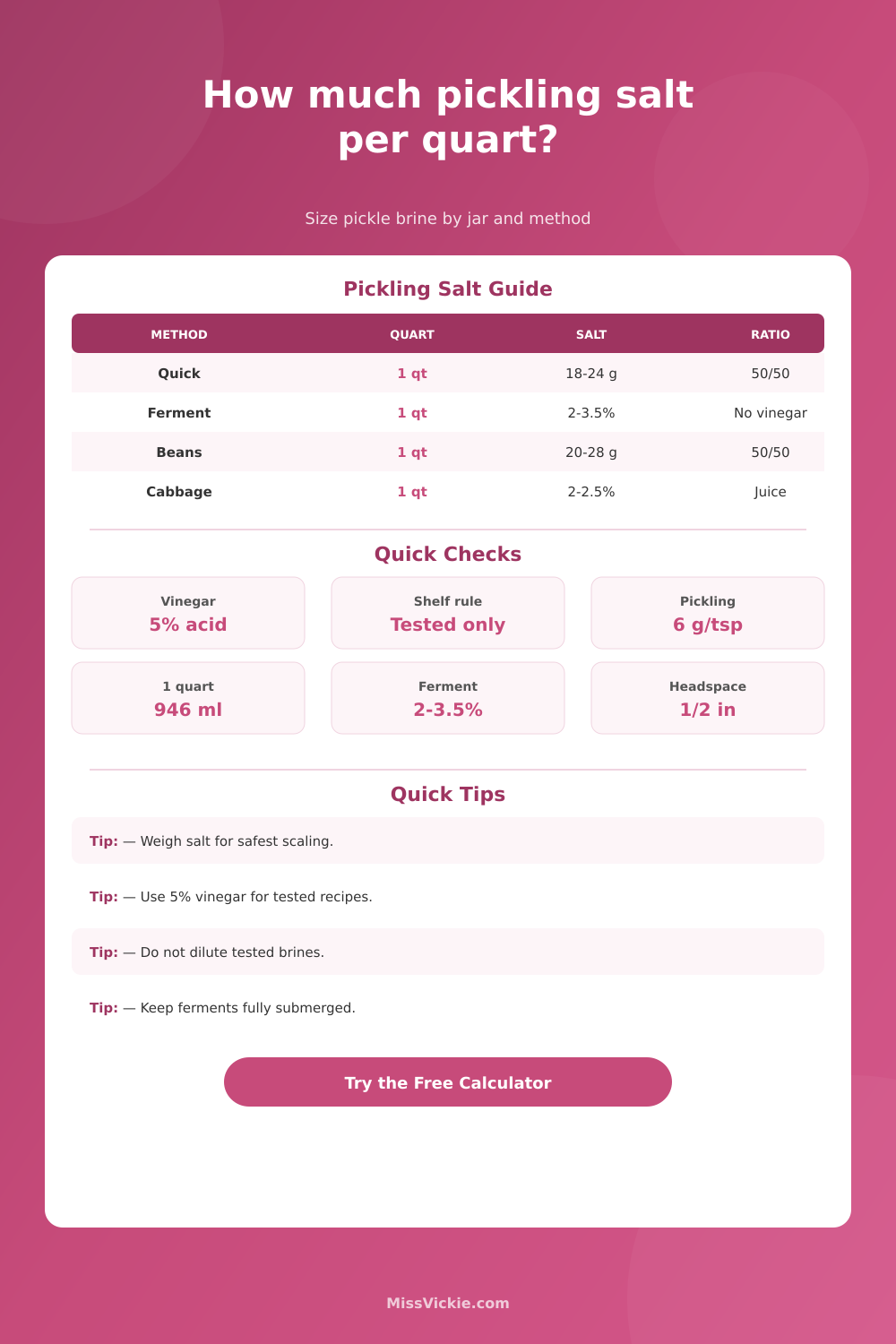
These tables are guardrails for estimating brine. Shelf-stable canned pickles should still follow a tested recipe from USDA, NCHFP, or a university extension source.
| Pickle Style | Salt Basis | Vinegar / Water | Safety Use | Calculator Note |
|---|---|---|---|---|
| Quick-pack vinegar pickles | Often 2% to 5% of liquid weight | Commonly at least half 5% vinegar in many recipes | Use only tested proportions for canning | Calculator flags low vinegar share. |
| Refrigerator pickles | Flavor brine, often 1.5% to 4% | Flexible for flavor if kept refrigerated | Not shelf-stable unless processed by tested recipe | Use cold storage guidance from the recipe. |
| Fermented cucumber pickles | Often 2% to 3.5% of vegetables plus water | No vinegar at start | Fermentation depends on salt, time, temperature, and acidity | Keep submerged and discard spoiled batches. |
| Sauerkraut-style cabbage | About 2% to 2.5% of cabbage weight | No added vinegar at start | Salt draws cabbage juice for fermentation | Use weight, not spoons, for cabbage. |
| Reduced-salt canned pickles | Only if the tested recipe allows it | Do not dilute acid to soften taste | Salt changes can affect fermented pickle safety | For sourness, adjust sugar in tested recipes. |
🫙Vegetable Pack And Brine Fill Guide
| Vegetable | Typical Jar Fill | Brine Fill Estimate | Default Salt Range | Best Method |
|---|---|---|---|---|
| Cucumber spears | Tight vertical pack | 50% to 58% of jar volume | 3% to 5% vinegar brine or 2.5% to 3.5% ferment | Vinegar or ferment |
| Cucumber slices | Layered chips | 58% to 65% of jar volume | 2% to 4% vinegar brine | Vinegar quick-pack |
| Green beans | Trimmed vertical pack | 54% to 62% of jar volume | 3% to 5% vinegar brine | Vinegar quick-pack |
| Peppers | Loose rings | 52% to 62% of jar volume | 2% to 4% vinegar brine | Vinegar quick-pack |
| Cabbage | Shredded and packed | Little added brine when juicy | 2% to 2.5% of cabbage weight | Fermentation |
🧪Batch Scaling Snapshot
✅Pickling Salt Notes
Food safety note: this calculator estimates ingredient amounts. For shelf-stable canned pickles, use a tested recipe and its specified processing time, jar size, headspace, and acid ratio.
Home cooks will tell you that this is usualy where they go wrong: measuring the salt. Packed jars are easy. So is selecting the right vinegar. But mismeasure the brine, and it’s all over. A small change in acidity, or several grams of salt, can mean the difference between crisp pickles and something else (not quite as good).
Use the calculator above to let the math work for you. It handles the conversions from jar volume to brine weight so you don’t have to guess. It translates vague percentages into spoonfuls you can hold in your hand. Knowing what those numbers mean help make it more than just another recipe card.
Why Measuring Salt Matters
Salt does two distinct jobs in pickling, and they are not always the same. When using salt in quick vinegar pickles, it protects the texture and enhances the flavor by strengthening the pectin in the vegetable’s cell walls. It keeps everything crunchy, while the acid take care of keeping it safe. But when making fermented pickles, the role of salt is an engine. It helps establish an environment that allows good bacteria to grow, but kills off bad bacteria. That’s why the calculator asks which kind of pickle you’re going to make right from the start… Ferment or vinegar? Because the math change completely. You want acid for safety and salt for structure. Combine the two, and either you end up with unsafe food, or soft pickles.
Most people mess up here: they enter in how many jars they have filled, as well as their fill level. For instance, a full quart jar doesn’t contain a quart of brined veggie. You might think you need two cups of liquid, but the calculator adjusts for actual void space based on your vegetable type. But different foods create more or less headspace. Green beans pack differently than sliced onions. Chips require more headspace than spears. How much do they “displace”? The calculator guesses. Then it multiplies that by your desired salinity (saltiness) percentage. It also includes just a bit more for when the brine spill onto the counter while ladling. That’s why so much brine seems to get lost in transit.
The calculator also monitors another key factor: the strength of the vinegar. Five percent acidity vinegar are used in most of the recipes being tested. You can use a milder vinegar. That’s fine, as long as you bump up the amount of vinegar in your brine to make it safe to can. The calculator alerts you to that danger. Want to dilute a proven recipe? Sure. But it won’t allow you to do so unless it warns you that the shelf-stability has been weakened. Big safety feature there. You can tinker with sugar for flavor; don’t monkey around with acid for safety. The ability to see the acid ratio in the results keep things within those limits, your safe bounds.
With fermentation, you need to get into another mind-set altogether: with ferment mode, the calculator will base your salt amount based off of total weight of vegetables + water instead of just the liquid volume. Because the cabbage will release some juice itself, you can’t know how big your final batch of brine will be until after fermentation begins. The only correct way to dose your cabbage is by weighing out the raw vegetable. When you select ferment mode, the calculator defaults to this weight-based calculation. It also warns you that spoons aren’t reliable ways to measure salt, crystals can vary widely in size. For example, one cup of fine pickling salt weighs nearly twice as much than one cup of coarse kosher salt. This is actualy one of the most frequent reasons why people’s ferments go wonky at home.
On the page, the reference tables makes clear how this all lays out for various veggies. For example, they give typical ranges of vinegar-to-water ratio and saltiness. That’s a starting point, though. Tweak those numbers to match your own taste. Tweak them also depending on how hard your water is, how warm the water is in your kitchen, and so on. The calculator lets you go as detailed as you want: upping the salt level for that extra-crunchy pickle; downing it if you’re trying to limit your sodium intake (as long as you aren’t canning for shelf storage).
It’s the difference between guessing at pickles and measuring pickles. It’s chemistry pretending to be cooking, and it pays off. Your jars turn from failure-prone to flawless. They get crunchy instead of limp. They taste balanced rather than bland. You know what? You can stop wasting vegetables on failed experiments.
Learning to measure the salt accurately, whether you’re putting up a gallon of beans or a quart of dills, is the key. Then you’ll be able to control those results. And that knowledge will make what was once a stressful exercise in the pantry become a repeatable ritual in the kitchen. There’s no more wasted vegetables; no more experiments gone wrong.
Learning to measure the salt accurately, whether you’re putting up a gallon of beans or a quart of dills, is the key. Then you’ll be able to control those results. And that knowledge will make what was once an anxiety-inducing exercise in the pantry become a repeatable ritual in the kitchen.
You should of used the calculator sooner.