Sugar Per Quart Sweet Tea Calculator
Calculate sugar for sweet tea by quart, sweetness level, tea strength, ice dilution, simple syrup strength, serving size, and pitcher yield.
🍵 Sweet Tea Presets
Choose a common pitcher or party setup, then adjust quarts, sweetness, tea strength, ice, serving size, and sugar form for your kitchen.
⚖ Tea Batch Details
Sweet tea sugar plan
Your sweet tea sugar estimate will update as you change the batch.
Batch Breakdown
Serving and Syrup Details
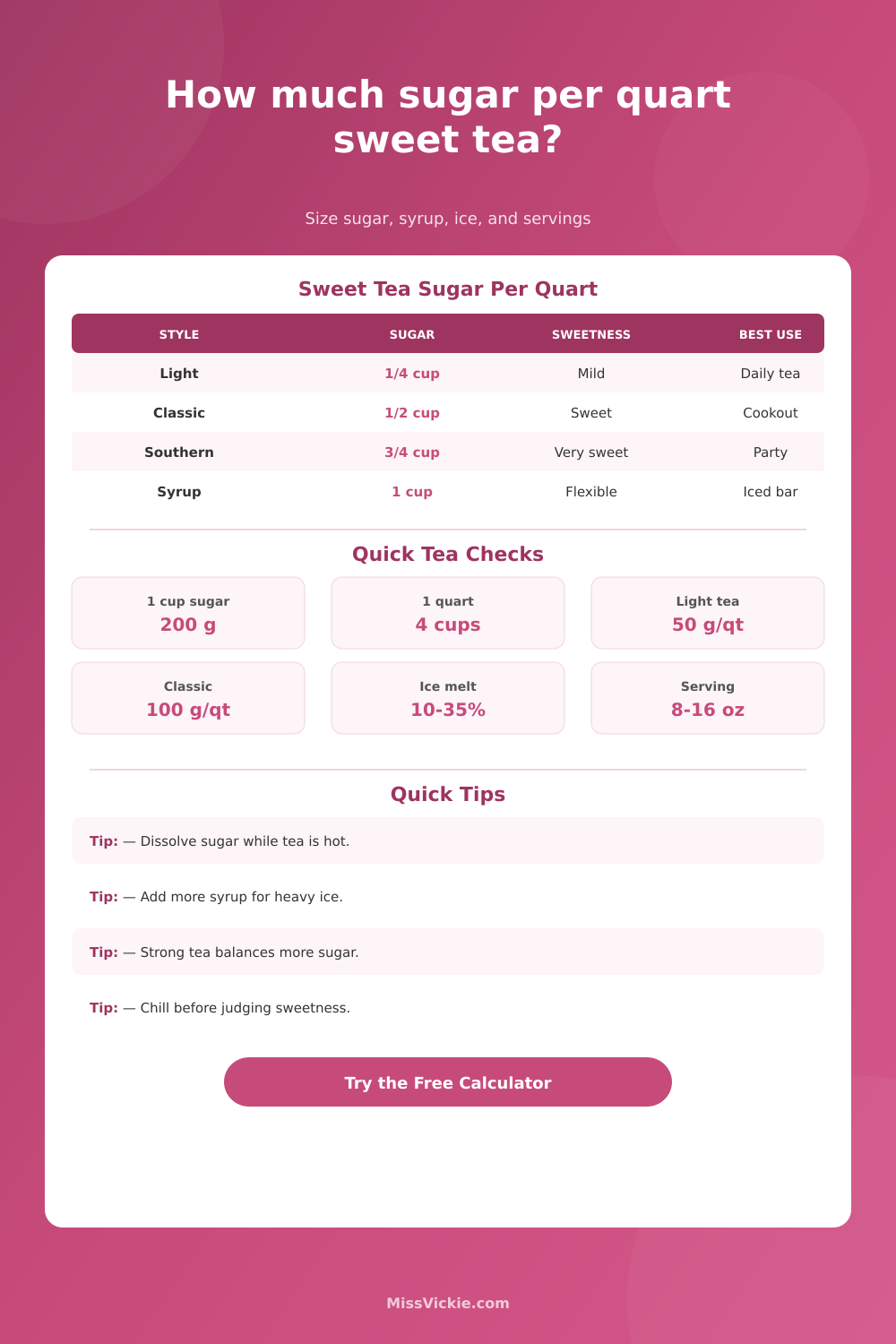
- Dissolve sugar while the tea concentrate is hot.
- Chill before tasting because cold tea reads less sweet.
🧂 Quick Sugar Measures
📊 Sweet Tea Reference Tables
| Sweetness Style | Sugar Per Quart | Sugar Per Gallon | Best Match | Flavor Note |
|---|---|---|---|---|
| Barely sweet tea | 25 g, about 2 tbsp | 100 g, about 1/2 cup | Unsweet tea drinkers | Keeps tea flavor first with just a small soft edge. |
| Light sweet tea | 50 g, about 1/4 cup | 200 g, about 1 cup | Everyday pitcher | Noticeably sweet but still lighter than restaurant sweet tea. |
| Half sweet tea | 75 g, about 3/8 cup | 300 g, about 1 1/2 cups | Half sweet, half unsweet blend | Good compromise for meals and refills. |
| Classic sweet tea | 100 g, about 1/2 cup | 400 g, about 2 cups | Cookouts and family meals | Traditional sweet pitcher strength for black tea. |
| Southern sweet tea | 150 g, about 3/4 cup | 600 g, about 3 cups | Very sweet iced tea | Best with strong tea, lemon, and plenty of ice. |
| Dessert sweet tea | 200 g, about 1 cup | 800 g, about 4 cups | Extra sweet party tea | Sweet enough to treat like punch or dessert beverage. |
| Beverage Reference | Approx Sugar | Per 12 oz Glass | Compared With Tea | Use In Calculator |
|---|---|---|---|---|
| Unsweet iced tea | 0 g per quart | 0 g | No added sugar | Select Barely sweet or Custom 0 for near-unsweet pitchers. |
| Light sweet tea | 50 g per quart | 19 g | Lower than soda | Choose Light for daily drinking or mixed sweet/unsweet tea. |
| Classic sweet tea | 100 g per quart | 38 g | Near many soft drinks | Choose Classic for a familiar restaurant-style glass. |
| Southern sweet tea | 150 g per quart | 56 g | Sweeter than most soda | Choose Southern when tea will be strong and poured over ice. |
| Lemonade style sweetness | 110 to 140 g per quart | 41 to 53 g | Tartness balances sugar | Use Classic or Southern when adding lemon juice. |
| Fruit tea punch | 120 to 180 g per quart | 45 to 68 g | Often very sweet | Use Southern or Custom for fruit-juice tea blends. |
| Batch Size | Light Sweet | Classic Sweet | Southern Sweet | 12 oz Servings |
|---|---|---|---|---|
| 1 quart | 1/4 cup, 50 g | 1/2 cup, 100 g | 3/4 cup, 150 g | About 2 to 3 glasses |
| 2 quarts | 1/2 cup, 100 g | 1 cup, 200 g | 1 1/2 cups, 300 g | About 5 glasses |
| 1 gallon | 1 cup, 200 g | 2 cups, 400 g | 3 cups, 600 g | About 10 to 11 glasses |
| 2 gallons | 2 cups, 400 g | 4 cups, 800 g | 6 cups, 1200 g | About 21 glasses |
| 3 gallons | 3 cups, 600 g | 6 cups, 1200 g | 9 cups, 1800 g | About 32 glasses |
| 5 gallons | 5 cups, 1000 g | 10 cups, 2000 g | 15 cups, 3000 g | About 53 glasses |
| Sugar Form | Sweetness Basis | Kitchen Measure | Liquid Added | When To Use |
|---|---|---|---|---|
| Granulated sugar | 200 g per cup | Pack and level lightly | No extra liquid | Best for hot tea because it dissolves cleanly while warm. |
| Superfine sugar | 190 g per cup | Use cup estimate carefully | No extra liquid | Dissolves faster in warm tea or cold adjustment glasses. |
| Raw turbinado sugar | 210 g per cup | Coarse crystals vary | No extra liquid | Gives a faint molasses note; dissolve fully before chilling. |
| Honey | 82% sugar by weight | About 340 g per cup | Small liquid amount | Use for floral tea, but flavor will be stronger than cane sugar. |
| Simple syrup 1:1 | About 200 g sugar per cup | 1 cup syrup per cup sugar | Adds same volume | Useful when guests sweeten glasses after tea is chilled. |
| Rich syrup 2:1 | About 267 g sugar per cup | 3/4 cup syrup per cup sugar | Adds less liquid | Good for tea bars, heavy ice, and fast correction by the glass. |
📝 Sweetness, Servings, and Tea Strength
About 9 g sugar in a 12 oz glass before ice dilution adjustments.
About 38 g sugar in a 12 oz glass, similar to many sweet beverages.
A common hot-brew starting point is about 4 regular tea bags per quart.
Large ice cups can dilute a pitcher enough to need a stronger base.
💡 Sweet Tea Measuring Notes
Sugar estimates use common kitchen conversions: 1 cup granulated sugar is about 200 grams, 1 quart is 32 fluid ounces, and 1 gram sugar adds about 4 calories. Tea strength and sweetness are personal, so taste a chilled sample before serving a large batch.
By using the ratio, you don’t have to guess amount of sugar, so no more worrying about whether it dissolved (or not).
Sweet tea are a structure problem: there’s a connection between melt water, solubility limits, and heat transfer. There is ice, there’s liquid, and then there’s a limit beyond which sweetener won’t dissolve. The calculator do this math for you. You input how much tea you want to make and at what sweetness level, and out comes exactly how many cups or grams will be required. You will no longer waste summer afternoons with the usual process of trial and error.
How to Make Perfect Sweet Tea
That said, here’s what everyone does wrong: they ignore the ice! Yeah, maybe you made a perfect quart of tea. Maybe you added what you think is the correct amount of sugar. And maybe it taste awesome in your kitchen. But when you plop it into a glass filled with massive ice cubes … the ice melts. The water-water dilute your tea. Now you’re sipping lukewarm water which remind you of some sugar somewhere.
To account for all this, the tool lets you choose how much ice dilution you expect. If you’ll be serving this at a party and want to use super-heavy ice cups, bump up the dilution percentage. Then the calculator adjust its sugar target upwards to match. It is not cheating. It is just chemistry. You’re sweetening the total volume, not merely the concentration.
The second mistake are the type of sweetener. By default, it’s granulated sugar. For hot tea, granulated sugar will dissolve well. Stirring granulated sugar into cold tea won’t work. It’ll settle and make your tea gritty, which isn’t pleasant.
To change to rich syrup or simple syrup, use the calculator. That’s important if you’re making big batches. Stirring granulated sugar around in a gallon of tea until dissolved is a tedious task. With syrup, it mix right away. It’ll also add liquid volume, and the tool will adjust accordingly for that added liquid.
You can also go with honey. Honey is sweeter then cane sugar. It has a strong flavor that’ll compete with the flavor of the tea leaves. Go light on the honey unless you’d rather have tea that tastes more like a floral syrup.
And then there’s tea strength itself. You can’t put a lot of sugar in a light steep. A weak brew just ends up tasting flat and cloying if you throw too many sweetener on it. A strong cup (longer steep time, maybe an extra bag) means you’ve got more tannins. Tannins mean bitterness. Bitterness keep things balanced against the sweetness. The calculator accounts for that by letting you tweak your tea strength setting. If you go with a stronger base, it may recommend a bit more sugar to keep things balanced. This is how the sweet tea at restaurants always seem so bold. They make it strong. Then they add enough sugar to match.
Intuition won’t help you scale up. Easy enough to make two quarts. Making five gallons for a barbecue is another beast altogether. This is laid out in the reference tables on the page. These tell you how much sugar you’ll want based off volume for a light, classic, or southern style batch.
Southern style are really sweet. It is really, really sweet. It is intended to be that way. Pairs nicely with lots of ice and a wedge of lemon.
If you’re making this for a crowd you need to know upfront how much sugar you’ve got. Don’t risk buying a bag of sugar and hoping it’s going to be enough. Measure twice, pour once.
And finally: Don’t forget that tea isn’t as sweet when it’s cold as it is when it’s hot. Lower temperature cause our taste buds to lessen their response to sweet. So if you find your tea too sweet when it’s warm, when it’s chilled it’ll seem bland. Chill a sample first and always do so. Then taste it cold. From there tweak.
The calculator is just a beginning. Your own taste buds are the deciding factor. Do this from the get go and you would of ended up with an episode of weak tea disaster.