Yeast Per Bread Loaf Calculator
Estimate yeast for one loaf or a full batch using flour weight, loaf count, yeast type, rise time, dough temperature, sugar and fat level, cold ferment schedule, hydration, and baker percentages.
🍞 Bread Loaf Presets
Choose a common bread plan, then fine-tune flour per loaf, loaf count, yeast type, dough temperature, rise time, cold ferment, sugar, fat, and salt.
⚖ Loaf And Fermentation Inputs
Bread loaf yeast plan
Enter loaf details to calculate yeast.
Baker Formula
Dough Context
📊 Yeast Conversion Cards
📘 Bread Loaf Baker Tables
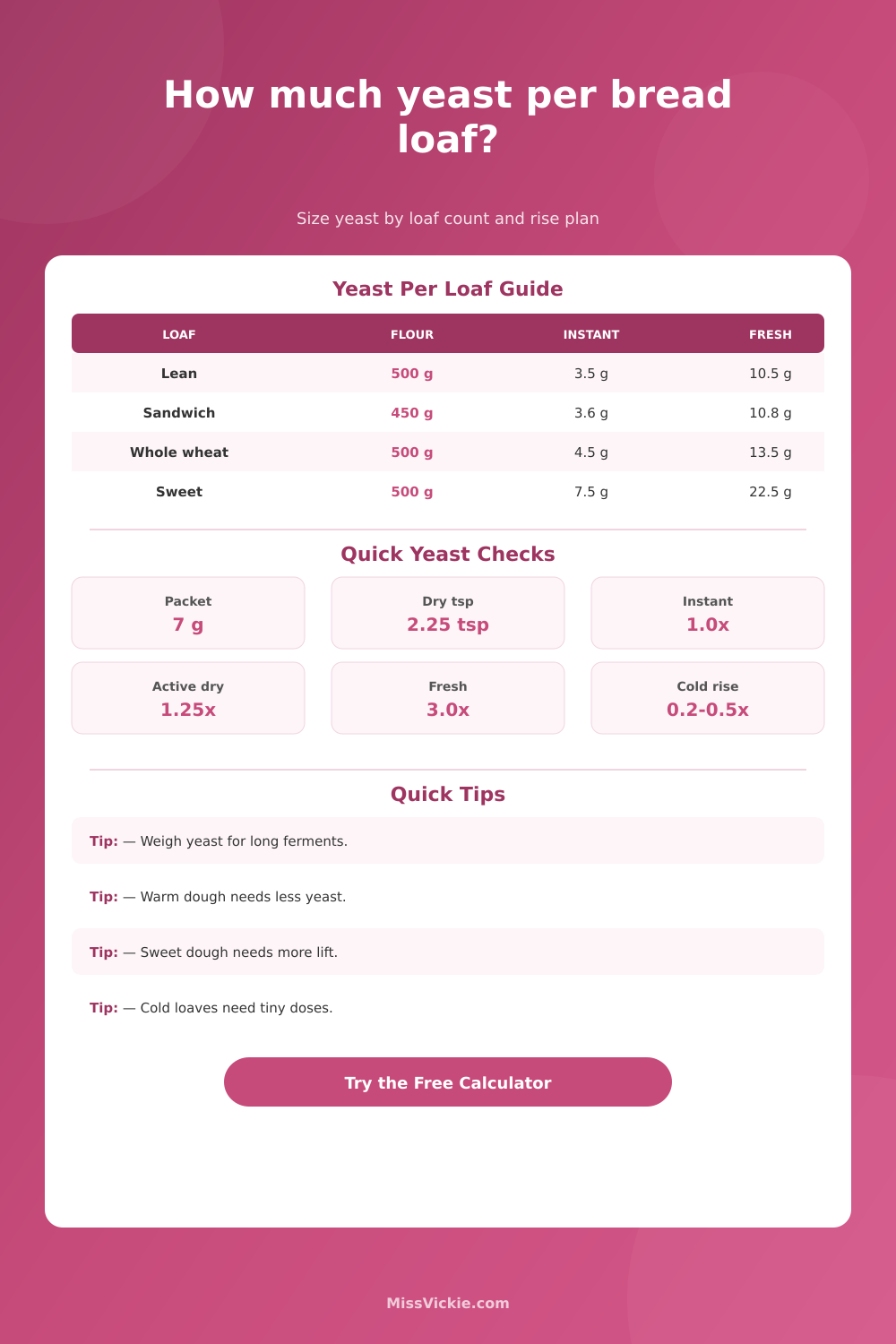
| Bread Loaf Type | Flour Per Loaf | Instant Yeast Percent | Typical Rise Plan | Formula Note |
|---|---|---|---|---|
| Lean artisan loaf | 450 to 600 g | 0.10% to 0.70% | Long room rise or cold ferment | Lower yeast builds flavor and open crumb. |
| Sandwich pan loaf | 400 to 550 g | 0.50% to 1.00% | Same-day bulk and proof | Moderate yeast gives predictable sliceable bread. |
| Whole wheat loaf | 450 to 600 g | 0.70% to 1.20% | Same-day or overnight | Bran and heavier dough often need a little more lift. |
| Sweet enriched loaf | 450 to 650 g | 1.00% to 2.00% | Warm same-day rise | Sugar, butter, eggs, and milk slow ordinary yeast. |
| Brioche-style loaf | 450 to 600 g | 1.20% to 2.30% | Warm bulk, often chilled after mixing | High butter loads need time and stronger yeast planning. |
| Instant Yeast Equivalent | Instant Yeast | Active Dry Yeast | Fresh Cake Yeast | Osmotolerant Instant |
|---|---|---|---|---|
| Small slow loaf dose | 0.5 g | 0.6 g | 1.5 g | 0.5 g |
| Moderate one-loaf dose | 3.5 g | 4.4 g | 10.5 g | 3.2 g |
| One common packet | 7 g | 8.8 g | 21 g | 6.3 g |
| Sweet loaf boost | 8 g | 10 g | 24 g | 7.2 g |
| Six-loaf batch dose | 21 g | 26 g | 63 g | 19 g |
| Rise Time And Temperature | Yeast Direction | Typical Multiplier | Loaf Baking Note |
|---|---|---|---|
| 1 to 2 hours, warm dough | Use more yeast | 1.4x to 2.0x | Good for quick pan bread but flavor stays mild. |
| 3 to 5 hours, 72F to 78F dough | Use moderate yeast | 0.8x to 1.2x | Reliable for everyday sandwich loaves. |
| 8 to 16 hours, cool room | Use less yeast | 0.35x to 0.70x | Watch dough volume, not the exact clock. |
| 24 to 72 hours, refrigerated | Use much less yeast | 0.12x to 0.40x | Tiny yeast amounts prevent blown-out cold dough. |
| Baker Percentage Item | Lean Bread | Sandwich Bread | Sweet Bread | How It Affects Yeast |
|---|---|---|---|---|
| Flour | 100% | 100% | 100% | All yeast math is based on total flour weight. |
| Water or liquid | 60% to 78% | 58% to 68% | 50% to 65% | Very stiff dough rises more slowly. |
| Salt | 1.8% to 2.2% | 1.8% to 2.2% | 1.5% to 2.0% | High salt slows fermentation and strengthens dough. |
| Sugar | 0% to 3% | 2% to 8% | 10% to 25% | High sugar pulls water away from yeast. |
| Fat | 0% to 4% | 3% to 10% | 10% to 35% | Fat tenderizes but slows gluten and gas expansion. |
🧮 Loaf Fermentation Checks
Use the calculated instant equivalent directly in most home bread recipes.
Measure a little more active dry yeast for the same loaf lift.
Fresh yeast has more moisture, so the gram amount is higher.
Cold ferment bread needs very small yeast amounts and more patience.
💡 Yeast Per Loaf Notes
This calculator gives practical starting amounts for bread baking. Yeast age, flour strength, water temperature, mixing, pan size, room humidity, and proofing warmth can change the final rise.
Yeast is the variable in baking bread that trips up most home bakers. Even if we measure our flour and water precisely to the gram, a collapsed or too dense loaf can still happen. Usually it’s not the flour that’s at fault. Rather, it’s about the interaction of the amount of yeast (and how it interacts) and environment.
This calculator will do all the math for you, but if you understand why it does what it does, you’ll feel confident improvising around those numbers. Here’s the first thing to know: Yeast is not a one-size-fits-all ingredient like salt. One teaspoon of yeast in a warm kitchen will perform more differently than in a cool room or in a rich dough compared to a wet one.
Why You Need the Right Amount of Yeast
This tool takes into account enrichment level, rise time and dough temperature for the baseline. For instance, a sweet, milk bread with high fat and sugar content require more yeast. This is because sugar slows down the yeast’s metabolism by drawing water out of cells. High fat also makes the dough more tender, as the fat coats the gluten and slows down gas expansion. Without considering these variables you may add a standard amount of yeast but your dough might never hit the bench.
For example: when planning a long cold ferment, the calculator will cut your yeast way back. Why? Lots of bakers fear refrigerator fermentation. They act as if time standing still is a bad thing, but that’s when the magic happens.
With a cold schedule, the calculator cut down the yeast dose, sometimes to under half what it would of been for a fast rise. And this is on purpose. Your goal isn’t to kill off all the sugars with too much yeast; instead, you want the yeast to endure the cold temperatures and then do its work at the last minute. Overdosing yeast for a dozen-hour cold rest is something I see all the time, and it lead to an excessively open crumb and no flavor.
Also keep in mind when reading this: what kind of yeast do you have? The conversion ratios aren’t random. Fresh yeast has more activity and higher water content by weight, so it require about three times as much by weight as dry yeast. Active dry yeast has a protective coating that must be hydrated before it can becomes active; therefore, it demands approximately twenty-five percent more in volume than instant yeast to provide the same amount of lift. Instant yeast has been processed and milled down fine enough to dissolve instantly, which makes it most efficient yeast for home use.
The charts on the page explain all this, and there’s no guesswork about if you’re supposed to toss in another pinch or not.
All that changes when you add enrichment. Time plus strong gluten development equals a lean artisan loaf made with nothing but flour, water, salt, and yeast. It has the benefit of rising slowly and having its structure tightly built so it can accommodate a little yeast. On the other hand, a brioche (by definition a type of pastry) are loaded with butter and eggs. To make up for all that weight, amount of yeast needs to be higher so dough can rise even though it is weighed down by the extra ingredients. This is the balance between tenderness and structure.
Lastly: all of this is a beginning; none of these numbers is hard-and-fast rules. Your kitchen will get warmer or cooler depending on time of year. Different brands’ flours are different strengths. The calculator provides a scientifically sound place to start, but use your eyes and hands as your last test. Pay attention to how the dough behaves, not only to the clock. When it’s time, it’ll be time. Otherwise, give it some more time. Math takes you to the door; observation takes you through it.