Chicken Broth Per Can Calculator
Convert chicken broth cans into recipe cups, milliliters, prepared condensed broth, sodium per serving, simmer loss, pantry substitutions, and can-by-can shopping amounts.
🥣 Broth Can Presets
Pick a common cooking situation, then adjust the can size, condensed setting, recipe cups, sodium label, servings, evaporation, and substitutions.
⚖ Can And Recipe Details
Chicken broth can plan
Prepared broth, can count, sodium, and substitution details update as you edit the recipe.
Can Math
Serving And Swap Notes
📏 Common Can Size Quick Cards
📋 Cup, Milliliter, And Can Reference
| Container | Fluid Ounces | US Cups | Milliliters | Notes |
|---|---|---|---|---|
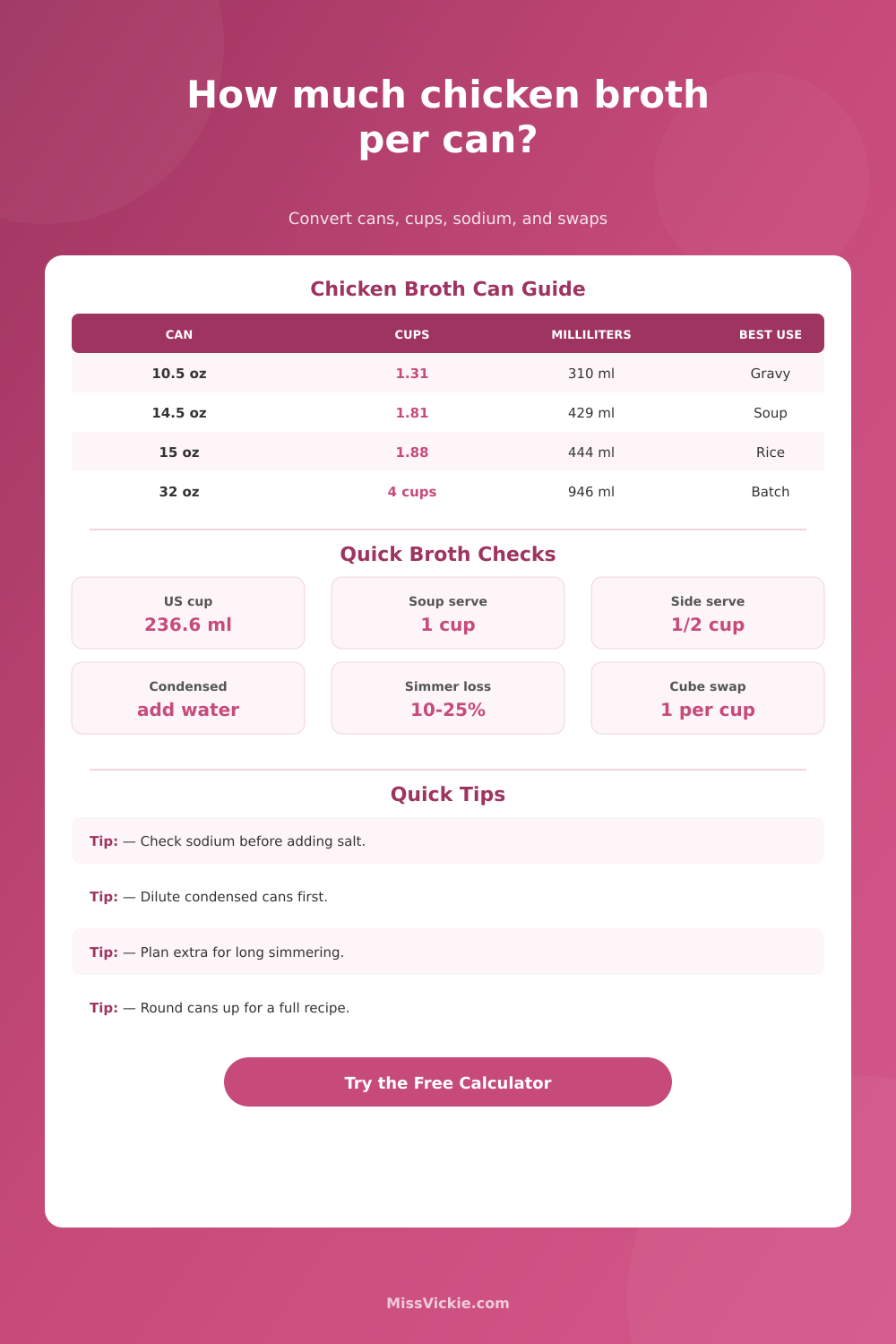
| Small condensed can | 10.5 fl oz | 1.31 cups | 310 ml | Often used for gravy, casseroles, and condensed soup recipes. |
| Standard broth can | 14.5 fl oz | 1.81 cups | 429 ml | A common shelf-stable chicken broth can for soups and rice. |
| Standard large can | 15 fl oz | 1.88 cups | 444 ml | Close enough to 2 cups for forgiving recipes, but not exact. |
| One US cup | 8 fl oz | 1 cup | 236.6 ml | Use this for recipe math and substitution ratios. |
| One quart carton | 32 fl oz | 4 cups | 946 ml | Equivalent to about 2.2 standard 14.5 oz cans. |
Can volumes are label volumes. Draining, product thickness, and measuring-cup fill line can shift kitchen measurements slightly.
🧂 Sodium Dilution Reference
| Broth Style | Typical Sodium Per Cup | Dilution | Prepared Sodium Effect | Kitchen Use |
|---|---|---|---|---|
| Regular chicken broth | 700-900 mg | None | Stays near label value | Soups, rice, pan sauces, stuffing. |
| Low sodium broth | 350-600 mg | None | Leaves more room for salt | Better for reductions and salty add-ins. |
| Unsalted stock | 40-150 mg | None | Season at the end | Good for precise salt control. |
| Condensed broth | Label varies | 1 can water | About half per cup | Dilute before measuring for recipes. |
| Double concentrate | Label varies | 2 cans water | About one third per cup | Useful when pantry space is tight. |
🔄 Chicken Broth Substitution Table
| Substitute | Amount For 1 Cup Broth | Flavor Strength | Sodium Note | Best For |
|---|---|---|---|---|
| Bouillon cube | 1 cube plus 1 cup water | Medium to strong | Often salty | Quick soups, rice, and casseroles. |
| Bouillon powder | 1 teaspoon plus 1 cup water | Medium | Measure lightly | Recipes needing a clean broth amount. |
| Chicken base paste | 1 teaspoon plus 1 cup water | Rich | Usually salty | Gravy, noodles, pan sauces. |
| Vegetable broth | 1 cup | Milder | Varies by brand | Soups and risotto when chicken flavor is flexible. |
| Water plus butter | 1 cup water plus 1 tsp butter | Light | Add salt to taste | Rice, stuffing, and casserole moisture. |
| White wine plus water | 1/4 cup wine plus 3/4 cup water | Bright | Usually low sodium | Pan sauces and braises. |
🍲 Common Recipe Amounts
| Recipe | Typical Broth | 14.5 oz Cans | Evaporation Planning | Serving Guide |
|---|---|---|---|---|
| Pan gravy | 1 1/2 to 2 cups | 1 to 2 cans | Low loss, thickened quickly | About 1/4 cup per person. |
| Rice pilaf | 2 cups | 2 cans opened, some leftover | Absorbed by rice | About 1/2 cup cooked rice side. |
| Chicken noodle soup | 6 to 8 cups | 4 to 5 cans | Add 10-15% for simmering | About 1 to 1 1/2 cups per serving. |
| Stuffing | 2 to 4 cups | 2 to 3 cans | Little evaporation before baking | About 1/2 cup per side serving. |
| Slow cooker chicken | 1 to 3 cups | 1 to 2 cans | Covered cook has low evaporation | Count sauce as part of the meal. |
🧾 Nutrition Snapshot
calories per cup, sodium often drives the seasoning.
mg sodium per cup is a common label range.
protein per cup varies widely by brand.
water lowers sodium concentration per prepared cup.
💡 Broth Measuring Tips
It’s a recipe that requires three cups of chicken broth and there you stand with a 14.5 ounce can in the pantry. Easy math, in theory, but not when your heart are racing, wondering whether you’re one can short, or two away from having plenty.
This type of scenario catches so many home cook. In fact, it has little to do with cooking and far more to do with converting the ounces on label into kitchen cups. There must be an easy way to understand what’s in that can once you’ve opened it. Then, should you rush off to buy some more?
How to Measure Chicken Broth Correctly
Except that most folks think each can have precisely two cups. It doesn’t. A typical 14.5 ounce can is actualy roughly 1.81 cups. It is a mere fraction, but it is significant enough to make a difference in a delicate sauce or risotto. A slightly more voluminous 15 ounce can is more like two cups, though still shy by a little over an eighth of a cup. Round down and you’ve got yourself some dry rice. Round up, and you’ve wasted a can that might go bad in your fridge.
No longer do you need to guess, enter what you’re looking for into the calculator (above) and what you’ve got, and let it do the math for you. Time to cook.
The other issue is the condensed broth dilemma. The small 10.5 ounce cans fits nicely in the cupboard but can be problematic because you cannot just substitute them directly for regular broth. You must thin it out with some water. Typically, you need one part concentrated liquid to one part water. Otherwise you get thick, salty soup. And then you forgot to thin it out before pouring into your measuring cups!
No worries here, just tell the tool whether you’re working with concentrate or ready-to-use stock. It’ll take care of the rest, automatically adjusting to the new amount. Problem solved (and no more salty-soup-for-guests humiliation).
Another sneaky hidden ingredient is sodium. Regular (non-low-sodium) chicken broth has almost 900 milligrams of it per cup. That is a significant chunk of your daily limit! By contrast, if you use low salt, you’ll knock off most of this. You can plug in whatever your bottle says and the calculator will guess at how much sodium remains once you factor in what evaporates during cooking and/or what additional water you may pour on top. This could be helpful for those with low-sodium diets or people hoping to adjust seasoning level of the finished product.
Another thing frequently overlooked in the home kitchen is evaporation. An hour of simmering mean some of your water has evaporated into the air. Not your salt. What’s left behind are more concentrated. So when your recipe says “four cups” of broth, and you want it all at the end, you have to add more than four cups at the beginning.
The tool also accounts for simmer loss. You can select a gentle simmer for something like a quick rice side dish, or a heavy reduction for something like a rich gravy. Add the additional water, then let the recipe finish with exactly as much liquid as you need.
Getting substitutions wrong is also simple. If you don’t have canned broth, you might use a bouillon cube instead. A cup of water and a cube dissolved in it is a good replacement for volume. But it’s not necessarily an exact substitute for flavor. Bouillon cubes comes in various strengths. The amount of bouillon to use can vary since some cubes are stronger then others. The calculator can help you guesstimate the substitution, ensuring that you won’t wind up with something bland or metallic.
Or it can help you check what you have in your pantry versus what the recipe needs. You tell it how much canned broth you have on hand. Then it will let you know whether you should crack open another can or if you’ll be covered.
If you aren’t planning all the way through a recipe, you might just want to quickly check which sizes will work to convert what you have on hand. The reference table on the page shows how many regular sized cans is approximately equal to one carton (for example, two and a half standard cans equals a 32 ounce carton). So the next time you’re at the store and they has an item on sale in carton form rather than can form, you know whether it’s worth switching (based off how fast you use things up and where it would be best stored!).
It’s all about time and ratios. It’s about having your broth there when you need it. Pour and stir. Don’t stop to do math in the middle of a recipe. Knowing your can sizes helps. Knowing what happens as you evaporate or dilute the broth helps. Take the guess work out. Focus on the herbs and the heat. You should of had the broth there when you need it. That’s what cooking is about.