Frosting for Sheet Cake Calculator
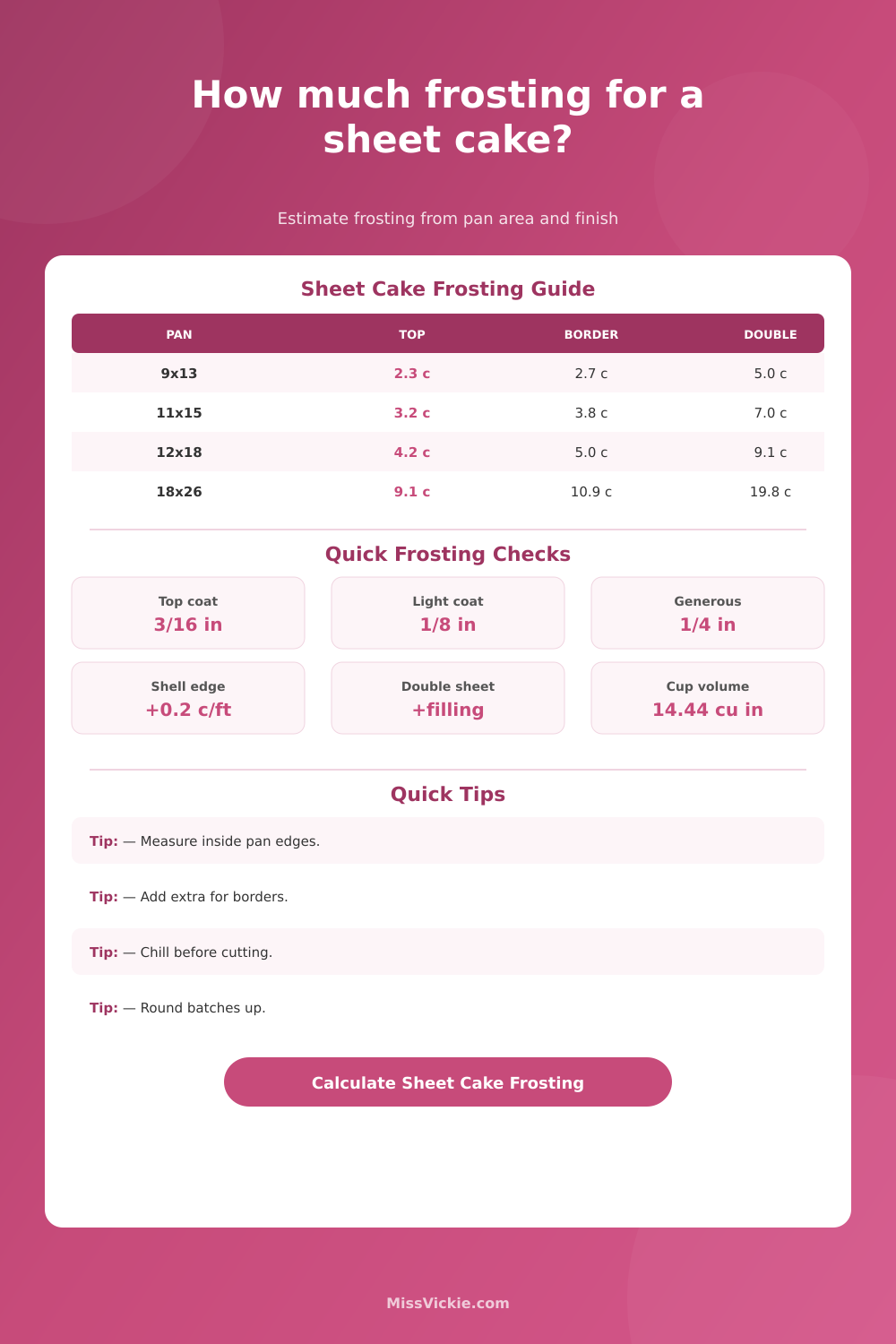
Estimate frosting for rectangular sheet cakes from pan dimensions, top thickness, exposed sides, filling layers, piping borders, serving cuts, and frosting type.
🍰Sheet Cake Frosting Presets
Choose a sheet-cake scenario, then fine-tune the pan, thickness, border, filling, and serving plan.
📏Pan, Finish, and Serving Inputs
Sheet cake frosting estimate
Adjust the inputs to calculate frosting from rectangular sheet-cake surface area.
Surface area formula
Practical kitchen plan
📊Sheet Pan Fast Cards
📐Pan Size Frosting Table
| Sheet pan | Top area formula | Standard top only | Top plus shell border | Two-layer filled sheet |
|---|---|---|---|---|
| 8 x 8 inch square | 8 x 8 = 64 sq in | 1.2 to 1.5 cups | 1.5 to 1.9 cups | 2.8 to 3.3 cups |
| 9 x 13 home sheet | 9 x 13 = 117 sq in | 2.1 to 2.6 cups | 2.5 to 3.1 cups | 4.6 to 5.4 cups |
| 10 x 15 jelly roll | 10 x 15 = 150 sq in | 2.7 to 3.3 cups | 3.2 to 3.9 cups | 5.8 to 6.8 cups |
| 11 x 15 medium sheet | 11 x 15 = 165 sq in | 3.0 to 3.6 cups | 3.5 to 4.2 cups | 6.3 to 7.4 cups |
| 12 x 18 half sheet | 12 x 18 = 216 sq in | 3.9 to 4.8 cups | 4.6 to 5.5 cups | 8.3 to 9.7 cups |
| 13 x 18 third sheet | 13 x 18 = 234 sq in | 4.2 to 5.2 cups | 5.0 to 6.0 cups | 9.0 to 10.5 cups |
| 18 x 26 full sheet | 18 x 26 = 468 sq in | 8.4 to 10.3 cups | 9.9 to 11.8 cups | 17.9 to 20.9 cups |
Table ranges assume about 3/16 inch top frosting, practical spreading loss, and buttercream-like density. Very soft whipped toppings can need extra volume.
🧮Surface Area Formula Reference
| Sheet cake feature | Formula | When it applies | Frosting thickness cue | Why it matters |
|---|---|---|---|---|
| Top coat | Length x width x top thickness | Every frosted sheet cake | 1/8 to 1/4 inch | This is the main frosting volume for a tray cake. |
| Exposed sides | 2 x (length + width) x cake height x side thickness | Unmolded or display sheet cakes | 1/16 to 3/16 inch | Side frosting is small on thin sheets but noticeable on tall slabs. |
| Filling layer | Length x width x filling thickness | Two stacked rectangular sheets | 1/8 to 1/4 inch | Filled sheets need much more frosting than top-only sheets. |
| Piped border | Perimeter x cups per foot | Shell, rope, rosette, and message borders | 0.08 to 0.34 cup per foot | Border frosting scales with edge length, not serving count. |
| Safety margin | Raw cups x margin factor | Color matching, texture, spreading loss | 0 to 25 percent | Rounding up avoids running short on the final corner. |
🍰Frosting Style and Batch Table
| Frosting type | Typical yield | Approx weight per cup | Best sheet cake use | Planning note |
|---|---|---|---|---|
| American buttercream | 3 cups per batch | 150 g / 5.3 oz | Birthdays, borders, writing | Stable and easy to pipe, so it is the calculator baseline. |
| Swiss meringue buttercream | 4 cups per batch | 135 g / 4.8 oz | Smooth display sheets | Softer and silkier, with good coverage at moderate thickness. |
| Cream cheese frosting | 2.5 cups per batch | 165 g / 5.8 oz | Carrot, spice, red velvet | Chill before clean sheet-cake slicing. |
| Stabilized whipped cream | 2.75 cups per batch | 85 g / 3 oz | Light chilled sheet cakes | Use a little more volume because it spreads with less body. |
| Whipped ganache | 2.25 cups per batch | 175 g / 6.2 oz | Chocolate sheets | Dense but smooth; heavy borders add weight quickly. |
| Ermine frosting | 3.25 cups per batch | 140 g / 4.9 oz | Red velvet sheet cakes | Good for broad, smooth top coverage. |
| Pourable glaze | 2 cups per batch | 190 g / 6.7 oz | Texas sheet cake | Calculated thinner because glaze levels itself. |
🍴Serving Cut Reference
Common for birthdays, potlucks, and office cakes.
Better when cake is the main plated dessert.
Small pieces suit catered dessert tables.
Useful for school, coffee service, and tasting trays.
| Pan size | Party 2 x 2 | Dessert 2 x 3 | Wedding 1 x 2 | Frosting cue |
|---|---|---|---|---|
| 9 x 13 inch | 24 servings | 18 servings | 54 servings | Top-only frosting gives about 1.5 tbsp per party serving. |
| 11 x 15 inch | 35 servings | 25 servings | 77 servings | Border piping spreads across more edge pieces. |
| 12 x 18 inch | 54 servings | 36 servings | 108 servings | Half sheets often need a 5 to 6 cup batch plan. |
| 13 x 18 inch | 54 servings | 39 servings | 117 servings | Wide bakery sheets benefit from a generous smoothing margin. |
| 18 x 26 inch | 117 servings | 78 servings | 234 servings | Full sheets usually need multiple frosting batches. |
💡Sheet Cake Frosting Tips
A sheet cake seems easy, until you’re armed with a spatula and standing face-to-face with it. If you’ve ever attempted to make one batch of frosting cover multiple square feet, you know what I’m talking about.
Round layer-cake pans is not the same as rectangles; if you forget your pan’s shape, you’ll end up with patches or a dried-out top. Remember: Volume matter less than surface area, so the calculator above does that math for you.
Tips for Frosting Your Sheet Cake
Thickness is the most significant variable. Most recipes assume a thick, slathered layer, but sheet cakes is usually spread thinner, closer to a quarter inch or less. Reducing this by just a little bit, say, from a thick layer down to a quarter inch or less, will save you a surprisingly large amount of butter. The “thickness” input determine the required structure of your icing; thicker layers will cover more of the surface’s flaws while making it harder to apply smooth, and vice versa. It’s an aesthetic/economy tradeoff.
Remember the edges. If your cake is sitting right on its tray and you’re serving it as-is, there are no sides to cover; easy-peasy math. But what if you unmold the cake for a display? Now you have sides to cover, including vertical ones. This adds volume that the surface area formula doesn’t include until you factor in their height. To get an accurate number (rather than a good estimate), it add the side area onto the top area, so now you’ve got a complete figure. Because when it comes down to it, people tend to go through the middle of a slide-out before they reach the end and cover all those sides.
The wild cards are the borders and piping. A thin border of just shells will use a little bit extra, while a thick border in rope or a full rosette pattern can eat up a good chunk of your batch. For this reason, the calculator ask for information about your piping style. The recipe scales based off the perimeter (the outside length) of the pan rather than the area. So though both square and sheet cakes might be the same size for the top surface, the sheet has a much larger perimeter different than its area, which means it require additional frosting for that border, regardless. And that’s what folks typically don’t account for.
When there’s filling though, it completely changes the equation. For example, if I’m stacking 2 layers with frosting between them, then I want the frosting to coat bottom of my top layer. In other words, that’s an additional full sheet of frosting within the cake. Therefore, the calculator consider this as a separate layer, so it won’t assume you can simply double the amount for your top coat. In fact, you’ll need more since the filling isn’t spread out as evenly, and frequently needs to be a bit thicker (to support its own weight).
The type of frosting affects the yield and weight. A cup of heavy, stable American buttercream will be thicker than a cup of Swiss meringue buttercream, which is light and silky. It will also be thicker than a cup of cream cheese frosting, which are soft and heavier. That means you’ll spread your SMBC thinner. Factor in a bit more volume to prevent seeing the cake through the frosting. Use an American buttercream as the main reference point for estimating how much a cup will do for you.
Practical considerations include serving size: keep in mind that smaller slices mean more edges per person, which can affect how much frosting is visible on each plate. That will impact how many pieces of cake has frosting showing on their plates. For example, if you use smaller slices, do you want them all to be evenly frosted without any dry corners? Do you plan to cut it into wedding-sized piece? How does that impact servings? The tool lets you estimate servings according to what size you’re cutting, and helps you turn those vague “cups” into actual portions.
Lastly, give yourself a little wiggle room. Some frosting gets stuck on your spatula and in your bowl, and more importantly, the frosting will shrink while setting up. Giving yourself extra 10-20% of frosting will allow for some touch ups/thickening where needed. Better to go a bit over than run out at the last inch and freak out!
You should of measured actual cake, rather than relying solely on the pan label, and let the math do the work. The outcome is a nice, even, non-stressful looking layer of frosting.