Frosting for Layer Cake Calculator
Estimate frosting for round layer cakes by diameter, layer count, filling thickness, crumb coat, side finish, piping, frosting style density, cups, grams, and recipe batches.
🍰 Layer Cake Presets
Choose a cake style, then fine tune the diameter, layers, filling thickness, crumb coat, finish, piping, frosting density, and batch yield.
⚖ Cake and Frosting Inputs
Layer cake frosting estimate
Adjust the cake size, layers, filling, finish, and frosting style to calculate cups, grams, and batches.
Frosting Allocation
Geometry and Factors
🧁 Frosting Coverage Snapshot
📊 Layer Cake Comparison Tables
| Round Cake | Layers | Light Finish | Smooth Finish | Heavy Piping |
|---|---|---|---|---|
| 6-inch layer cake | 2 to 3 | 2.5 to 3.5 cups | 3.5 to 4.5 cups | 4.5 to 6 cups |
| 8-inch layer cake | 2 to 3 | 3.5 to 5 cups | 5 to 6.5 cups | 6.5 to 8.5 cups |
| 9-inch layer cake | 2 to 3 | 4.5 to 6 cups | 6 to 8 cups | 8 to 10 cups |
| 10-inch layer cake | 3 to 4 | 7 to 9 cups | 9 to 11.5 cups | 12 to 15 cups |
| 12-inch layer cake | 3 to 4 | 10 to 13 cups | 13 to 16.5 cups | 17 to 22 cups |
| Frosting Style | Typical Density | Best Layer Cake Use | Spreading Behavior | Batch Note |
|---|---|---|---|---|
| American buttercream | 195 g per cup | Borders, flowers, thick fills, birthday cakes | Stiff and easy to scrape smooth | Often 4 to 5 cups per batch |
| Swiss or Italian meringue buttercream | 170 to 175 g per cup | Smooth sides, wedding tiers, less sweet cakes | Silky and light; needs chilling for sharp edges | Measure by cup and gram because it aerates |
| Cream cheese frosting | 215 g per cup | Carrot, red velvet, spice, pumpkin layers | Softer; avoid very thick side coats in heat | Make extra if piping borders |
| Chocolate ganache | 285 g per cup | Sharp coats, drips, dense chocolate filling | Heavy and compact with less air | Grams are more reliable than cups |
| Stabilized whipped cream | 145 g per cup | Berry cakes, light fillings, chilled cakes | Very light; use thicker layers sparingly | Best made close to serving time |
📏 Finish and Piping Factors
Only the spaces between cake layers get filling, so a 4-layer cake has 3 filling layers.
A light crumb coat is thin but still covers the full top and side surface.
A standard coat uses more frosting on the vertical side wall than most bakers expect.
Full rosette sides use far more frosting than scraped smooth sides.
💡 Layer Cake Frosting Notes
The calculator models a round layer cake as stacked cylinders. Square cakes can be approximated by entering the equivalent round diameter, but sharp corners usually need a small extra buffer.
Baking gone wrong? Burnt cake? Nope. Run out of frosting three quarters of the way through baking the perfectly levelled, edge-burnished, layered sponge perfection? That’s the most common baking fail, because most home bakers measure out their cakes by cups of batter rather than thinking about how much frosting it will take to cover them. Plug in your cake’s diameter (and number of layers) into the calculator above and it does the work for you. You won’t have to estimate whether one standard batch will be enough for side. This turns visual estimation into exact calculation.
How much frosting do I need for the crumb coat, the final coat, and the piping? Answer: how much cake can it possibly cover? First, we need to talk about the shape of the cake. Three layers of a six-inch cake is more volume than it look like. Most people don’t think about spaces between each layer where filling goes, and that’s accounted for with this tool as well.
How to Calculate Frosting for Your Cake
So how much do we need? There are two filling areas for a three-layered cake, not three. You’ll need a quarter inch of frosting in each of these areas so that your cake stay together without the filling squishing the cake. Too little filling, and the layers will slip. If you make the filling too thick, the cake becomes unstable. This tool takes into account structure of a cake to make sure you’ve got something to work with before applying any frosting to the exterior.
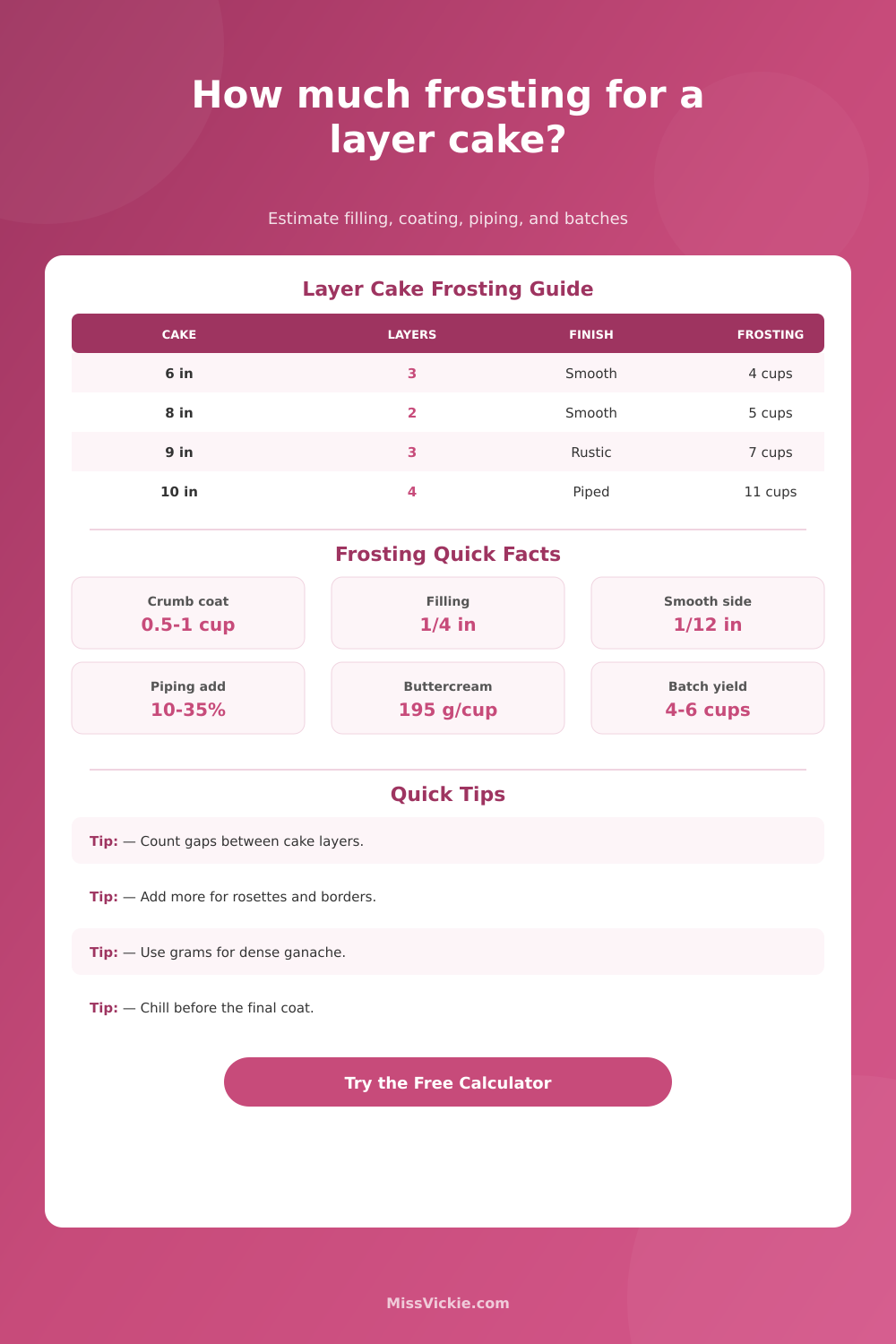
Next is the crumb coat. That’s the thin layer that traps the loose crumbs until the final finish goes on. You’d think this is nothing. But on a whole cake, it covers every inch. For a standard cake, that’s roughly 1/2 cup. If you’re working with multiples of those (for example, multiple cake layers for a tiered wedding cake), that amount start adding up fast. Depending on your cake, whether it has a lot of crumbs, and what type of finishing frosting you’re using (a dark one will help conceal any strays), there’s no such thing as too little or too much when it comes to the crumb coat. There’s even an option for none, light, standard, or thick.
If you have a dark cake, like a red velvet or chocolate, then “thick” might be your best bet. Any stray crumbs would appear as gray speckles against a white finished look. Having the correct setting here ensures that your final layer looks clean and isn’t ruined.
How much frosting does it take? This depends hugely on the side finish. If your cake has a rustic swoop, you’ll need far less then if it has a sharp edge with a smooth finish. You’re essentially creating a complete wall of cream all the way round. Where there’s sponge showing, there’s not so much to cover! Everything from a thin coat to a full rosette is an option in the calculator. A full rosette on the side might add almost half as much frosting again as a scraped finish. And that’s where they mess up, people think a decorative finish is purely about style, when actualy it’s about volume too.
The second part is: how heavy? How much does your frosting weigh, in terms of grams per cup? Does it pack a lot of weight into each cup (like say, American buttercream weighs ~195g per cup)? Or is it more airy (whipped cream weighs ~145g per cup)? Is it so heavy that you’ll get close to a pound (nearly 285g) per cup with a heavy chocolate ganache? Once you choose what kind of frosting, the tool will know the gram output to adjust for that. That’s key for when you’re doubling recipes. Doubling a batch of buttercream won’t give you the same weight as doubling a batch of meringue-based buttercream. Knowing this allow you to purchase enough sugar and butter.
Next comes the piping. Even a basic border isn’t nothing, but rosettes or a heavy dose of floral piping really start to eat into your frosting. Add some padding here for the frosting you will lose to scraping and any additional colors you might need to match.
The page also includes a handy reference chart below. It details what a fully piped ten inch cake needs. This is more like a dozen plus. This is why scale is important: as cakes get bigger they not only has to hold more, but also look good doing it.
At the end of the day, it’s all very precise, and veiled in artistry. A loaf of bread can be eyeballed; a layer cake cannot. Whether it’s a bare-bones semi-naked finish or an over-the-top piped masterpiece, knowing what kind of frosting you’ll require is the difference between a nervous last-minute trip to the grocery store versus a cool, collected cake assembly. You should of known that!
Adjust the inputs to suit your style: The math remains unchanged, but the result is completely yours.