Cornstarch to Thicken Sauce Calculator
Estimate cornstarch and water slurry for glossy stir-fry sauce, pan sauce, gravy, fruit sauce, sweet glaze, and acidic reductions without guessing at the stove.
🥘 Sauce Presets
Choose a real sauce situation, then adjust volume, target viscosity, current thickness, sugar, acidity, simmer time, slurry ratio, and serving temperature.
⚖ Sauce Details
Cornstarch slurry result
Your sauce thickening plan will appear here.
Calculation Breakdown
Stove Method
📏 Sauce Thickening Reference
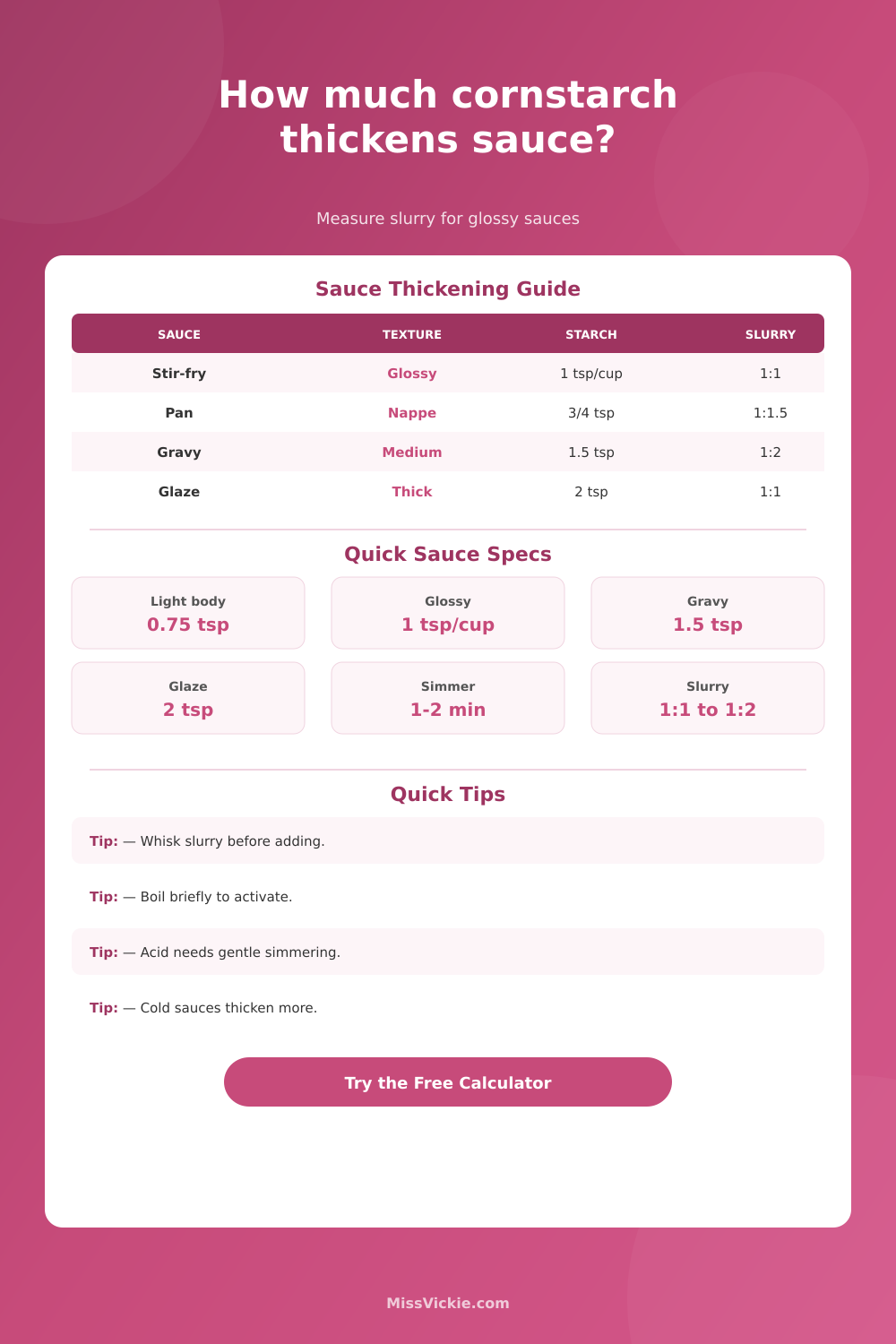
📋 Cornstarch Per Cup by Sauce Goal
| Target Viscosity | Typical Cornstarch | Best Sauce Use | Visual Cue | Cooking Note |
|---|---|---|---|---|
| Light body | About 3/4 teaspoon per cup | Brothy pan sauces, light noodle sauces, thin gravy adjustments | Sauce runs but no longer looks watery. | Add in one stage and stop as soon as the sauce looks cohesive. |
| Nappe spoon coat | About 1 teaspoon per cup | Pan sauce, stir-fry sauce, pot sticker sauce, savory reduction | Finger line through the spoon coating holds briefly. | Bubble 60 to 90 seconds while stirring to remove raw starch taste. |
| Glossy stir-fry cling | About 1 1/4 teaspoons per cup | Wok sauce for vegetables, noodles, chicken, beef, tofu, or seafood | Sauce shines and clings to food without pooling heavily. | Add to a hot pan near the end so vegetables stay crisp. |
| Medium gravy | About 1 1/2 teaspoons per cup | Turkey gravy, roast drippings, mushroom gravy, pot roast sauce | Sauce pours in a ribbon and covers the plate lightly. | Use a looser slurry so it disperses before lumps can set. |
| Thick glaze | About 2 teaspoons per cup | Teriyaki glaze, sweet chili sauce, barbecue glaze, wing sauce | Sauce coats a spoon heavily and clings to meat. | High sugar continues to tighten as it cools, so check after resting. |
| Very thick filling | About 2 1/2 teaspoons per cup | Fruit sauce, pie-style topping, chilled dessert layer | Sauce mounds softly before settling. | Cook until fully clear and glossy, then cool before judging final set. |
Cornstarch thickness varies with sauce solids, pan heat, stirring, salt, sugar, acid, and cooling. This calculator uses common kitchen ratios and reserves part of the slurry for gradual adjustment.
🔬 Acidity, Sugar, and Simmer Behavior
| Sauce Condition | Calculator Adjustment | Why It Matters | Best Slurry Ratio | Stirring Cue |
|---|---|---|---|---|
| Low acid, low sugar | Baseline | Stock, soy sauce, broth, and pan juices thicken predictably. | 1:1 to 1:1.5 | Whisk until the sauce turns glossy and bubbles evenly. |
| Balanced savory sauce | Slight increase | A little sugar, wine, or vinegar is common in stir-fry and pan sauces. | 1:1.5 | Stream in gradually while the sauce is simmering. |
| High acid sauce | Moderate increase | Lemon, vinegar, wine, and tomato can weaken cornstarch if boiled too long. | 1:1.5 to 1:2 | Add late, simmer briefly, and avoid extended boiling. |
| High sugar sauce | Small increase | Sugar can delay hydration, then the sauce may tighten after resting. | 1:1 to 1:1.5 | Look for clear gloss, then rest a spoonful for 30 seconds. |
| High acid and sugar | Larger increase | Sweet sour sauces need enough starch but should not be cooked hard for long. | 1:1.5 to 1:2 | Add in stages and stop just before the final thickness. |
| Creamy or dairy base | Slight decrease | Cream, butter, and cheese add body before starch is counted. | 1:2 | Keep heat gentle so the sauce does not split or scorch. |
🥘 Common Sauce Volumes
| Sauce Job | Typical Volume | Light Body | Glossy Cling | Thick Glaze |
|---|---|---|---|---|
| Small pan sauce for 2 servings | 1/2 to 3/4 cup | 1/2 teaspoon cornstarch | 3/4 teaspoon cornstarch | 1 to 1 1/2 teaspoons cornstarch |
| Stir-fry sauce for 4 servings | 1 to 1 1/2 cups | 3/4 to 1 teaspoon cornstarch | 1 1/4 to 2 teaspoons cornstarch | 2 to 3 teaspoons cornstarch |
| Gravy boat for family dinner | 2 to 3 cups | 1 1/2 to 2 1/4 teaspoons cornstarch | 2 1/2 to 4 teaspoons cornstarch | 4 to 6 teaspoons cornstarch |
| Party tray glaze or sauce | 4 to 6 cups | 1 to 1 1/2 tablespoons cornstarch | 1 2/3 to 2 1/2 tablespoons cornstarch | 2 2/3 to 4 tablespoons cornstarch |
| Batch sauce for meal prep | 8 to 10 cups | 2 to 2 1/2 tablespoons cornstarch | 3 1/3 to 4 1/4 tablespoons cornstarch | 5 1/3 to 6 2/3 tablespoons cornstarch |
🧪 Slurry Mixing Reference
Best for small stir-fry pans when you need strong thickening with little added liquid.
A good all-purpose ratio for pan sauce, gravy fixes, and glossy wok sauces.
Safer for larger pots because the starch disperses before it can form lumps.
Useful for delicate sauces, dairy sauces, and staged thickening near the end.
💡 Sauce Thickening Notes
The problem is that many times we find ourselves standing over a pot of sauce that looks more like water than anything else. Everything tastes great, you’ve reduced it down to perfection, yet it’s still watery.
Cornstarch is budget-friendly and safe bet. But when mixed dry, it make lumpy sauce, and throwing a heap into a pot will compromise your sauce’s consistency.
How to Use the Sauce Thickener Calculator
Input your desired thickness and volume of sauce. The calculator then does the math and tells you the exact amount of starch and cold water to combine to create a smooth solution instead of clumpy sludge.
So, starches has a core mechanism: they thicken through hydration. And when you drop cornstarch on a hot liquid, it doesn’t really soak up the water very effectiveley. It forms little white islands of raw powder that are nearly impossible to whisk out later.
That’s why the slurry is such an important step. When you whisk the starch with a cool liquid first, you disperse the granules before any heat comes along to make them clump together. And that’s what the tool considers by offering a choice of slurry ratios.
If you’re making something for a smaller pan, use a one-to-one slurry to get a thicker substance. Use a one-to-two slurry if you want something looser that will pour better onto a bigger pot full of stew or gravy.
So how do you know which to pick? Less precisely than you think! What you want is the ability to pour it in without making too big of a mess, and yet not dilute your sauce quite so much that it loses its flavor.
Thickening is not as simple as just measuring volumes might suggest; sugar and acid also makes things more complicated. If your sauce is heavy on the sugar (think fruit sauces or teriyaki glazes), then this can hinder the hydration of the starch. In the heat of the moment, your sauce may appear to be running thin, when in fact it will pull together greatly upon cooling.
Conversely, acidic ingredients, such as lemon juice or vinegar, can break down the starch molecules if they are boiled too aggressively. To handle these factors, the calculator increase its suggested cornstarch calculation for high-sugar or high-acid sauces. Basically, it’s adding a bit of wiggle room in case your reduction turns out runny.
For instance, the tool will recommend a bit of extra starch for a sweet and sour sauce compared to a plain old gravy. Why? It takes into account what happens in the pot, which is chemistry interfering.
There’s also the hidden variable of serving temperature. As a cornstarch-thickened sauce cools it behaves differently. If you serve a stir fry sauce right from the wok, what appeared just right may look too thin on the plate, where it sets up a bit more as it sits. Or maybe your fruit sauce should be thick enough to coat a spoon, even if it’s chilled first.
Do you want to serve this hot, warm, or chilled? The tool has you select this choice because it makes a difference. What the sauce tries to achieve as a finished product differ depending on the temperature. With a hot sauce, you judge it for its cling and gloss. With a cold sauce, you judge it for how well it holds its shape. They are small things but they matter.
Home cooks tend to overdo it with their starches, fearing that a bit less will result in an under-thickened sauce. And so the calculator recommends we do it in stages: Add three-quarters of your estimate, stir, and let it simmer for a minute or two to activate the starch. If it’s still too loose, add the rest. That way, there is no danger of going too far (as people often do) and making a nice glossed-up sauce into a gloopy paste.
On the page, the reference table explains this well; the various teaspoons required are matched up against the desired thickness levels. It is a visual reference for just what glossy or nappe should look like.
It does take some practice to learn how to trust the process. Watch the bubbles. After adding the slurry, the cornstarch thickened sauce should bubble vigorously for at least a minute. That’s long enough to ensure that granules are all gelatinized and to cook out any raw taste. If you rush it, there will be an unpleasant aftertaste (like paste). Take your time, and you’ll end up with a shiny and smooth sauce.
The numbers come from the calculator; patience and your eyes is the last line of quality control. Watch the bubbles, start with the slurry, then let the heat do the rest.