Fry oil depth, chicken displacement, headspace, batch load, and smoke point check
Oil to Fry Chicken Calculator
Estimate how much oil to pour into a pot or fryer for chicken wings, tenders, breasts, thighs, drumsticks, or mixed pieces while leaving room for hot expansion and bubbling.
📌Chicken Frying Presets
Choose a common chicken frying setup, then fine-tune the pot diameter, oil depth, chicken load, headspace, oil type, and safety margin.
⚖Pot, Oil, And Chicken Inputs
Oil And Safety Breakdown
📊Quick Reference Checks
🍗Chicken Cut Oil And Batch Table
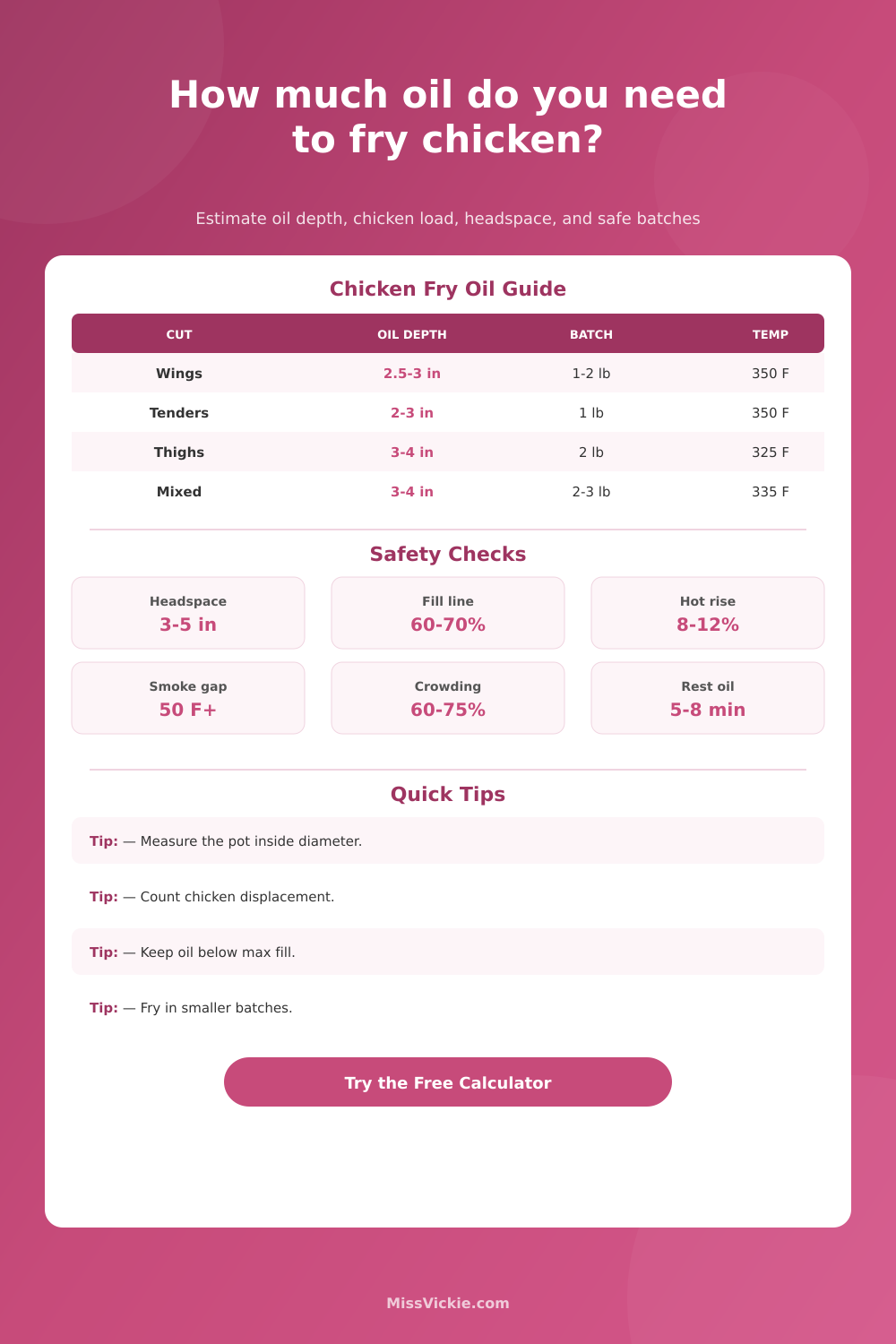
| Chicken Cut | Typical Oil Depth | Batch Load | Target Oil Temp | Displacement Rule |
|---|---|---|---|---|
| Wings or wingettes | 2.5 to 3 inches / 6 to 8 cm | 1 to 2 lb / 0.5 to 0.9 kg | 350 F / 177 C | About 0.38 qt per lb |
| Tenders or strips | 2 to 3 inches / 5 to 8 cm | 1 to 1.5 lb / 0.5 to 0.7 kg | 350 F / 177 C | About 0.32 qt per lb |
| Bone-in thighs | 3 to 4 inches / 8 to 10 cm | 1.5 to 2 lb / 0.7 to 0.9 kg | 325 F / 163 C | About 0.45 qt per lb |
| Drumsticks | 3 to 4 inches / 8 to 10 cm | 1.5 to 2 lb / 0.7 to 0.9 kg | 335 F / 168 C | About 0.43 qt per lb |
| Breast cutlets | 2.5 to 3 inches / 6 to 8 cm | 1 to 1.5 lb / 0.5 to 0.7 kg | 350 F / 177 C | About 0.34 qt per lb |
| Mixed bone-in pieces | 3 to 4 inches / 8 to 10 cm | 2 to 3 lb / 0.9 to 1.4 kg | 325 to 340 F / 163 to 171 C | About 0.46 qt per lb |
| Popcorn chicken | 2 to 2.5 inches / 5 to 6 cm | 0.75 to 1.25 lb / 0.3 to 0.6 kg | 350 F / 177 C | About 0.28 qt per lb |
| Whole small chicken | 4 to 5 inches / 10 to 13 cm | One bird only | 325 F / 163 C | Water-test first, then dry fully |
🌡Smoke Point And Temperature Table
| Oil Or Fat | Approx Smoke Point | Chicken Fry Range | Best Use | Calculator Warning |
|---|---|---|---|---|
| Peanut oil | 450 F / 232 C | 325 to 375 F | Classic deep-fried chicken | Good cushion at 350 F |
| Canola oil | 400 F / 204 C | 325 to 350 F | Home frying and tenders | Watch temps above 350 F |
| Vegetable oil | 400 F / 204 C | 325 to 350 F | Mixed chicken batches | Keep below sustained smoking |
| Soybean oil | 450 F / 232 C | 325 to 375 F | Large batches and wings | Good cushion at normal temps |
| Corn oil | 450 F / 232 C | 325 to 375 F | Bone-in chicken | Good high-heat choice |
| Sunflower oil | 440 F / 227 C | 325 to 365 F | Tenders and cutlets | Use refined high-heat oil |
| Safflower oil | 450 F / 232 C | 325 to 375 F | Crisp coating | Strong smoke cushion |
| Lard | 375 F / 190 C | 315 to 340 F | Traditional shallow fry | Small cushion at high temps |
| Light olive oil | 465 F / 241 C | 325 to 375 F | High-heat refined olive oil | Avoid extra-virgin oil here |
Smoke points vary by refinement, age, crumbs, and oil condition. Discard oil that smells burnt, foams excessively, or smokes at normal chicken frying temperatures.
📏Pot Size And Headspace Reference
| Inside Pot Diameter | 3 Inch Cold Depth | 4 Inch Cold Depth | Suggested Headspace | Common Chicken Load |
|---|---|---|---|---|
| 8 in / 20 cm | 2.6 qt / 2.5 L | 3.5 qt / 3.3 L | 3 in / 8 cm | 0.75 to 1.25 lb |
| 9 in / 23 cm | 3.3 qt / 3.1 L | 4.4 qt / 4.2 L | 3 in / 8 cm | 1 to 1.5 lb |
| 10 in / 25 cm | 4.1 qt / 3.9 L | 5.4 qt / 5.2 L | 3 to 4 in / 8 to 10 cm | 1.5 to 2 lb |
| 11 in / 28 cm | 4.9 qt / 4.7 L | 6.6 qt / 6.2 L | 4 in / 10 cm | 2 to 2.5 lb |
| 12 in / 30 cm | 5.9 qt / 5.6 L | 7.8 qt / 7.4 L | 4 to 5 in / 10 to 13 cm | 2.5 to 3 lb |
| 14 in / 36 cm | 8.0 qt / 7.6 L | 10.7 qt / 10.1 L | 5 in / 13 cm | 3 to 4 lb |
🚦Chicken Frying Safety Margins
Cold oil rises when chicken, basket, bubbling, and heat expansion are added.
More headspace is better for bone-in, wet, or frozen chicken pieces.
Keep the practical basket load below full capacity so temperature recovers faster.
A bigger gap gives more room for burner swings and thermometer lag.
💡Oil Level Notes
When deep frying chicken, pay close attention to your pot capacity and amount of oil. Make sure that you have sufficient space in your pot to be able to add the meat without the oil spilling over. If the oil doesn’t have any headspace it will overflow and become a fire hazard. To avoid this, keep in mind that the difference often comes down to having about three inches of headspace. This is necessary so that the oil can bubble and displace.
Pouring some oil into a pot should be pretty straightforward right? Well not exactly… That meat takes up some space in there. When the chicken goes into the pan, raw chicken take up only the same amount of volume it did when it was out of the water. So as soon as the chicken touches the pan, the oil level jumps up. But what if the pot is at capacity first? Then the oil spills over.
How to Fry Chicken Safely and Well
This is where the tool comes in. The tool estimates how much the oil level will rise based off two things: (1) the weight of the chicken and (2) the inner diameter of your pan. It even figures in the fact that the hot oil expand. Moisture being released from the meat causes violent bubbling, this is also figured into the equation.
You can’t really guess how much oil you need. You need to understand the shape of your cooking vessel. Most Dutch ovens taper toward the bottom. That creates an issue because the bottom will hold less volume than the top. So if you measure how much oil goes into the pot from the top, you might believe there’s plenty of room when actualy there isn’t as much as you thought. When working with a straight-sided stockpot you know what you’re getting: linear displacement which makes for more consistent results. The tool accounts for your cookware shape and adjusts its formulas accordingly.
Safety concerns aside, you don’t want to fry wings in an oil that breaks down at low temperatures. Different oils also has different smoke points. Don’t exceed these smoke points. Doing so will produce unhealthy compounds and introduce unwanted flavors into your food. For example, extra-virgin olive oil and lard break down at lower temperatures. Soybean and peanut oil is more suitable for high-heat applications such as frying. Their comfort zone provides a healthy margin of safety for frying wings. Maintain a minimum difference of fifty degrees between your oil’s smoke point and your frying temperature. This includes fluctuating burners and lagging thermometers. Refer to this chart on the page for smoke points of various fats and whether they can withstand three hundred fifty degrees without going up in smoke.
Another error is crowding the pot. When you overload your fryer, the oil temperature will fall. Once this happens, the chicken absorbs heat faster then your burner can replace it. The end result is soggy, greasy chicken. Instead of properly cooking the meat, oil soaks into it. To avoid this issue, maintain the batch load at no more than sixty to seventy-five percent of the pot’s capacity. This enables rapid recovery for each piece while waiting in line.
Knowing how much chicken fits safely before it causes the oil to overflow is just as critical as knowing how much oil you’ll need. It is about safety and crispiness. Because when a batter is moist, it gives off steam quickly. That in turn makes the oil bubble-up farther than it does with a drier coating of flour. You can enter how much moisture your batter contains into the calculator. It will account for that by giving you additional head space allowances if your coatings is on the wet side.
And so it makes you think about the physics of frying. It shifts the focus from just the recipe. “Displacement makes it easy. It takes the nervousness out of frying. You know exactly how much oil to put in. You have enough room for an air gap. You know exactly how much oil to put in and that you’ll have enough room for an air gap. And because the math keeps all the oil in the pot, it comes out perfect.”