Flour Cups Per Pound Calculator
Convert flour pounds, cups, and grams with flour-specific cup weights, measuring style adjustments, batch scaling, and practical cup rounding for baking.
🍞 Baking Conversion Presets
Choose a real baking scenario, then fine-tune the flour type, amount, measuring method, batch multiplier, and rounding preference.
⚖ Flour Conversion Details
Flour conversion result
Your flour conversion will appear here.
Conversion Breakdown
Kitchen Rounding
📊 Quick Flour Benchmarks
The cup weights below use common spoon-and-level baking weights; actual flour density changes with brand, humidity, sifting, and how firmly the cup is filled.
📘 Flour Weight Reference Tables
| Flour Type | Base Cup Weight | Cups Per Pound | Ounces Per Cup | Best Recipe Use |
|---|---|---|---|---|
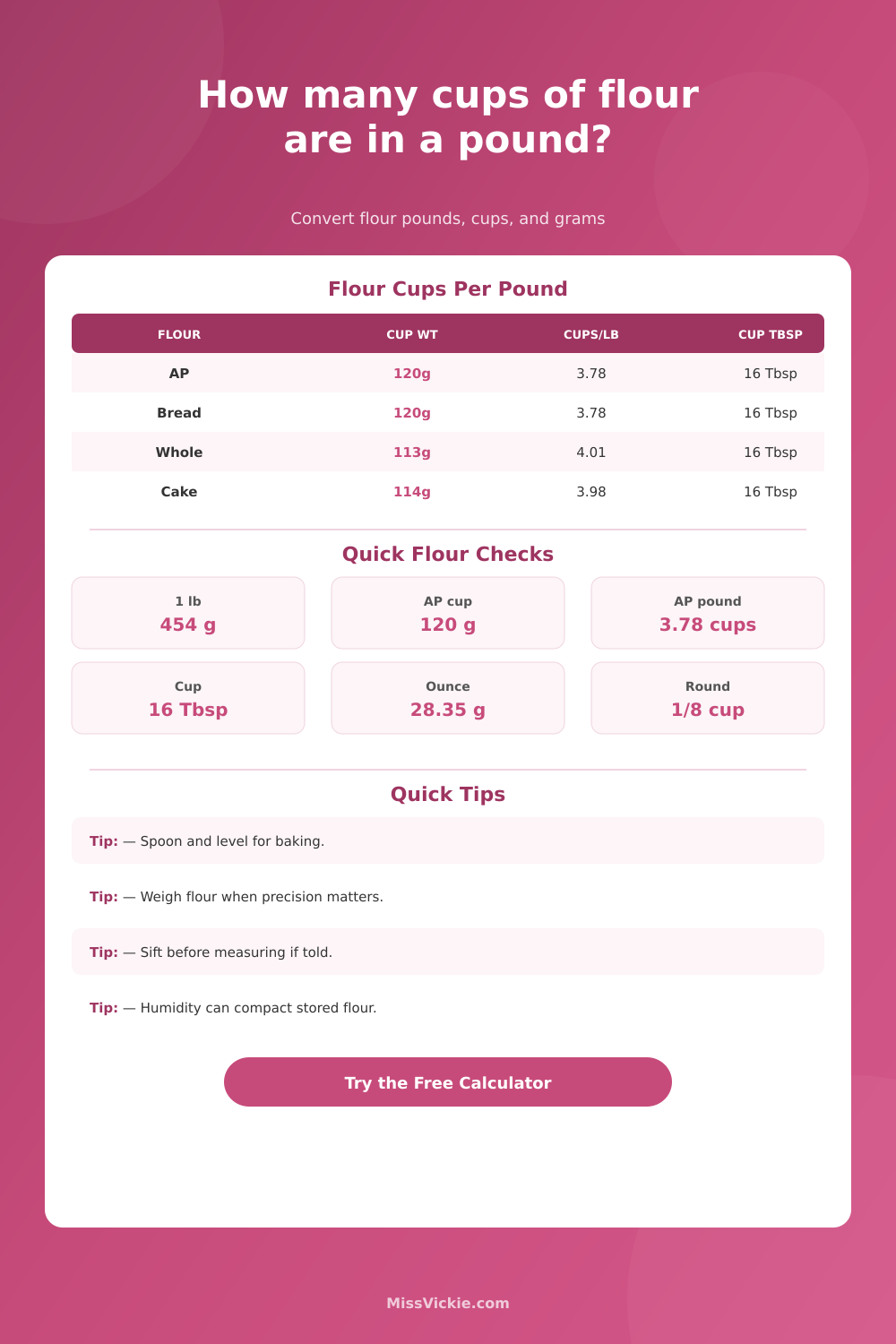
| All-purpose flour | 120 g per cup | 3.78 cups per lb | 4.23 oz | Cookies, muffins, pancakes, pie dough, and general baking. |
| Bread flour | 120 g per cup | 3.78 cups per lb | 4.23 oz | Yeasted loaves, pizza dough, bagels, rolls, and chewy breads. |
| Whole wheat flour | 113 g per cup | 4.01 cups per lb | 3.99 oz | Whole grain breads, muffins, pancakes, and hearty doughs. |
| Cake flour | 114 g per cup | 3.98 cups per lb | 4.02 oz | Layer cakes, sponge cakes, tender cupcakes, and fine crumbs. |
| Pastry flour | 106 g per cup | 4.28 cups per lb | 3.74 oz | Biscuits, scones, tart shells, tender cookies, and pie pastry. |
| Self-rising flour | 113 g per cup | 4.01 cups per lb | 3.99 oz | Biscuits, quick breads, pancakes, and Southern-style bakes. |
| Rye flour | 106 g per cup | 4.28 cups per lb | 3.74 oz | Sourdough blends, rye loaves, crackers, and dense breads. |
| Almond flour | 96 g per cup | 4.72 cups per lb | 3.39 oz | Cookies, cakes, crusts, macarons, and gluten-free baking. |
| Measuring Style | Density Effect | What Happens To Cups Per Pound | Use When | Calculator Adjustment |
|---|---|---|---|---|
| Spoon into cup and level | Baseline cup weight | Standard cups per pound | The recipe simply says cups of flour. | 100% of listed grams per cup. |
| Aerated before scooping | Slightly lighter cup | More cups for the same pound | The flour was stirred or fluffed before measuring. | 96% of listed grams per cup. |
| Sifted before measuring | Much lighter cup | Noticeably more cups per pound | The recipe says sifted flour, then measure. | 88% of listed grams per cup. |
| Dip cup and sweep | Heavier cup | Fewer cups for the same pound | You scoop directly from the bag or canister. | 110% of listed grams per cup. |
| Packed or compressed cup | Very heavy cup | Far fewer cups per pound | The flour is firmly pressed or settled in storage. | 118% of listed grams per cup. |
| Humid pantry or compacted bag | Moderately heavy cup | Slightly fewer cups per pound | Flour has settled during storage or absorbed moisture. | 105% of listed grams per cup. |
| Package Weight | All-Purpose Flour | Whole Wheat Flour | Pastry or Rye Flour | Almond Flour |
|---|---|---|---|---|
| 1 pound | 3.78 cups | 4.01 cups | 4.28 cups | 4.72 cups |
| 2 pounds | 7.56 cups | 8.03 cups | 8.56 cups | 9.45 cups |
| 5 pounds | 18.90 cups | 20.07 cups | 21.40 cups | 23.62 cups |
| 10 pounds | 37.80 cups | 40.14 cups | 42.79 cups | 47.25 cups |
| 25 pounds | 94.50 cups | 100.35 cups | 106.98 cups | 118.12 cups |
| Recipe Amount | AP Flour Weight | Whole Wheat Weight | Cake Flour Weight | Kitchen Note |
|---|---|---|---|---|
| 1 cup | 120 g / 0.26 lb | 113 g / 0.25 lb | 114 g / 0.25 lb | A small weight difference can matter in cakes and bread dough. |
| 2 cups | 240 g / 0.53 lb | 226 g / 0.50 lb | 228 g / 0.50 lb | Good reference for a small batch of muffins or pancakes. |
| 3 cups | 360 g / 0.79 lb | 339 g / 0.75 lb | 342 g / 0.75 lb | Common loaf-bread range before hydration is added. |
| 4 cups | 480 g / 1.06 lb | 452 g / 1.00 lb | 456 g / 1.01 lb | Close to one pound for many flour types, but not exact for AP. |
| 8 cups | 960 g / 2.12 lb | 904 g / 1.99 lb | 912 g / 2.01 lb | Useful for doubled recipes and large pie or biscuit batches. |
🧁 Flour Comparison Grid
Reliable baseline for most home baking when spooned and leveled.
Lighter per cup, so a pound measures a little over four cups.
Lower cup weight means a pound stretches into more measured cups.
Much lighter per cup than wheat flour, so volume rises quickly.
💡 Flour Measuring Notes
How much can you make with a 5lb bag of flour? That’s the question most home bakers ask when they buy flour. And here’s the problem: Weight isn’t the same thing as volume when it comes to dry goods. Mass is measured in pounds; space is measured in cups.
To close this gap, we need to consider density. Different types of flours has different densities, as do different ways of packing into the cup. Once you specify which kind of flour and what style you use to measure, the calculator do the rest. Then you’ll know how many cups you’ll get out of that one pound of white stuff.
How to Convert Pounds of Flour to Cups
Most conversions we do in the kitchen start from all-purpose flour. When spooned into a measuring container and leveled off, one cup weigh around twelve grams. In other words, 1 lb = approximately three and three-quarter cups. But what happens when you use whole wheat flour? Since whole wheat flour is airy and light, you gets slightly over four cups per pound. Why? The bran flakes leave small pockets of air which decreases the density of the flour.
Even cake flour is lighter still. They weighs fewer gram per cup. Using one instead of the other will result in a denser loaf (read: a brick) rather than a tender crumb. To avoid this, you must compensate by weighing your ingredients. And this is where the table below becomes useful.
Here’s a visual breakdown of how many cups equal a pound based off the grain. The biggest variable in this equation is the baker’s hand and how they measure. What type of flour you buy also matters. For example, bread flour weigh differently than all-purpose flour, which in turn, weighs differently from pastry flour.
But how do you actualy measure the flour? Many professional bakers weigh their ingredients because it removes the guesswork of air pockets and moisture content. But that math can still help bridge the gap. But we live in the real world where most home cooks don’t have scales so I’m working to give them some good advice to help ensure accurate results without one.
The gold standard of measurement for accuracy is called “spoon and level.” Basically, you simply scoop flour into your measuring cup until it’s full but don’t pack it down then swipe away any extra above the rim with a knife or other utensil. That ensures the same amount of flour each time.
Most folks will grab their measuring cup and stick it in the bag of flour. That compacts the flour, squeezing out air. It greatly (and I mean greatly) adds weight per cup. So what happens? There is twenty to thirty percent more flour in the cup than the recipe calls for.
The flour calculator take that into account too. You can pick your method of measuring flour and the calculator will adjust accordingly. And then it will adjust your number of grams per cup to match. So if you dip your cup, it thinks that’s more weight, and so less cups per pound overall. And that’s the bit most folks are getting tripped up on. A cup is not a cup. There’s physics to how it gets compacted.
Here’s another twist, sifting. There are recipes that require sifted flour. Sifted flour is lighter (fluffier) than unsifted flour. Depending on how much you sift, each cup will be lighter. Therefore, you’ll have to use additional cups to get to a pound. On the other hand, when measured first and then sifted, it will heavier by cup. You can notice this slight difference when making delicate baked goods such as macarons or even sponge cakes. The exact ratio matter.
Humidity does matter too. When storing your flour in a humid environment, the flour will absorb moisture and become heavier and denser. This results in heavier (more dense) flour which means you gets fewer cups per pound. This is why professional bakers use weights rather than measurements. They do not have to guess if flour has moisture or air pockets.
This gets difficult for casual home cooks when it comes to doing recipes in batches. Doubling the recipe isn’t as simple as doubling the number of cups. You have to make sure your volume conversions works. For example, if a recipe says half a pound of bread flour, what does that convert to? Almost two cups. What happens when you double it? How do you figure out how much total flour you’ll need for a half- or even party-sized batch?
Or what about rounding off? Three point seven eight cups is an exact decimal; who wants to go measuring all day in their real kitchen? Get it rounded to the next quarter cup or eighth and suddenly this plan becomes actionable. There’s a small margin of error, but it can be managed.
Making food (for one person or many) relies on knowing how much of the stuff is there. This calculator connects what came out of that bag with what went into that bowl. It converts density from physics class into an easy kitchen lesson. Yes, you’ll continue to rely on hand-feel, but at least you’re beginning in the correct spot. Knowing what it is that gets measured is key to pulling off the rest of the magic. When you see the connection between volume and weight, it no longer seems mysterious. No more guesswork, just intentional baking.