Eggs Per Omelette Calculator
Estimate whole eggs, extra whites, beaten egg volume, filling capacity, pan batches, and nutrition for folded omelettes, diner-style plates, meal prep, and brunch service.
🍳 Omelette Presets
Choose a real kitchen scenario, then fine-tune egg size, appetite level, fillings, pan diameter, and extra whites.
⚖ Omelette Sizing Details
Your omelette egg plan
Enter your omelette details to calculate the egg count.
Egg Breakdown
Cooking Breakdown
📊 Omelette Batch Snapshot
📘 Egg Size Reference
| Egg Size | Edible Weight | Approx Volume | Calories | Protein |
|---|---|---|---|---|
| Small egg | 38 g without shell | About 2.5 tbsp or 37 ml | 54 cal | 4.8 g |
| Medium egg | 44 g without shell | About 2.9 tbsp or 43 ml | 63 cal | 5.5 g |
| Large egg | 50 g without shell | About 3.25 tbsp or 48 ml | 72 cal | 6.3 g |
| Extra-large egg | 56 g without shell | About 3.7 tbsp or 54 ml | 80 cal | 7.0 g |
| Jumbo egg | 63 g without shell | About 4.1 tbsp or 61 ml | 90 cal | 7.9 g |
Egg weights follow common USDA sizing for edible whole egg; kitchen volume is approximate because yolk-to-white ratio varies.
🍳 Style, Pan, and Egg Count Table
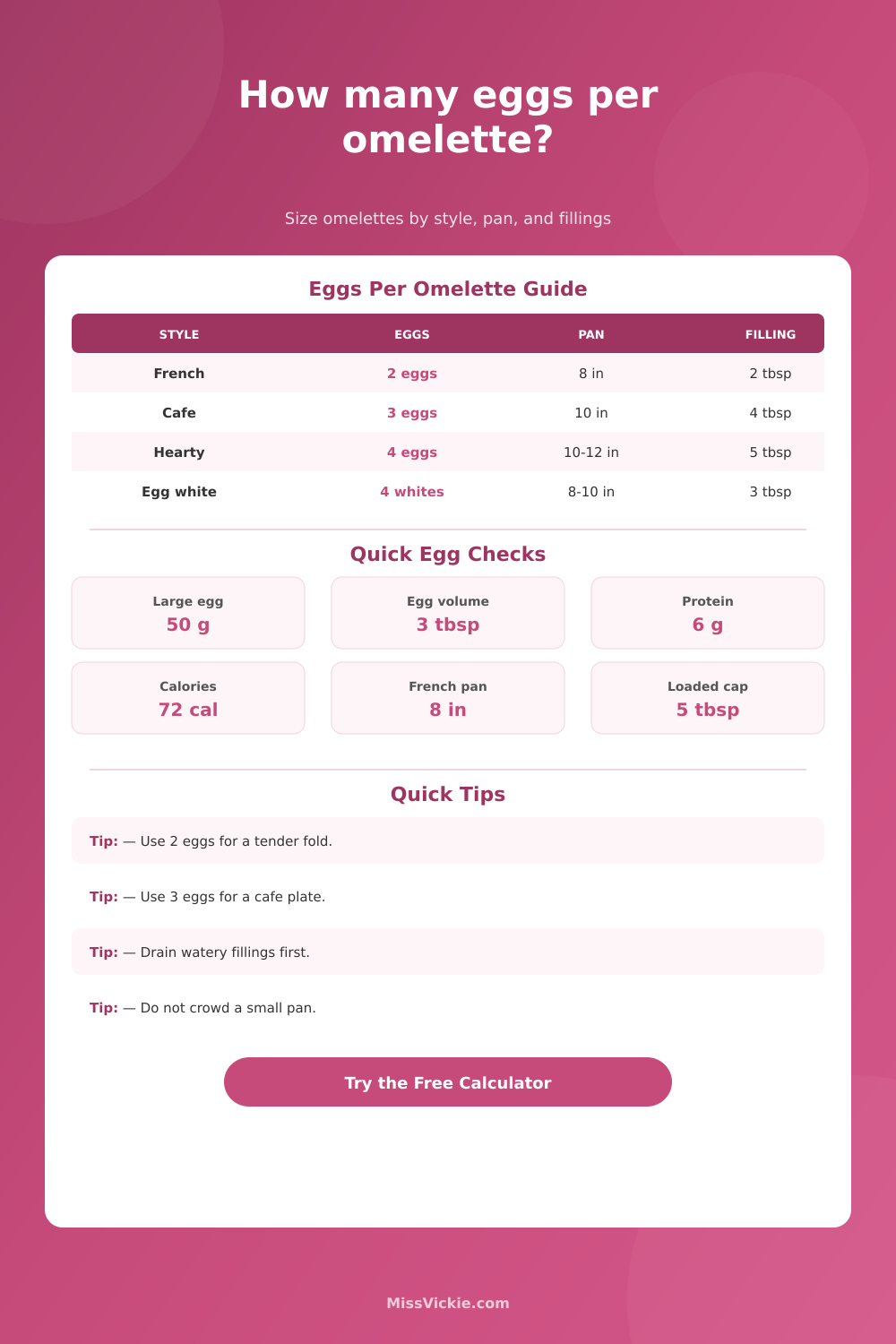
| Omelette Style | Typical Eggs | Best Pan | Texture Goal | Cook Cue |
|---|---|---|---|---|
| French-style tender fold | 2 large eggs | 8-inch skillet | Thin, soft, barely browned | Roll while top still looks glossy. |
| Classic home omelette | 2 to 3 large eggs | 8 to 9-inch skillet | Foldable with gentle curds | Fill when top is softly set. |
| Cafe 3-egg omelette | 3 large eggs | 9 to 10-inch skillet | Thicker diner-style plate | Cook lower if filling is heavy. |
| Hearty loaded omelette | 3 to 4 large eggs | 10 to 12-inch skillet | Sturdy base for fillings | Keep fillings warm and drained. |
| Egg-white omelette | 4 to 5 whites | 8 to 10-inch skillet | Lean, pale, high-protein | Use lower heat to prevent toughness. |
🫕 Filling Limit Reference
| Filling Load | Safe Amount Per Egg | Moisture Risk | Best Use | Preparation Note |
|---|---|---|---|---|
| Plain eggs only | 0 tbsp per egg | Very low | French folds, kids plates | Season the beaten eggs lightly. |
| Light herbs or cheese | 1 tbsp per egg | Low | Two-egg breakfast omelettes | Finely chop herbs and shred cheese. |
| Standard cheese and vegetables | 1.5 tbsp per egg | Medium | Home breakfast or brunch | Pre-cook mushrooms, peppers, and onions. |
| Loaded meat and vegetables | 2 tbsp per egg | Medium-high | Diner-style omelettes | Warm fillings before adding to the eggs. |
| Watery vegetables | 1 tbsp per egg | High | Spinach, tomato, zucchini | Cook or squeeze out extra moisture first. |
| Extra meat or protein | 1.75 tbsp per egg | Medium | Ham, sausage, chicken, tofu | Dice small so the omelette folds cleanly. |
👥 Common Omelette Quantity Table
| Service Size | Tender 2-Egg Style | Cafe 3-Egg Style | Loaded 4-Egg Style | Egg-White Style |
|---|---|---|---|---|
| 1 omelette | 2 whole eggs | 3 whole eggs | 4 whole eggs | 4 to 5 whites |
| 2 omelettes | 4 whole eggs | 6 whole eggs | 8 whole eggs | 8 to 10 whites |
| 4 omelettes | 8 whole eggs | 12 whole eggs | 16 whole eggs | 16 to 20 whites |
| 8 omelettes | 16 whole eggs | 24 whole eggs | 32 whole eggs | 32 to 40 whites |
| 12 omelettes | 24 whole eggs | 36 whole eggs | 48 whole eggs | 48 to 60 whites |
💪 Nutrition Comparison Grid
About 12.6 g protein before fillings, butter, or cheese.
About 18.9 g protein for a fuller diner-style omelette.
About 14.4 g protein with little fat from the egg base.
Adds about 3.6 g protein and 2 tbsp liquid volume.
💡 Omelette Sizing Tips
7 AM heartbreak is unique. You carefully whisk together a few eggs in anticipation. You crack them open. Then you see they all slide off the side of your skillet in a tidal wave of regret.
Why? Because you forgot breakfast geometry. To save yourself from this fate, there’s an egg-per-omelette calculator (above) to do the maths for you based off your preferred fillings and pan size. But it’s more than simply tallying up number of eggs. It’s grasping the structural capacity of cooked protein.
The Secret to Perfect Omelettes
Why do most home cooks sticks with two or three eggs? It’s not necessarily instinctive. Omelettes are different than scrambled. Do you want a light and delicate pale cylinder (French) or would you prefer a fluffy, soft scrambler? (The latter needs fewer egg.) Depending on your style, one generally should of use no more than two big eggs in an eight-inch pan.
If you try to force too many eggs into that same small pan, the bottom browns before center sets. This means you get a hard mess instead of a neat fold. There isn’t enough heat reaching the top layer to cook it through, which results in a broken scramble instead of a clean omelette. So depending on the style you choose, number of eggs will be changed up or down according to its volume-to-surface-area ratio.
But then there is the issue of filling. Most recipes just mess this up. You shouldn’t be able to put as much ham and cheese as you want into every omelette, right? There is a tensile strength limit on an egg sheet. Too much filling, and as you attempt to fold it, the structure give way. The tool considers how much filling you use to recommend a safe ratio.
Fillings that are watery (like spinach or fresh tomatoes) also give off moisture and steam while cooking. That moisture breaks down the egg structure, and if you choose high-moisture fillings, the calculator will often recommends using a bigger pan or slightly more eggs. A small thing, but it helps keep the omelette together.
Another variable that doesn’t get enough attention is egg size. And we all think big means normal; most of the time, yes. Except when you’re using jumbo eggs (if you buy them at a local farm) and your egg contains so much more than it used to. Making an omelette with the same number of jumbos as larges will result in a heavy-duty, thick thing that won’t cook up evenly. Here’s where the volume/weight table on the page comes in: a quick and clear explanation of how weight equals volume. It is a conversion chart, not just a set of recipes. Want to be sure you’re pouring just enough into the skillet? It works no matter what shell looks like.
But when you’re cooking for a crowd it’s a different tempo altogether. One omelette is a solo performance; twelve are a logistics operation. With the calculator, you can batch the eggs and not have to crack the shells in a hurry as the first omelette gets cold. It tells you exactly how many eggs will feed the whole group, including if they want multiple small omelettes vs a big platter. That way, you don’t run out of eggs halfway through serving your guests. And it estimates how much active time will be spent on stove. So you have an idea of how long you’ll be chained to the stove.
And then there’s that protein aspect. For all those who desire more filling but less fattening than a three-yolk omelette, it lets you include some whites for an added boost. You’ll be able to control the richness while scaling up or down on protein and overall volume. This is a clever tweak to make your meal more personally for your nutrition, rather than changing the actual size of the food being served. That means it has a lighter footprint but offers the same plate-filling experience. The nutrition breakdown per omelette are displayed as well. No guessing games here.
Flair is not what makes someone a master at the omelette. It’s all about ratios: the right amount of egg, the right size pan, the right amount of fillings. Get your ratios correct and it folds on its own. The egg holds. The filling does not escape. You have one of those sure-handed, no-napkin-needed breakfasts that leaves you feeling like a champ. Get the number right and the rest works out.