Prime Rib Cooking Time Per Pound Calculator
Estimate prime rib roast timing from weight, grade, bone style, oven temperature, starting temperature, doneness, sear method, resting plan, and thickness.
🥩 Prime Rib Presets
Choose the closest roast plan, then adjust the inputs for your oven, rib count, starting temperature, and target finish.
⚖ Roast Inputs
Prime rib timing plan
Enter roast details to estimate cooking time.
Roast Setup
Timing Math
Cooking Schedule
📊 Prime Rib Snapshot
🌡 Doneness And Safe Temperature Table
| Finish | Final Center Temp | Typical Pull Range | Texture | Safety Note |
|---|---|---|---|---|
| Rare | 125°F / 52°C | 112-118°F | Very red, soft center | Below USDA minimum for beef roasts. |
| Medium rare | 130-135°F / 54-57°C | 118-126°F | Warm red-pink center | Popular restaurant finish, below USDA minimum. |
| Medium | 140°F / 60°C | 128-134°F | Pink center, firmer slices | Close to minimum; verify after rest. |
| USDA roast minimum | 145°F / 63°C | 132-138°F | Light pink, firmer center | USDA minimum for beef roasts with 3 minute rest. |
| Medium well | 150°F / 66°C | 138-144°F | Trace pink, firm slices | Above roast minimum. |
| Well done | 160°F / 71°C | 148-154°F | Little pink, drier texture | Above roast minimum. |
A thermometer in the thickest center is more reliable than any per-pound estimate.
⏲ Method Time Per Pound Table
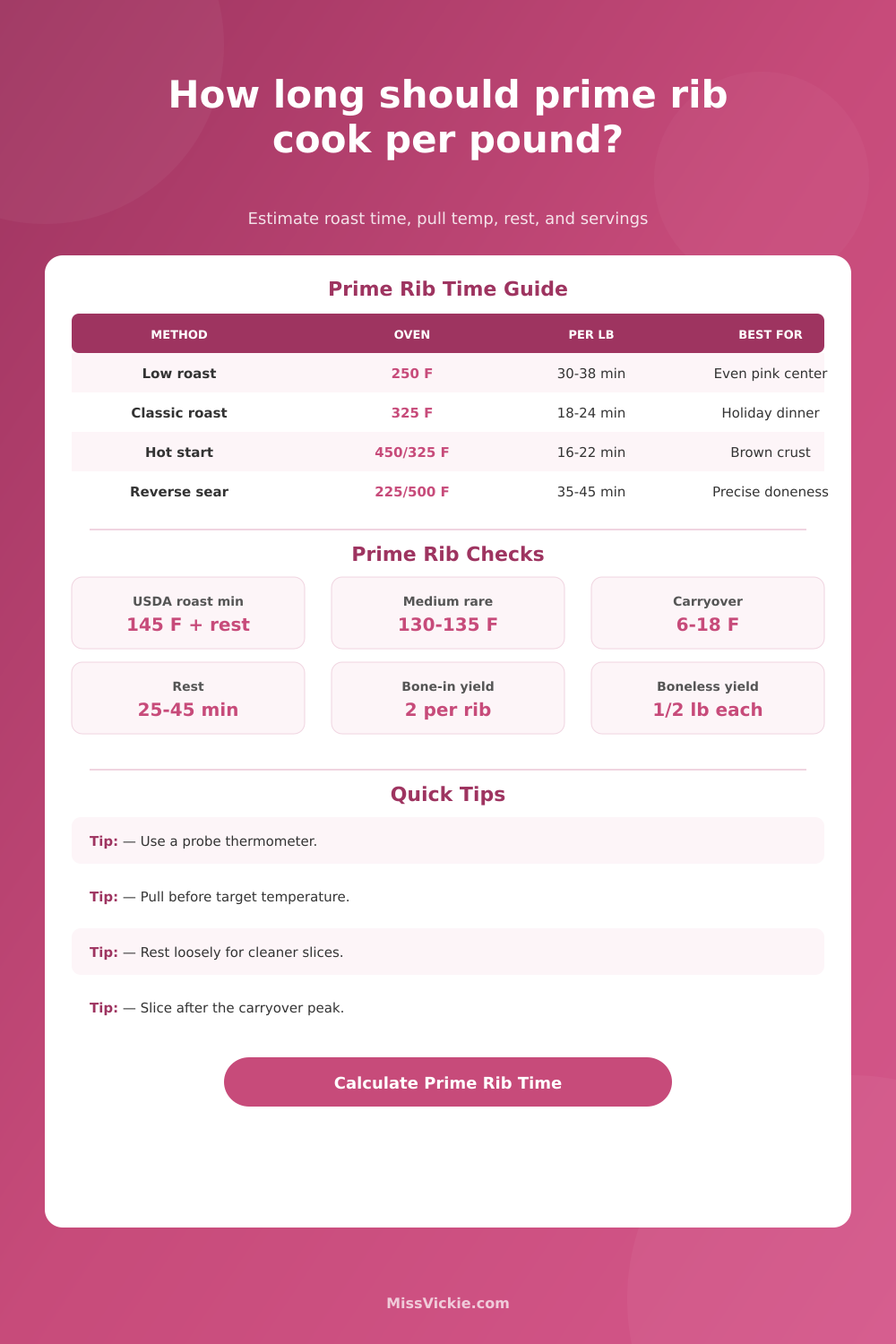
| Method | Main Oven Temp | Approx Per Pound | Sear Time | Best Use |
|---|---|---|---|---|
| Steady low roast | 225-250°F | 32-45 min/lb | Optional finish | Most even center-to-edge color. |
| Classic roast | 300-325°F | 18-26 min/lb | Optional hot start | Holiday timing with balanced browning. |
| Hot start then roast | 450°F then 325°F | 16-24 min/lb | 15-20 min at start | Crust without a final blast. |
| Reverse sear | 200-250°F then 500°F | 35-48 min/lb | 8-12 min at end | Precise doneness and crisp crust. |
| Higher steady roast | 350-400°F | 13-19 min/lb | Usually none | Faster roast with more gray band risk. |
🍽 Yield And Serving Table
| Roast Type | Planning Rule | Cooked Yield | Best Slice Size | Notes |
|---|---|---|---|---|
| Bone-in standing rib | 1 rib serves about 2 adults | 58-64% | 8-10 oz cooked | Bone weight lowers carved yield. |
| Bones tied back | 2 adults per rib section | 60-66% | 8-10 oz cooked | Easy carving with bone flavor. |
| Boneless rib roast | 1/2 lb raw per adult | 66-72% | 6-8 oz cooked | Higher yield and faster slicing. |
| Large-end roast | Plan extra trim | 55-62% | 8-10 oz cooked | More cap and fat pockets. |
| Dry-aged roast | Plan 5-10% more raw weight | 55-63% | 6-8 oz cooked | Trimming and moisture loss reduce yield. |
🔥 Oven Temperature Comparison
| Oven Setting | Speed | Crust | Carryover | Tradeoff |
|---|---|---|---|---|
| 200-225°F | Slowest | Needs final sear | Low to medium | Very even doneness but longer schedule. |
| 250°F | Slow | Light crust | Medium | Good balance for reverse sear. |
| 300-325°F | Moderate | Good browning | Medium to high | Classic holiday compromise. |
| 350-400°F | Fast | Strong crust | High | More outer doneness band. |
| 450-500°F sear | Short blast | Strongest crust | Depends on timing | Use before or after main roast, not as the whole cook. |
📝 Prime Rib Method Comparison
Best when dinner timing matters and a moderate crust is enough.
Best for even pink slices and a crisp final crust right before carving.
Best for a browned exterior without moving the roast at the end.
Best for thick roasts where gentle heat protects the center.
💡 Prime Rib Timing Tips
It’s two hours before the guests arrive and there’s this three pound bone in prime rib roast staring at you from its tray. And then you look at the clock and then it looks at you. Twenty minutes a pound for medium rare, or so old rule goes. Sounds easy enough until you recall your oven is running hot, or your roast was pulled fresh from a thirty eight degree fridge.
Things you cannot see makes calculating prime rib cooking time per pound difficult; that’s where a prime rib cooking time per pound calculator comes in to save your evening. After plugging in your desired doneness and weight, it crunches the numbers while you go think about how you’ll pull off all those side dish.
Why Use a Prime Rib Cooking Calculator
Cooking times aren’t just about weight either. Bones is heat sinks and slow down the heat transfer from outside to inside, so a seven pound roast with bones will take longer then a seven pound boneless one. To adjust for that (and account for other factors like type of bone), you can specifies your grade and bone style on the calculator, and it’ll tweak the internal model accordingly based off how fast the heat goes in.
Now maybe you’re thinking “well yeah, if I crank up the heat, I can speed things up”. Not quite. The higher temp change the relationship between pinky middle and gray band, so if you don’t change your pull time, you’ll wind up with a raw middle and well-done edges. The tool estimates the sweet spot where you get center to hit target while keeping the crust under control. It’s a balancing act.
Beef also gets roasted wrong: Many people confuse doneness when making roast beef. We tend to cook to what we desire at the end. I.e., what we’ll serve ourselves on our plates. For a big hunk of dense meat such as prime rib, carryover cooking matter a lot. After removing it from the heat source, it continues to cook and its internal temp will increase by as much as 10-20 degrees.
So if you take it off when it’s reading one thirty five degrees on thermometer, sitting there on the rack, it will push up into medium territory before you even think about carving. The pull temperature you get back from the calculator is less than your desired final temp because it takes into account leftover rise in temp while resting.
A 25 minute wrap-in-foil rest provides enough time for heat to move into the middle of the roast, but not so much that the outside steams away and the juice redistributes. By then, the heat has had time to migrate inward and even out temperature gradient. Cut right away and inside will be considerably cooler than edges. Longer holds is available for resting meat; shorter ones for quick carvers. Just select what works best with your service schedule from the calculator.
Which should you choose? If you want precision or know that your oven has some oddities, use a reverse sear. Start low and slow to bring up the inside gently. Finish with high heat to get the crust. That’s going to take longer in terms of total kitchen time, but you’ll have even doneness. To make it easier and quicker, go with a hot start: Four hundred fifty degrees at first to set the outside, then drop down to three twenty five. You run the risk of an uneven gradient here (unless you keep your eye on it), but it’s fast and simple. It all comes clear from chart on page, which presents the trade-offs between speed and precision.
A good probe thermometer inserted into the center (thickest) portion of roast is better than any formula. There are variables and physics involved, so the calculator is simply an estimate. Each roast differ in shape. Every oven’s a little different. Use the numbers as an estimate to get you close, but make your final call with what you see, feel, and taste.
Confidence at the table matters more then being perfectly accurate on paper. When you stab into that roast with that knife and notice a rosy edge all the way across, you’ll know it was cooked just right. You should of used the calculator earlier to be sure. Actualy, the meat looks realy luxurios.