Water Bottles Per Liter Calculator
Convert liters into water bottles and plan event hydration from bottle size, guests, hydration target, case pack, refill buffer, serving period, and event type.
💧Water Bottle Presets
Choose a common kitchen, party, or catering water plan, then adjust the liters, bottle size, guest count, target, case pack, buffer, and serving period.
⚖Water Planning Inputs
Water bottle plan
Your water bottle estimate appears here.
Bottle Conversion
Guest Hydration
Case And Service Plan
📌Quick Bottle Size Cards
🔍Bottle Size Comparison Grid
Best for kids meals, boxed lunches, and settings where half bottles are common.
Works well for short indoor meals, picnics, and lower-waste snack tables.
The easiest event planning size because two bottles equal one liter.
Good for active service, outdoor heat, and guests who carry one bottle longer.
📘Bottles Per Liter Reference Table
| Bottle size | Size in ml | Bottles per liter | Liters per 24-pack | Best use |
|---|---|---|---|---|
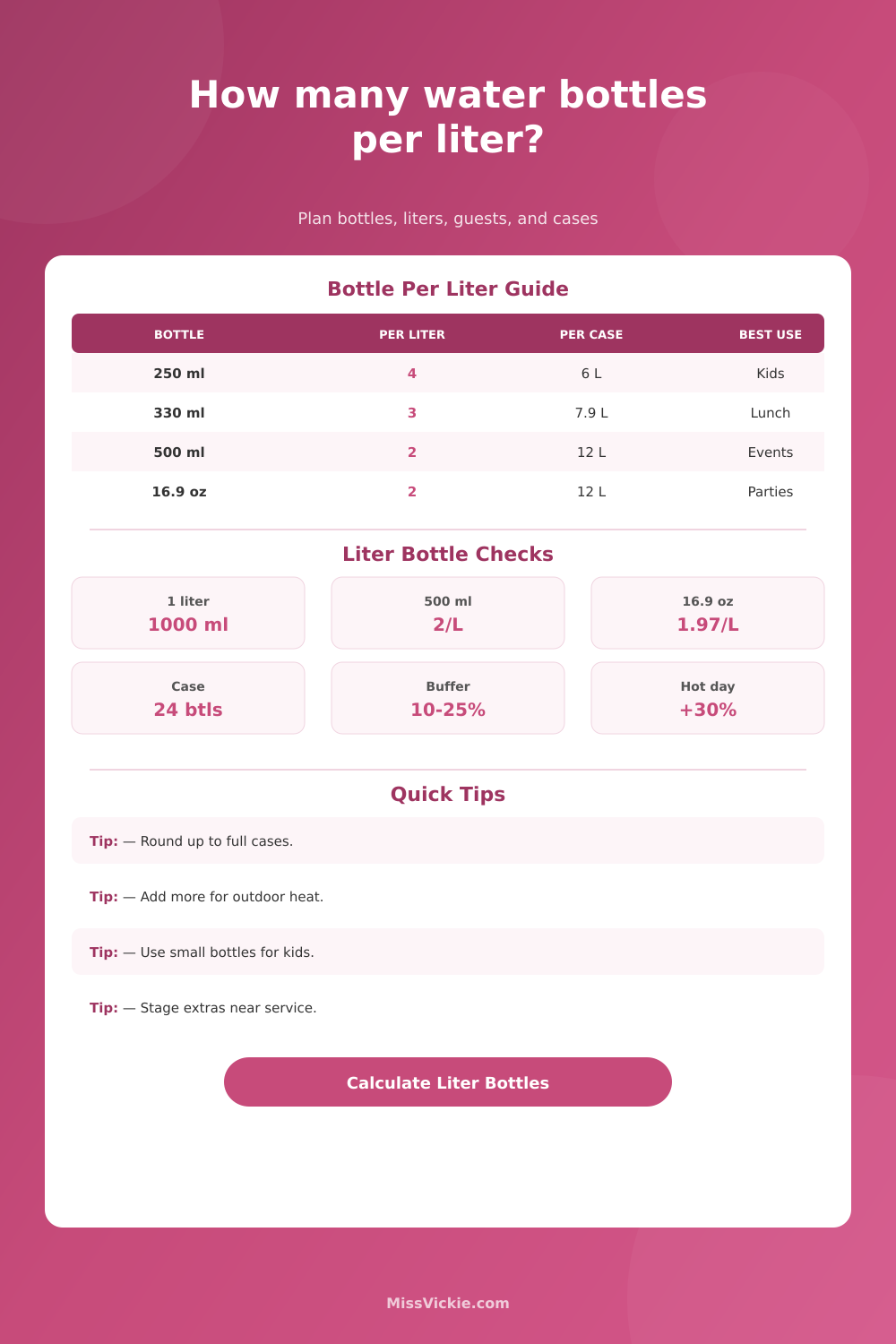
| Mini bottle | 250 ml | 4.00 bottles | 6.0 L | Kids meals, lunch boxes, small side servings. |
| Lunch bottle | 330 ml | 3.03 bottles | 7.9 L | Short indoor meals and potluck tables. |
| Standard bottle | 500 ml | 2.00 bottles | 12.0 L | Parties, meetings, and everyday event planning. |
| 20 fl oz bottle | 591 ml | 1.69 bottles | 14.2 L | Longer meals, outdoor tables, and travel coolers. |
| Sport bottle | 700 ml | 1.43 bottles | 16.8 L | Active guests and warm service periods. |
| One-liter bottle | 1000 ml | 1.00 bottle | 24.0 L | Family coolers, buffet backup, and refilling cups. |
🍽Event Hydration Table
| Event type | Baseline per guest | Time adjustment | Buffer cue | Planning note |
|---|---|---|---|---|
| Indoor meal or meeting | 0.4 to 0.6 L | Small for under 2 hours | 10 to 15% | Good default when other drinks are served. |
| Buffet or potluck | 0.5 to 0.75 L | Medium for grazing service | 12 to 20% | Guests return to the table at different times. |
| Outdoor warm-weather event | 0.75 to 1.1 L | Large for heat | 20 to 35% | Place chilled cases near food and seating. |
| Sports or active crowd | 1.0 to 1.5 L | Large for activity | 25 to 40% | Use bigger bottles or multiple pickup points. |
| Formal reception | 0.3 to 0.5 L | Depends on bar service | 8 to 15% | Water demand drops when table service covers glasses. |
📦Case Pack Planning Table
| Case pack | 500 ml liters | Guests at 1 bottle | Guests at 2 bottles | Use case |
|---|---|---|---|---|
| 12 bottles | 6 L | 12 guests | 6 guests | Small dinner, office table, family cooler. |
| 24 bottles | 12 L | 24 guests | 12 guests | Standard party case and easy buying unit. |
| 28 bottles | 14 L | 28 guests | 14 guests | Warehouse packs and larger family events. |
| 32 bottles | 16 L | 32 guests | 16 guests | Good for potlucks and team snack lines. |
| 40 bottles | 20 L | 40 guests | 20 guests | Large indoor events or cooler restock plan. |
⏱Serving Period Adjustment Table
| Serving period | Calculator factor | Typical setting | Service cue | Extra note |
|---|---|---|---|---|
| Under 2 hours | 0.85x | Short meeting, snack, quick meal | One central station is usually enough. | Round to full cases for simplicity. |
| 2 to 4 hours | 1.00x | Party, potluck, dinner, shower | Keep chilled bottles visible. | Normal buffer covers late arrivals. |
| 4 to 6 hours | 1.25x | Reception, cookout, game day | Restock halfway through service. | Use a higher buffer outdoors. |
| All-day service | 1.65x | Festival, prep crew, tournament | Split cases across stations. | Plan cooler rotation and backup stock. |
Bottle counts are planning estimates. Actual demand changes with temperature, salty foods, alcohol service, guest age, activity level, cup refills, and whether bottles are self-serve or handed out.
💡Water Bottle Planning Tips
This is the preparation stage. Planning out water helps prevent panic at events. What’s the host’s big mistake? Underestimating how many bottles fill up a liter. We’re used to thinking of stuff in liters; it’s a big unit. But when we go shopping, we get little increment-size single-use plastic bottles. That difference is where gap happens and where most people mess up there planning.
The tool on this page closes the gap between liters and bottles. The tool take your fluid volume targets and turns them into real-life inventory. It translates your goals from guest count to number of individual bottles. It even groups them together into case packs so that you don’t have to run around buying one-off units at last minute.
How to Plan for Enough Water
Here’s how: You know what you’re measuring. What happens when you establish a per-guest hydration goal? It isn’t guesswork. It’s an estimate of thirst based off factors like the temperature, the duration, the type of event, and the amount of physical activity involved. An inside meeting at work require far less water than an outdoor barbecue during a hot, humid afternoon. Human thirst isn’t constant; the tool thinks about this. It considers your variables.
Unless you take the weather into account, there’s no way you’ll make it to the end of the party without running dry. That is where many people makes a mistake. They assume their basic requirements, then fail to compensate for sweat-induced inventory depletion. More than you’d expect, logistics are impacted by bottle size. Two regular-sized 500-milliliter bottles equals a liter, which makes things convenient. It’s easy to do quick math in your head.
Four mini bottles equal a liter. They hold less volume. That impacts storage requirements completely. You’ll use more coolers. You’ll take longer distributing. Sport bottles gives you fewer containers but might weigh too much for kids to carry.
According to the reference table, here’s what happens when you convert number of packs into total liters. Six liters equals a twenty-four pack of minis. Twelve liters equals a twenty-four pack of standard bottles. Unless you pay attention to the volume, doubling up doesn’t mean you doubled up on water. You also need to plan for case packing. Most of the time when you purchase items at scale, it’s in bulk. It is not in individual bottles.
So if your calculation shows that you’ll need forty-five bottles, you can’t simply purchase exactly forty-five bottles. No, you’re going to have to round up to the next full case. This means you might purchase fifty bottles, or maybe even sixty. That leftover isn’t wasted; it’s your buffer. And you can specify what this refill percentage will be within the calculator, for things like last-minute items and/or half-filled bottles. Better to have an extra three cases on hand than to say “Oops” and be out of stock.
The heat also affects how much water gets consumed at a party. Hot temperatures makes humans guzzle down water… Both quicker and deeper. That casual sip turns into a steady stream. And when the party extends beyond four hours, those initial starting guesses is no longer enough. As the evening drags on, the body starts demanding food and drink: the longer people are out, the more their bodies wants. But that gradual rise catches hosts by surprise. The first couple of hours go great. By hour five, demand spikes.
Preparing a buffer for extended service times isn’t being pessimistic. It’s respecting biology. The water plan also includes setting expectations for how much water is needed to prevent running out without creating a mountain of empty plastic bottles. In other words, invisible hydration: guests stay cool and hydrated without ever knowing where all that water came from.
Panic goes away if you get off the guesswork and put your hand around the actual need. Then just open another case when necessary. Knowing exactly how much you have on hand to keep everyone cool means the few minutes invested in calculating before set-up should of been worth the peace of mind.