Cake Servings Calculator
Estimate how many slices a cake will serve from shape, pan size, layers, slice style, event type, appetite, trim waste, and tier count.
🍰Cake Serving Presets
Choose a common cake plan, then adjust the eight inputs for your pan, guest list, and cutting style.
🧮Cake Inputs
Cake Serving Plan
A two-layer 8 inch round cake cut into party dessert slices.
Portion Setup
Serving Math
Cutting Route
- Chill the cake before marking slices.
- Cut tiers from top size down.
- Use the slice style as the guide.
- Reserve a few servings for uneven cuts.
📊Serving Size Snapshot
🍫Slice Style Comparison
Best for birthdays and casual dessert plates.
Small neat cuts stretch a tiered cake for more guests.
Balanced for brunches, office events, and buffet trays.
Use when cake is the main dessert and seconds are likely.
🍰Round Cake Serving Table
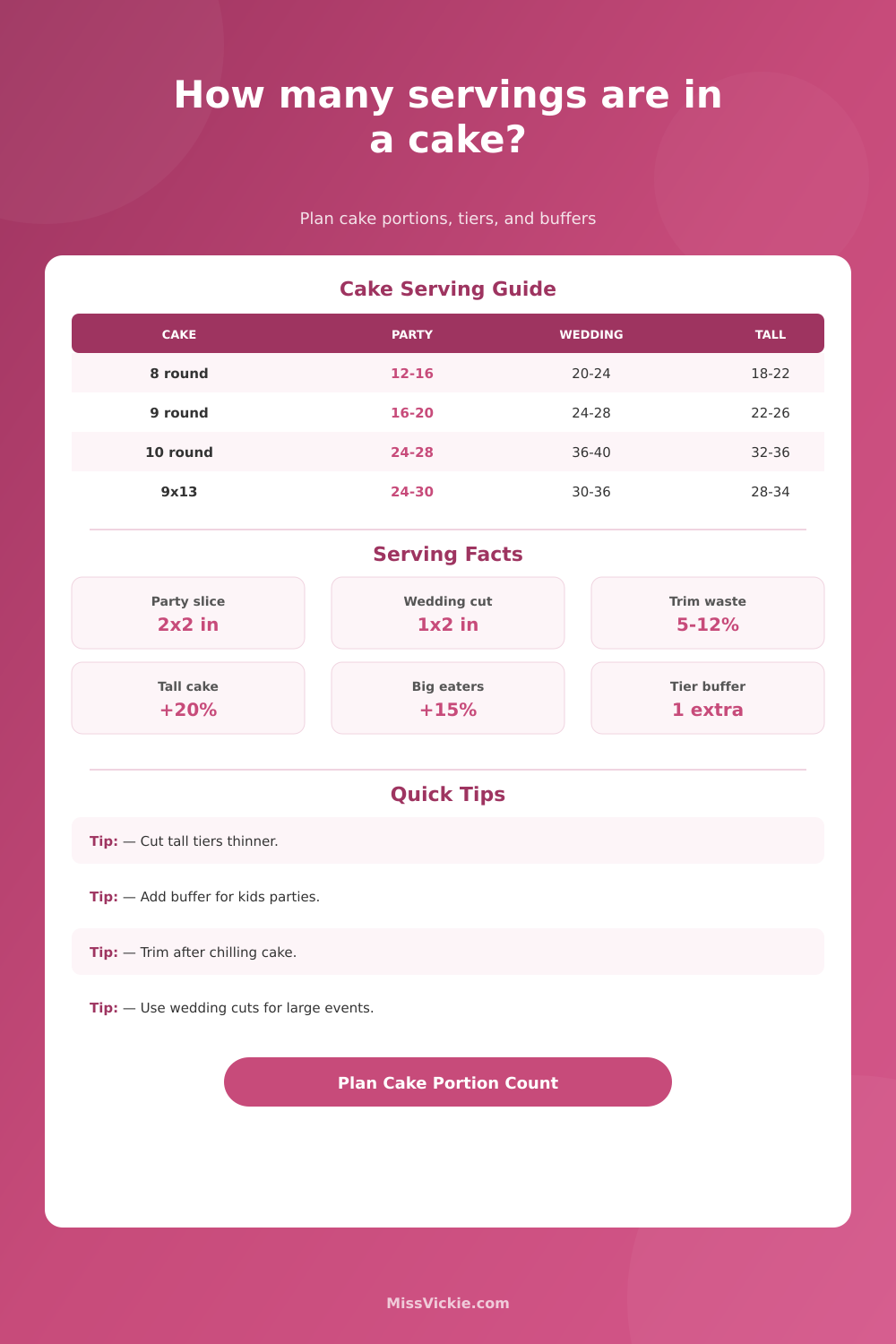
| Round size | Party slices | Wedding slices | Best use |
|---|---|---|---|
| 6 inch round | 6 to 8 servings | 10 to 12 servings | Small family dessert or top tier. |
| 8 inch round | 12 to 16 servings | 20 to 24 servings | Birthday cakes and small gatherings. |
| 9 inch round | 16 to 20 servings | 24 to 28 servings | Bakery rounds and office desserts. |
| 10 inch round | 24 to 28 servings | 36 to 40 servings | Large parties or lower tier. |
| 12 inch round | 36 to 45 servings | 56 to 60 servings | Reception cake base tier. |
📋Sheet And Square Serving Table
| Pan style | Approx size | Party servings | Service note |
|---|---|---|---|
| 8 inch square | 8 x 8 inch | 16 servings | Easy grid cuts for family dessert. |
| 9 inch square | 9 x 9 inch | 20 servings | Good for potluck squares. |
| Quarter sheet | 9 x 13 inch | 24 to 30 servings | Most common party tray. |
| Half sheet | 12 x 18 inch | 48 to 54 servings | Best for offices and school events. |
| Full sheet | 18 x 24 inch | 96 to 108 servings | Use for large service lines. |
🧁Layer And Tier Adjustment Table
| Setting | Typical effect | Use when | Cutting cue |
|---|---|---|---|
| Single layer | Standard slice count | Sheet cakes, snack cakes, simple rounds | Use normal party rectangles. |
| Two layers | More satisfying portions | Most filled round cakes | Keep slices neat and vertical. |
| Three layers | Thin cuts still feel full | Tall celebration cakes | Cut thinner wedges or strips. |
| Two tiers | Add smaller upper cake | Small weddings and showers | Cut the top tier last if needed. |
| Three tiers | Highest event yield | Formal receptions | Separate tiers before service. |
🍴Event Appetite Table
| Event type | Appetite pattern | Suggested slice | Buffer note |
|---|---|---|---|
| Birthday party | Normal to hearty | Party dessert slice | Add extra for children and seconds. |
| Wedding reception | Light to normal | Wedding slice | Small cuts work with a full menu. |
| Dessert buffet | Guests sample several sweets | Petite or coffee slice | Lower cake demand per guest. |
| Office potluck | Mixed appetite | Coffee slice | Plan neat tray cuts and a small reserve. |
| Kids party | Uneven serving loss | Party slice | Extra trim helps cover messy cuts. |
💡Cake Serving Tips
Serving counts are practical estimates for cooled, filled cakes. Very soft fillings, tall decorations, carved cakes, and uneven cutting can change the final yield.
There’s nothing like realizing your guest list has expanded since last Tuesday to set off the panic. But the cake was baked and now sits cooling on the counter, two delicious layers. “Will this be enough?” you wonder, gaping at its grand roundness. Will I have to watch half the guests look at empty, sugar-filled dessert table with hungry eyes?
Most home bakers falter here not for any lack of baking aptitude but for what might seem like a simple math problem: estimating slices. Turns out serving yield depend more on definition of a slice and the amount of cake you plan to sacrifice to the trim pile. Now enter your pan size and cutting style into the calculator above, and let it do the math for you (no more guessing at conversions and coefficients).
How to Serve Cake to More Guests
It begins with the shape: A square tin allow for efficient grid cutting with minimal waste, but an 8-inch round will produce different results, triangular pieces that lose volume near the center. Squares also permit even cutting, whereas rounds force you to make triangular cuts, wasting volume toward middle. You can use oval or heart-shaped pans.
No worries: The calculator takes that pesky edge trim into account, too; the part where the baker scrapes off some extra frosting and eats it before anyone else can gets any. That trim waste percentage isn’t just pulled from thin air. It factors in amount of crust you’ll need to slice away to get a pretty piece of cake on a dish instead of a jagged mess of whatever used to be a baked good.
But it all depends on whether you’re making wedding or party slices. Party slices is about two inches square, giving you plenty of filling and crumbs for what’s supposed to be a dessert. For weddings, which take place after a full meal (and possibly additional desserts), cakes is cut into much smaller pieces, typically one or two inches, so they don’t overwhelm guests’ stomachs. At a buffet where five other desserts are available, serving large slices means people either won’t eat any of the cake, or they’ll leave early.
This allows you to switch between party and wedding sizes and immediately see the impact of shrinking your footprint: You can feed more people without having to add more batter to the pan. Accuracy beats guesswork here; this little change in input lead to a big shift in output.
There’s also another wrinkle: height (literally). A three- or four-layered tall cake pleases the eye different than a flat one does. The taller the cake, the thinner the cut, yet the height somehow satisfy. A three-inch high wedge may have a modest surface area but still seems substantial, while a measly inch-thick slice look paltry by comparison. To reflect this, the calculator takes layer number into account when figuring out yield.
If your cake is stacked up like a wedding cake, keep in mind that top tier will typically be used for some sort of ceremony or saved to be eaten later. Because of this, it won’t actualy go into the main serving pool.
It’s wise to add some leeway for second helpings, particularly at kid’s parties, where nobody knows how much anyone else might eat; and crumbs gets whisked away faster than you can say “when’s dessert?” Theory isn’t practice. No matter how sharp your knives or cool your refrigerator is, there will always be some slices that stick, some that fall apart, some that need trimming back. That’s friction, and it’s accounted for in the percentage of waste in tool itself.
Unless you’re shaping things, try to aim for 7-10%, but don’t be scared to pad it a little bit if the numbers seem close. Better to have a tiny stash hidden in the fridge than to beg people if they want half of your neighbor’s cake. You should of planned better.
Planning defeats anxiousness. Confidence reigns when every guest has their own little moment of happiness served up without the stress or an empty plate while waiting in the photo booth line.