Ice Cream Servings Per Gallon Calculator
Plan ice cream by gallons or quarts, scoop size, serving style, event size, kids and adults, toppings, melt buffer, and freezer temperature.
🍨Choose an ice cream plan
Pick a common serving setup, then fine tune the tubs, scoop size, toppings, crowd mix, and cold-hold plan.
⚖Enter tub and serving details
Ice cream plan ready
Adjust the fields to estimate servings per gallon and gallons needed.
Serving math
Crowd and buffer
📌Quick serving cards
📊Serving size comparison
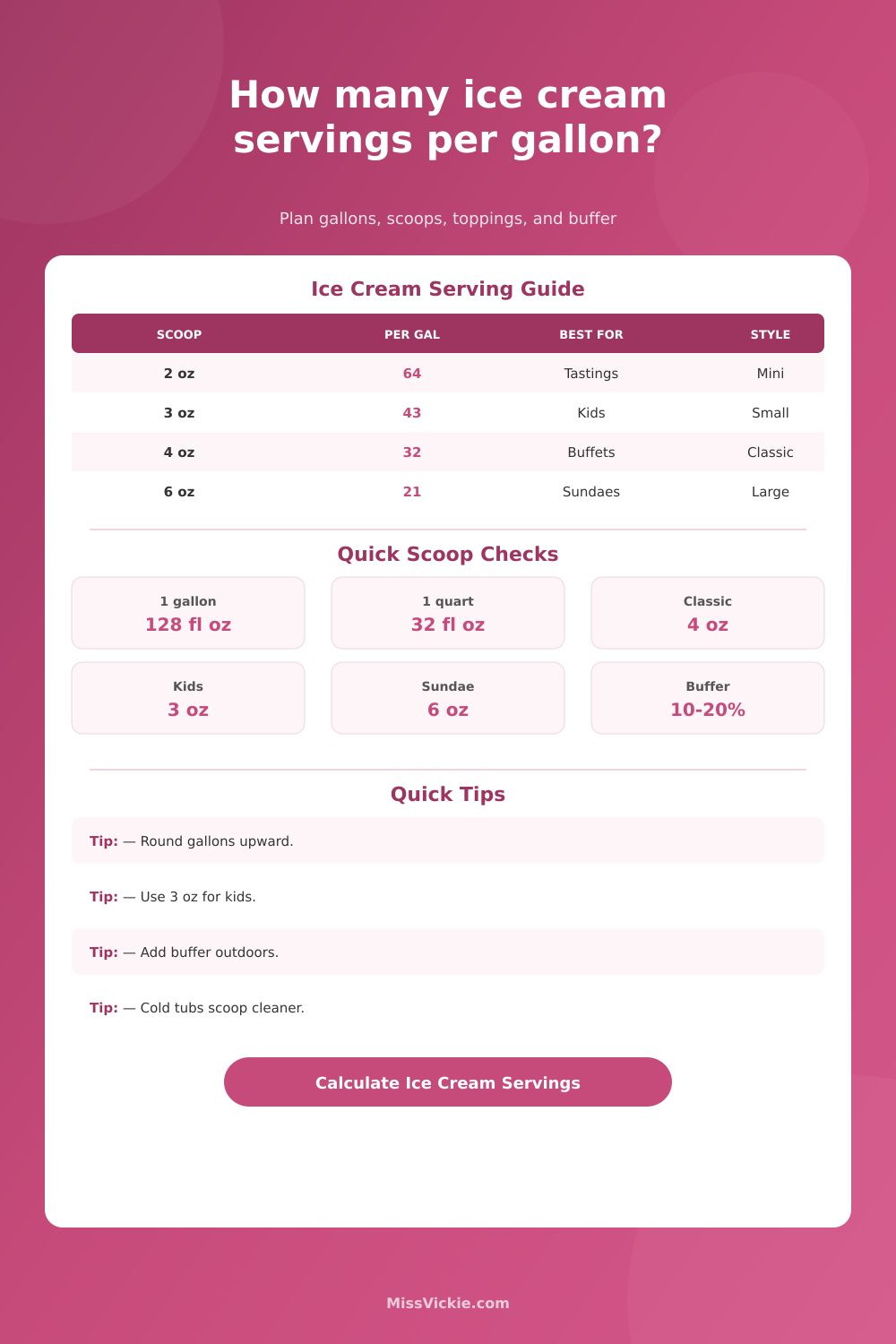
About 64 small tastes per gallon before any buffer.
About 43 kid portions per gallon before toppings.
About 32 single scoops per gallon for cups or cones.
About 21 larger dessert portions per gallon.
📘Reference tables
| Scoop size | Servings per gallon | Servings per quart | Best use |
|---|---|---|---|
| 2 fl oz | 64 servings | 16 servings | Tastings, mini cones, dessert flights. |
| 3 fl oz | 42 to 43 servings | 10 to 11 servings | Kids parties and small dessert tables. |
| 4 fl oz | 32 servings | 8 servings | Standard single scoop cups or cones. |
| 5 fl oz | 25 to 26 servings | 6 servings | Generous adult servings. |
| 6 fl oz | 21 servings | 5 servings | Sundaes, floats, and dessert bowls. |
| Serving style | Scoop factor | Topping effect | Planning note |
|---|---|---|---|
| Single scoop cup or cone | 1.00x | Light toppings change little. | Best default for most parties. |
| Double scoop dessert | 1.85x | Toppings can reduce a small amount. | Plan bigger tubs or smaller scoops. |
| Sundae bar | 1.35x | Moderate toppings reduce ice cream demand. | Use wide bowls for easier portion control. |
| Buffet with cake or pie | 0.78x | Cake carries part of the dessert. | Great when ice cream is an add-on. |
| Small tasting portions | 0.55x | Toppings are usually skipped. | Good for flavor testing and samplers. |
| Milkshake or float base | 1.60x | Liquid additions stretch each serving. | Keep extra cold tubs nearby. |
| Group size | Kids scoop | Classic scoop | Sundae scoop |
|---|---|---|---|
| 10 people | 1 quart | 2 quarts | 2 quarts |
| 25 people | 2 quarts | 1 gallon | 2 gallons |
| 50 people | 1 gallon | 2 gallons | 3 gallons |
| 75 people | 2 gallons | 3 gallons | 4 gallons |
| 100 people | 3 gallons | 4 gallons | 5 gallons |
| Storage temperature | Scooping feel | Service risk | Buffer choice |
|---|---|---|---|
| -10°F to -5°F | Very firm | Slow scooping at first. | 8% to 12% is usually fine. |
| -4°F to 2°F | Firm but workable | Good balance for party service. | 10% to 15% works well. |
| 3°F to 8°F | Softening | Over-scooping becomes easier. | 15% to 20% is safer. |
| 9°F and warmer | Soft | Melt loss can grow quickly. | 20% to 25% is wise. |
Serving counts use US volume math: 1 gallon is 128 fluid ounces and 1 quart is 32 fluid ounces. Real scoops vary by dipper size, ice cream firmness, and who is serving.
💡Ice cream serving tips
When planning your ice-cream portions, you can’t just guesstimate how many guest will be served; there are too many variables (toppings, size of scoops, melting rate). After establishing your constraints, the above calculator crunches the numbers for you. No more doing math in your head while wearing an apron in a sweltering kitchen. Know that children have different consumption patterns different than grownups. And know that when your ice-cream runs out, this isn’t a matter of dessert; it’s a math problem.
But this also depends largely on the scoop: A typical commercial-style dipper will draw up ~4 ounces of ice cream. That’s approximately 32 servings per gallon. Moving down to kids’ size three ounce scoops? You’ll see an increase to around 43 portions. At first, this may not sound like much. But going from eleven extra servings could be the difference between hosting a party for twenty or being out of ice cream just as the cake comes out.
How to Plan Your Ice Cream Portions
Most customers depend on what they see… And when purchasing in bulk, that sense goes right out the window, since there isn’t always a direct link between how much a scoop of ice cream appears to weigh and how many servings it actualy contains. Toppings add an extra element into the mix. A scoop served alone requires a full-ounce portion straight outta the tub, whereas one with cherries, syrup and whipped cream is more like a base ingredient, not the whole meal. The tool recognizes the sundae-bar scenario by adjusting the serving size based off how you want it topped; other items fill some of the space in the bowl.
On the flip side, that double-scoop cone suddenly needs twice as much without looking any different when its served. This is true unless you know what kind of flavor experience you are offering before you buy the product. Waste depends heavily on temperature. Soft ice cream melts into drippy cones faster then zero degree ice cream which retains more of its shape. That drip loss is an actual volume you can’t get back once it goes from freezer to the customer’s mouth. Nobody licks off the residual ice cream stuck to their spoon either. Outdoor events on a hot day in July will be doomed if ambient heat speeds up the structural collapse, unless you would of added extra space to your plan to make up for that lost volume.
Children break average norms in other ways, too: They don’t consume food the way little adults would. Small plates may satisfy them less than full-sized servings, which means kids will often ask for more until they is full. Similarly, kids’ tiny stomachs mean they’ll order smaller meals, though they may need multiple helpings to reach fullness, or they might want nothing more after just one plate. The age-adjusted serving size accounts for this kind of fluctuation without leaving guests either hungry or overfed, since different ages requires a calculation that takes their biology into account instead of assuming everyone eats the same amount.
Planning ice cream servings for a summer party? Sign me up! When there are lots of people involved, pre-scooping is an easy solution. Portioning out your ice cream on a tray that’s been in the fridge prior to the party locks down the scoop size (and takes away any of the guesswork of people’s hands digging into the melting tub, under the gun). It also makes sense because it keeps the bulk product cooler longer, keeping its texture steady. It works best if freezer space is available and you has time to prep in advance.
Ice cream lasts forever, so it’s always okay to buy a bit more than what you figure you’ll need. Extra quarts can be used for smoothie bases or breakfast treats. Running out causes an awkwardness that will stick in people’s memories longer then the sugar buzz stays in their bodies. If you plan correctly, the potential for stress turns into easy fun, and when you leave, your guests are full and your tubs is empty. This is the only way to end the day.