Champagne Servings Per Bottle Calculator
Estimate champagne bottles, servings per bottle, guest coverage, toast counts, magnum substitutions, and foam loss from bottle size, glassware, pour style, guest count, event duration, and serving pace.
🍾Champagne Service Presets
Choose a common sparkling wine situation, then adjust bottle format, flute or coupe pour size, service pace, foam loss, and magnum plan for your event.
⚖Champagne Serving Inputs
Champagne bottle plan
Your champagne serving estimate appears here.
Pour Breakdown
Guest Coverage
Bottle And Magnum Plan
📌Quick Champagne Serving Numbers
🔍Champagne Pour Comparison Grid
Best for speeches, weddings, and midnight countdowns when each guest needs one glass.
Good default for receptions because it leaves room for bubbles and clean carrying.
Works for coupe towers and vintage-style service, with a little more surface area.
Use for dinner pairings or guests who drink sparkling wine as the main wine service.
🍾Bottle Size And Serving Table
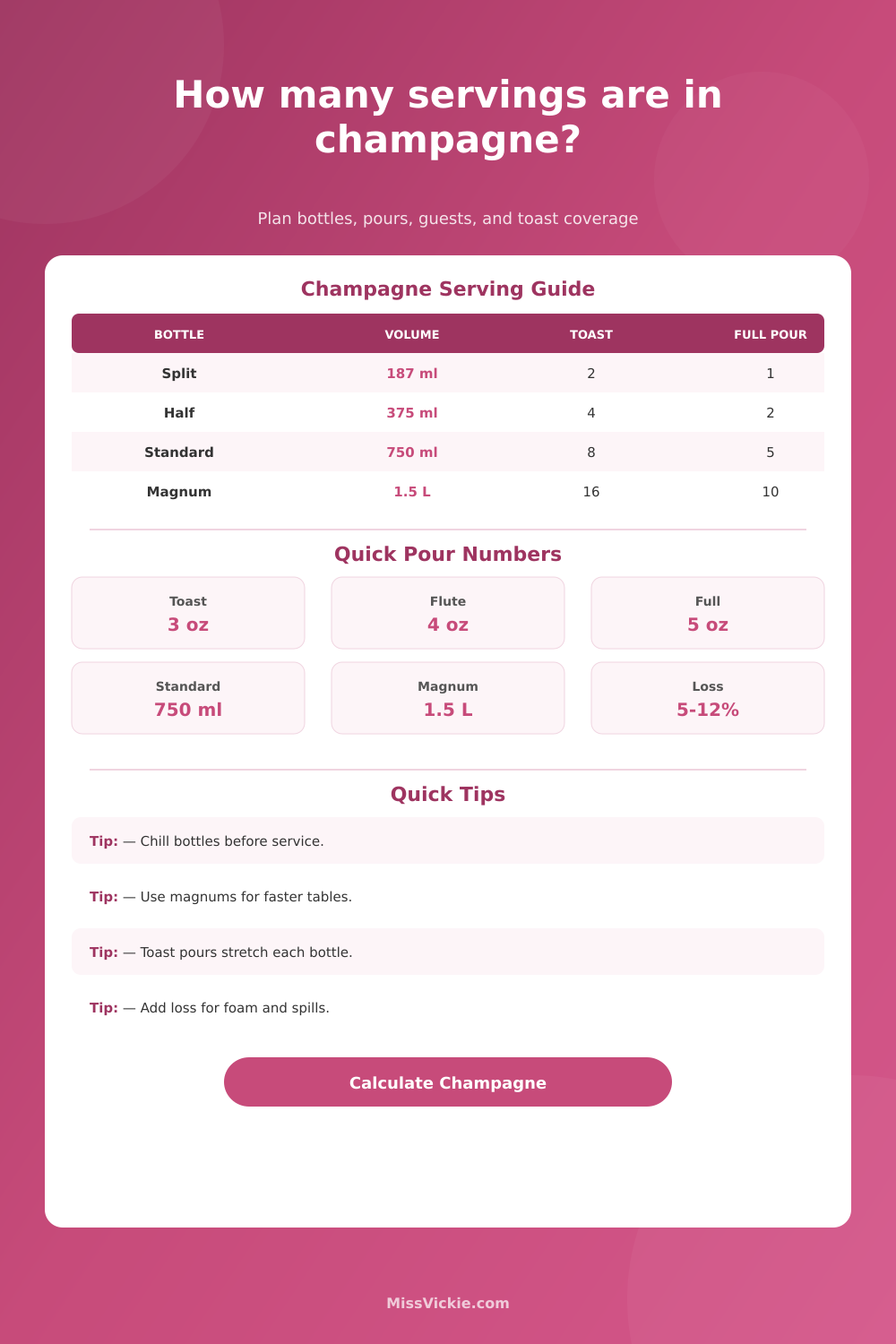
| Bottle size | Volume | 3 oz toast pours | 4 oz flute pours | 5 oz full pours |
|---|---|---|---|---|
| Split | 187 ml / 6.3 fl oz | 2 pours | 1 pour | 1 pour |
| Half bottle | 375 ml / 12.7 fl oz | 4 pours | 3 pours | 2 pours |
| Standard bottle | 750 ml / 25.4 fl oz | 8 pours | 6 pours | 5 pours |
| Magnum | 1.5 L / 50.7 fl oz | 16 pours | 12 pours | 10 pours |
| Jeroboam | 3 L / 101.4 fl oz | 33 pours | 25 pours | 20 pours |
🥂Service Style Planning Table
| Service style | Common pour | Guest pace | 750 ml bottles for 50 guests | Best use |
|---|---|---|---|---|
| Single toast | 3 oz | 1 serving each | 7 to 8 bottles | Weddings, speeches, countdowns. |
| Welcome pour | 3.5 to 4 oz | 1 to 1.5 servings | 9 to 13 bottles | Guests receive a glass on arrival. |
| Reception refills | 4 oz | 0.6 to 1 per hour | 14 to 22 bottles | Two-hour mixed beverage reception. |
| Dinner pairing | 5 oz | 1 to 2 servings | 11 to 22 bottles | Sparkling wine at the table. |
| Tasting flight | 2.5 oz | 3 to 5 small pours | 16 to 26 bottles | Guided tasting or flight bar. |
💨Foam Loss And Service Table
| Service condition | Suggested loss | Why it matters | Planning action | Notes |
|---|---|---|---|---|
| Well chilled bottles | 3 to 5% | Less foam and cleaner pours. | Use the lower buffer. | Keep bottles cold until pouring. |
| Tray passed flutes | 6 to 10% | Small spills and uneven fills add up. | Add at least one extra bottle per 50 guests. | Pre-pour close to service time. |
| Coupe tower | 10 to 18% | Overflow and show pours waste more wine. | Use larger reserve volume. | Practice the first pour path. |
| Warm outdoor setting | 10 to 15% | Foam rises faster in warm glassware. | Chill glassware or increase buffer. | Shade service stations. |
| Professional bar pour | 4 to 8% | Consistent pours reduce waste. | Use normal reception buffer. | Mark pour lines if needed. |
📦Magnum Substitution Table
| Magnum plan | Equivalent volume | Best event fit | Service advantage | Calculator behavior |
|---|---|---|---|---|
| No substitution | Plan by selected bottle | Retail buying and mixed labels | Simple count by bottle size. | Rounds total bottles only. |
| Showpiece magnum | 1 magnum = 2 standards | Head table, host toast, entrance table | Looks festive without changing the whole order. | Replaces two standards when possible. |
| Half volume magnums | About 50% of volume | Medium receptions and brunch bars | Fewer corks and faster refills. | Splits volume between magnums and standards. |
| All possible magnums | Magnums first, standards for remainder | Large sparkling-only events | Efficient for repeated table service. | Uses magnums for paired standards. |
💡Champagne Serving Tips
Champagne serving estimates vary with bottle temperature, glass shape, pour speed, foam, guest habits, other drinks available, and whether glasses are pre-poured or filled on request.
For example, you are hosting a two-hour brunch for forty guests. Forty-five minutes in, you notice everyone has emptied their glass. And since most people fill champagne flutes (instead of coupes) it’s clear you’ll need additional bottles of bubbly before the toast.
How do you know? Standard bottle deliver varying amount of pours. Avoid an embarrassing moment because no one likes running out of champagne! Use our calculator above. Simply input the number of guests & pour style to let the tool does the math. You won’t have to guess whether you’ve purchased enough for whole event or just initial hour.
How to Plan Champagne for Your Party
It’s all about managing volume (and hiding the fact under the cover of party planning). People tend to assume that no matter what, a 750 milliliter bottle is five full glasses. They fail to account for the fact that champagne bubbles push out some of it volume. The bubbles goes up the side of glass and make a bunch of froth, which is also not small. By failing to account for that loss, you’ll find yourself pouring watery dregs by lunchtime.
To compensate for this, tool allows you to input a percentage for both spill and foam. Depending on how quickly you pour and whether or not you have pre-chilled your bottles, this tends to range from five to twelve percent. If you’re having an outdoor party during the summer, a warm bottle will foam harder then a cold one; in those situations, buffer comes into play.
Everything else depend on the pour size. With a three ounce toast pour, it means eight servings per regular bottle. Drop down to a generous 5-ounce dinner pour and you’re now serving five. It’s more than math. It’s about strategy.
For example: Use smaller pours for a wedding toast; everyone wants a glass in the photo op. When serving a long brunch with sparkling as main drink, or a tasting flight, increase the pour size. Twenty minutes into your event, guests will be able to tell you if they feel like they’re getting a short drink. The calculator automatically updates bottle count based off your change of style, so there’s no need to re-calculate each time your event switches from a formal toast to a more casual sipping session.
Magnums: While not necessarily novel per se, magnums deserves mention for their ability to pour quicker at a party (i.e. You are pouring into multiple glasses instead of just one. Also, because it has a better ratio of cork surface area to liquid, it keeps the wine fresher longer then two normal bottles. Plus, two normal bottles fits inside a magnum. That’s why when you swap out standard bottles for magnums on the calculator, it will show you how many magnums versus standard bottle you’ll need. Managing inventory makes ordering simpler. You have fewer corks to pop open, which means less interruption while serving. If you’re having a bigger reception, use magnums for half your volume, or all of your volume, and you’ll find that the backbar is streamlined quite niceley.
There’s also the factor of event length, which seems obvious but becomes complicated in real life. Even with same number of guests, an hour-long party involves different logistics than a four-hour event. The longer the event last, the more likely guest are to have multiple drinks. This tool will help you measure how fast people drink based on your choice of pacing.
For example, if it’s a mixed drink situation, a conservative estimate would of roughly zero point eight servings per guest per hour. That figure increase if you’re serving only champagne. You can adjust the duration input up or down so that you don’t come up short as time stretches into the slow burn of late-night re-fills.
Remember to pre-chill your bottles for serving time. This may seem obvious, but it’s right in line with reducing your waste. When the champagne is cold, there’s less spillage and less evaporation. This means more gets into your guest’s glass and less ends up on floor. You can adjust this ‘loss’ figure on the calculator, but physical temperature control is the best insurance policy.
Round up a little just-in-case, since one leftover bottle is better than none. Bubbles do come to an end. Control the volume, embrace the froth and your party will remain bubbly from start-to-last toast.