Wine Servings Per Bottle Calculator
Estimate servings from any wine bottle size, pour size, wine style, event time, guest count, tasting or full-pour service, wine-drinking share, and spill buffer.
🍷Wine Serving Presets
Choose a real serving situation, then adjust pour size, event length, wine style, guest count, and buffer for your table.
⚖Serving Inputs
Wine Serving Plan
Estimate updates after calculation.
Bottle Breakdown
Event Demand
Buying And Service Notes
- Choose bottle size.
- Set pour size.
- Estimate drinkers.
- Round bottles upward.
📌Quick Serving Size Cards
🔍Pour Style Comparison Grid
Best for meal service when wine is a main beverage.
Good for open-bar service with beer or cocktails nearby.
Useful for sparkling wine, short speeches, and single moments.
Designed for flights, sample pours, and guided pairings.
🍷Bottle Size Serving Table
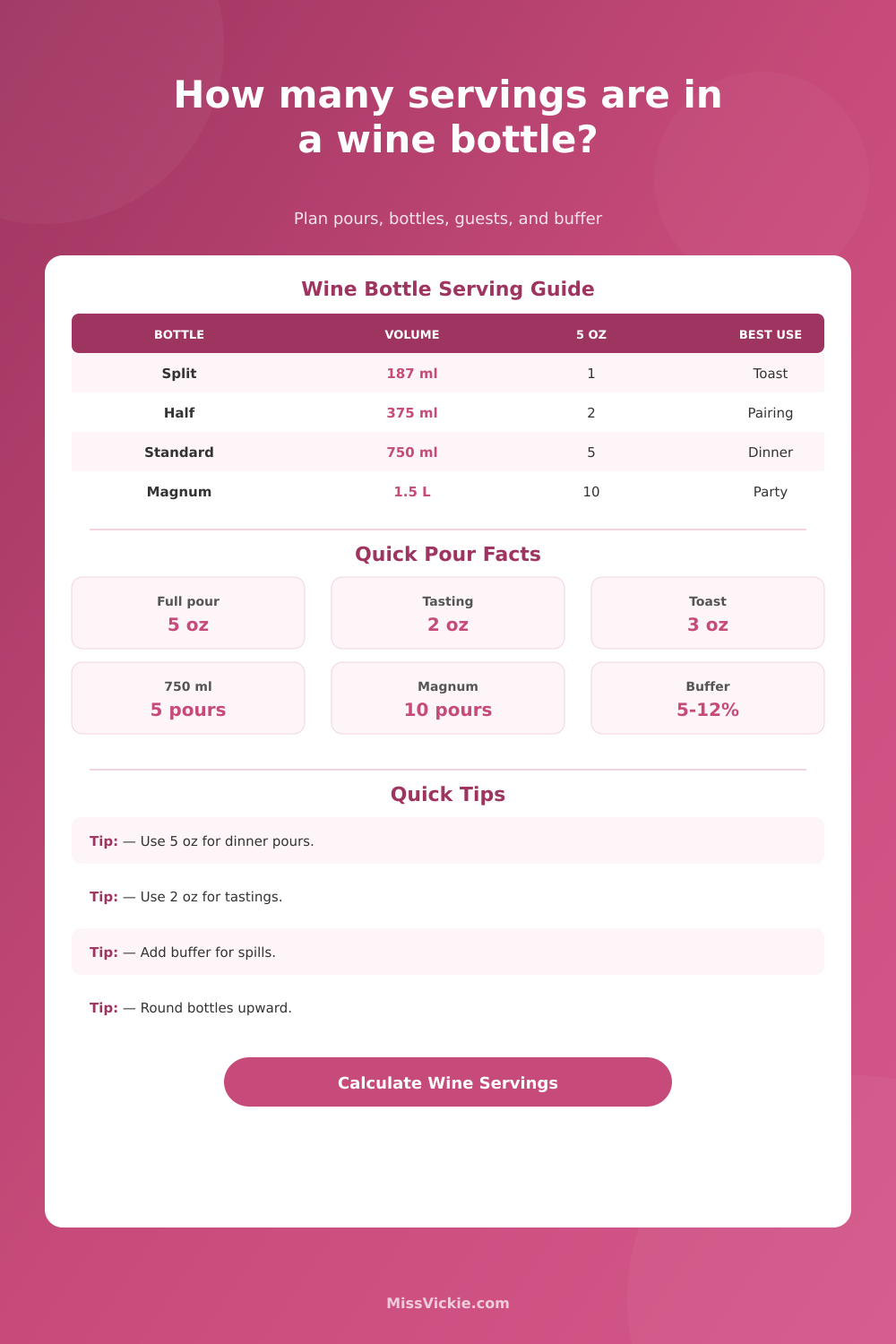
| Bottle Size | Volume | 5 oz Servings | 3 oz Servings | Best Use |
|---|---|---|---|---|
| Split bottle | 187 ml / 6.3 oz | 1 serving | 2 small pours | Picnics, favors, welcome drinks. |
| Half bottle | 375 ml / 12.7 oz | 2 servings | 4 small pours | Pairings, dessert wine, small tables. |
| Standard bottle | 750 ml / 25.4 oz | 5 servings | 8 small pours | Dinner, bar service, home meals. |
| Liter bottle | 1 L / 33.8 oz | 6 to 7 servings | 11 small pours | Casual table wine and sangria service. |
| Magnum | 1.5 L / 50.7 oz | 10 servings | 16 small pours | Parties, sparkling wine, center table service. |
| Double magnum | 3 L / 101.4 oz | 20 servings | 33 small pours | Large tables and ceremonial service. |
🍽Event Pour Planning Table
| Service Mode | Typical Pour | Pours Per Guest | 750 ml Bottles For 25 | Planning Note |
|---|---|---|---|---|
| Single toast | 3 oz / 90 ml | 1 to 1.25 | 4 to 5 bottles | Add buffer if glasses are filled before guests sit. |
| Dinner service | 5 oz / 150 ml | 2 to 3 | 10 to 15 bottles | Food pace and menu weight matter most. |
| Reception bar | 4 oz / 120 ml | 1.5 to 2.5 | 8 to 13 bottles | Reduce if mixed drinks are also popular. |
| Tasting flight | 2 oz / 60 ml | 4 to 6 | 8 to 15 bottles | Small pours still add up across many wines. |
| Course pairing | 3 oz / 90 ml | 3 to 5 | 8 to 13 bottles | Plan by courses, not by clock time alone. |
🔀Wine Style Adjustment Table
| Wine Style | Usual Pour | Pace Factor | Buffer Range | Serving Note |
|---|---|---|---|---|
| Still red dinner wine | 5 oz / 150 ml | Medium | 5 to 10% | Heavier menus often raise red demand. |
| Still white or rose | 5 oz / 150 ml | Medium-high | 6 to 12% | Warm rooms and brunch can increase refills. |
| Sparkling wine | 3 to 4 oz / 90 to 120 ml | Toast-heavy | 8 to 12% | Foam and tray service can waste small amounts. |
| Dessert wine | 2 to 3 oz / 60 to 90 ml | Low | 3 to 8% | Smaller pours make half bottles useful. |
| Tasting samples | 1.5 to 2 oz / 45 to 60 ml | Flight based | 5 to 10% | Count each sample as a serving. |
🧮Common Bottle Counts Table
| Guest Count | Toast Only | Dinner Wine | Tasting Flight | Reception |
|---|---|---|---|---|
| 10 guests | 2 standard bottles | 4 to 6 bottles | 3 to 5 bottles | 3 to 5 bottles |
| 25 guests | 4 to 5 bottles | 10 to 15 bottles | 8 to 15 bottles | 8 to 13 bottles |
| 50 guests | 8 to 10 bottles | 20 to 30 bottles | 16 to 30 bottles | 16 to 25 bottles |
| 100 guests | 15 to 20 bottles | 40 to 60 bottles | 32 to 60 bottles | 32 to 50 bottles |
Table assumes standard 750 ml bottles before unusual spill loss, very generous pours, or guests who strongly prefer another drink.
💡Wine Serving Tips
If you have three bottles to serve eight guests, and it’s dinnertime… Don’t freak out! You start feeling anxious because people drinks at different rates.
Using the calculator ensures that there will be no guesswork in your beverage budget. Your hunches become an actual shopping list before you walk out the door.
How to Buy the Right Amount of Wine
In theory, that should provide five five-ounce servings per 75ml bottle. In practice? That’s the problem (parties aren’t theoretical vacuums). Double pours occurs regularly as do spills. And guests will change drinks throughout the meal.
To accommodate such estimates, the tool asks you to set your service mode at the start of the experience: Is it a long dinner with lots of red meat? Or is it a series of small tastings from several different bottles? One requires deep pours from few source; the other small samplings from many.
Why does it matter? Because if you get the pace wrong, you’ll run out too soon … or else you’ll pay for unopened bottles. All guests aren’t wine drinkers. Wine isn’t for all, some drink cocktails, others beer, still others water. Don’t waste your money by assuming all guest want reds: use the calculator to make it real.
Wine is a heavy liquid that leaves sediment and spills. Include 5-10% as a margin for error and be realistic. No one likes to scrape out last bit from a carafe while explaining they’re out of bottles.
The pour size also varies depending on style. For example, dessert wines is heavier (in taste and density) and typically demand smaller glasses. Foamy cocktails like sparkling wine gets smaller pours at toast time, typically three ounces. These distinctions are broken out on the reference tables by bottle size.
They illustrate not only how much larger a magnum will be but also its greater size: two regular bottles equal one magnum; hence, twice the volume and twice the prestige. It’s also a handy detail for hot weather affairs, a large format bottle stay cooler longer.
The key is realizing what it’s measuring. It’s not about ounces but instead how much stuff flows through (which is why it’s called Flow). Enter details of your event (length, number of guests) and it calculates how often refills might be needed.
If it’s a two-hour cocktail party, people will get through more drinks then if it’s a four-hour seated dinner with food in their stomachs and hands. That’s money-savings. It keeps you from buying too much just because an event is longer. Believing that a longer event equals more alcohol consumption are a rookie-planner mistake.
Round up on bottles. Don’t ever round down. It is worth the cost of having an extra bottle on hand. It would of been better than being embarrassed by offering watered-down wine or awkwardly asking someone to pass a glass around. Your buffer is included in the rounded total given by the calculator. You’re given a solid number to jot into your notes.
From there, you can go shopping comfortabley, no stress involved. Wine is supposed to unite people, not cause us to worry about how many bottles we’ll need. Pour wisely and let the wine take care of the rest.