Bread Slices Per Loaf Calculator
Estimate slice count, sandwich yield, toast portions, loaf weight per slice, end-piece impact, waste, and how many loaves to buy or bake.
Pick a common loaf plan, then adjust thickness, heels, waste, and servings for your kitchen.
Bread Slice Plan
Estimate updates after calculation.
Count Breakdown
Serving Breakdown
Cut Plan
- Measure the cooled loaf.
- Choose slice thickness.
- Count heels as planned.
- Slice just before serving when possible.
Best for lunch boxes, trays, and standard fillings.
Useful for breakfast plates and soup service.
Use for stacked sandwiches and generous deli plates.
Good for sample boards, dips, spreads, and events.
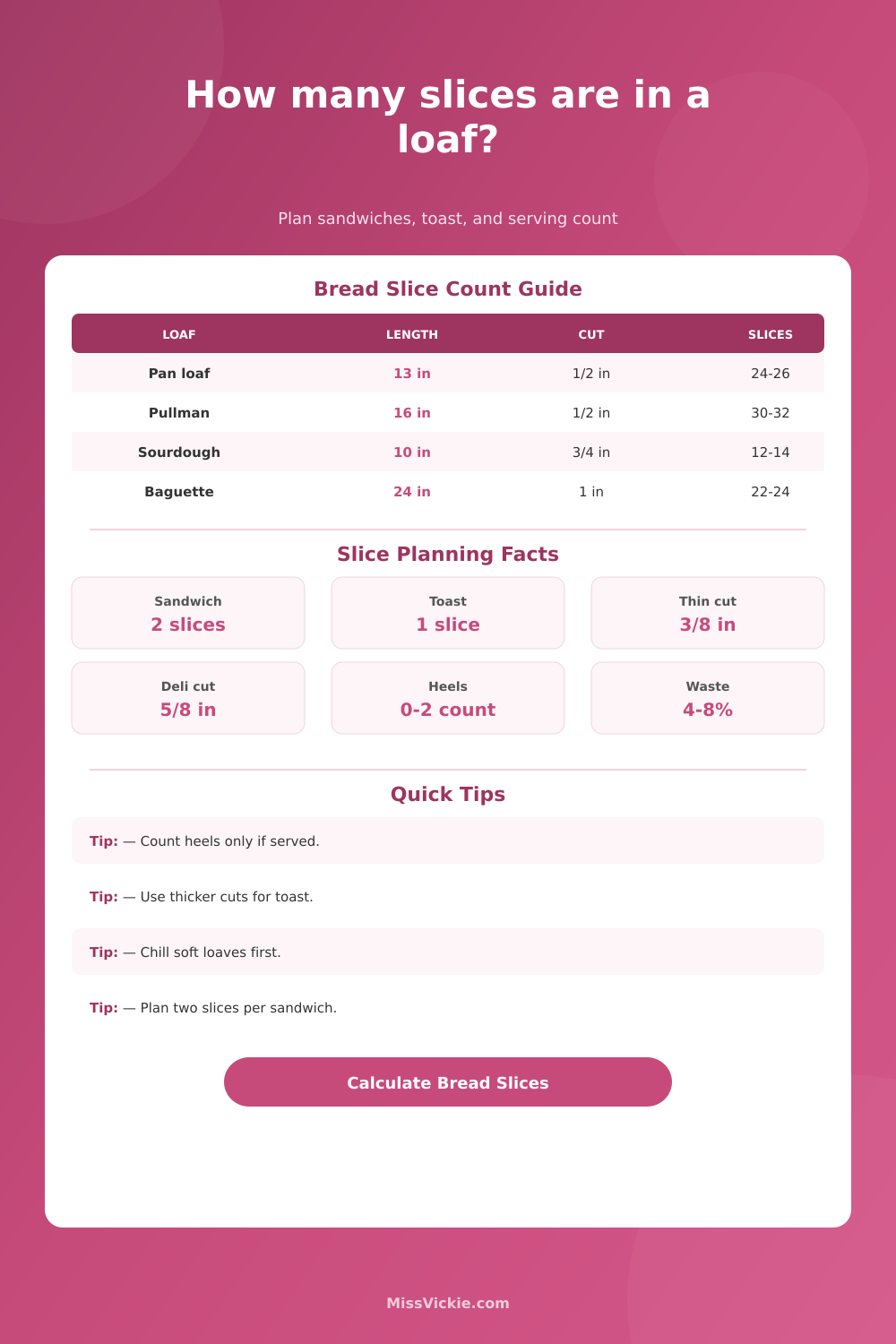
| Cut Style | Typical Thickness | Best Use | Expected Effect |
|---|---|---|---|
| Thin deli cut | 3/8 in / 1.0 cm | Tea sandwiches, petite toast | More slices, less structure |
| Classic sandwich | 1/2 in / 1.3 cm | Lunch sandwiches, grilled cheese | Balanced count and bite |
| Deli thick | 5/8 in / 1.6 cm | Rye, sourdough, sturdy fillings | Fewer slices, stronger hold |
| Toast thick | 3/4 in / 1.9 cm | Brioche, challah, French toast | Lower count, soft center |
| Crostini bias | 1 in / 2.5 cm | Baguette appetizers | Hearty pieces for toppings |
Actual count changes with knife kerf, loaf shape, and whether the two heels are served.
| Loaf Type | Common Length | Common Weight | Planning Note |
|---|---|---|---|
| Pan sandwich loaf | 12 to 14 in | 20 to 24 oz | Usually gives the most even slices. |
| Pullman loaf | 15 to 17 in | 28 to 36 oz | Long square shape works well for trays. |
| Boules and sourdough | 8 to 11 in | 24 to 34 oz | Widest slices may be cut in half for serving. |
| Deli rye loaf | 11 to 14 in | 24 to 32 oz | Thicker slices resist moist fillings. |
| Brioche or challah | 10 to 13 in | 16 to 24 oz | Soft crumb benefits from thicker cuts. |
| Baguette | 20 to 26 in | 10 to 16 oz | Bias cuts vary by angle and width. |
| Occasion | Servings | Slice Style | Loaf Planning Shortcut |
|---|---|---|---|
| Family lunch | 4 sandwiches | 2 slices each | 8 slices, plus 1 or 2 spare slices. |
| Soup night | 6 toast sides | 1 slice each | One small loaf is usually enough. |
| Lunch prep week | 10 sandwiches | 2 slices each | Plan about 20 usable slices. |
| Party tray | 24 halves | 1 slice per half pair | One long Pullman loaf often fits. |
| Club platter | 12 clubs | 3 slices each | Plan 36 usable slices before trim. |
| Adjustment | Typical Range | When To Use | Count Impact |
|---|---|---|---|
| Clean slicing | 0 to 3% | Firm loaf, sharp serrated knife, home use | Most slices are served. |
| Normal crumbs | 4 to 8% | Average sandwich loaf or toast service | One or two slices may be lost. |
| Soft enriched loaf | 8 to 12% | Brioche, challah, quick bread | More end and edge pieces may tear. |
| Catering buffer | 10 to 15% | Large tray, advance slicing, mixed fillings | Buy or bake an extra loaf sooner. |
| Heels not served | 0 to 2 slices | Sandwich trays and neat platters | Subtract ends from usable count. |
There’s this thing that happens: You’re pulling a fresh loaf from the bag, and you want to make a dozen sandwiches for a party. Then you remember you don’t do math in your head. Is it enough? How many should there be? Will they look full once they’re all cut up?
The Bread Slices Per Loaf Calculator helps you estimate how much bread you’ll need, how many servings you’ll get per loaf, what kind of trim waste there is, and how much the “end pieces” will affect things. It take the vague worry of having too little bread and makes it exact. It runs through the exact numbers so you don’t have to stress about buying one too few or one too many loaves of bread next time around. Meal planning is made easy.
How to Use the Bread Calculator
Loaves of a given weight aren’t necessarily interchangeable. You can take a fluffy brioche and a dense rye loaf, each weighing a full twenty-four ounces. Put them side-by-side on your cutting board and see how different they behave under the knife. To account for this, the calculator gives you the option to choose your loaf type (such as rye vs. Brioche), which factors in crumb loss and heel size.
Baking powder, sourdough vs. This choice factors in crumb loss and heel size. Slicing a soft bread will cause it to tear apart more readily, resulting in a larger proportion of its mass becoming misshapen edge or crumbs instead of neat slices. Slicing firm sourdough for toast results in less waste different than handling a delicate sandwich loaf, so you’ll end up with a greater proportion of your original dough going toward your sandwiches. It’s an error that people frequently make, by focusing exclusively on the number of total ounces without considering texture.
The other key variable is slice thickness, which also has a dramatic effect. Increasing slice thickness (from one-half-inch to three-quarters of an inch) will significantly decrease your number of slices, and vice versa. Thicker slices is stronger against moist fillings such as pickles or tomatoes, yet also consume a loaf sooner then thinner slices. This chart on the page explains it all: notice how the standard pan loaf yields shrink down to many fewer slices with each increase in thickness for comfort-food sandwiches like grilled cheese.
It’s just a matter of deciding which is most important for your own dish. Is it structural strength for a sloppy club sandwich? Or is it voluminous bulk for plain old toast? That’ll change the math.
Heels: Another problem is that these two heavy end pieces can be controversial in a kitchen. Some people keep them on because they make good croutons. Others cut them off and throw them away because they don’t want an odd number of slices on their platter. You get to choose if you’re going to consider those ends as legitimate servings (the calculator assumes so) or not at all. If you’re hosting a catered dinner party, you’ll probably remove them and subtract two from the total number of servings per loaf. For more informal gatherings, like a weekend brunch with the family, just do what makes sense, probably use ’em all. A little detail but it does have a direct impact on the number of loaves you need to buy.
The other thing is waste. That sounds insignificant…until it’s not. There is always some waste; the slice that dropped on the floor (or in your lap), some crumbs, an uneven cut that goes into the discard pile. You will want to plan for a few percent for all this, I say 4 to 8 percent. For many slices, if you’re cutting ahead for a crowd, you might want to up that to 10 or even 15 percent. Once bread is sliced, it goes stale more quickly and handling it further increases its crumbling. The last thing you should of is be out of bread when you thought you were spot-on, but didn’t account for real life.
There’s more to baking (or buying) bread than just its flavor. There are also logistics: How many servings does one loaf provide? Because this information can save you money and prevent wasted food, you’ll always know if you should buy more or less, slice it thin or thick, and if one slice is enough or if you need two.
Enter your figures, and goodbye, doubt! The next time you head into the kitchen, it won’t be a guess, but a plan. A good plan goes a long way towards preventing last minute panic and ensuring a smooth gathering. It can helps ensure everything is perfect.