Pizza Slices Calculator
Plan pizza by diameter, slice count style, crust thickness, appetite, topping load, party size, serving style, and a practical buffer for seconds.
1.Choose a pizza plan
Use a preset, then adjust any field for your exact crowd.
2.Enter pizza and crowd details
Pizza plan ready
Adjust the fields to build a slice plan.
Pizza math
Serving plan
3.Quick planning cards
4.Pizza size comparison
Best for one hungry person or two snack portions.
A flexible small group pizza with classic 8 slices.
The common large size for dinner orders.
Good value for parties if slices stay manageable.
5.Reference tables
| Serving style | Typical slices each | Area target | Use this when |
|---|---|---|---|
| Main meal | 2 to 3 | 55 to 75 sq in | Pizza is the main food. |
| Snack | 1 to 2 | 28 to 45 sq in | There are wings, dips, or desserts. |
| Buffet | 1.5 to 2.5 | 38 to 58 sq in | Pizza sits beside other dishes. |
| Kids table | 1 to 1.5 | 25 to 38 sq in | Mostly younger eaters. |
| Diameter | Pizza area | Classic cut | Area per slice |
|---|---|---|---|
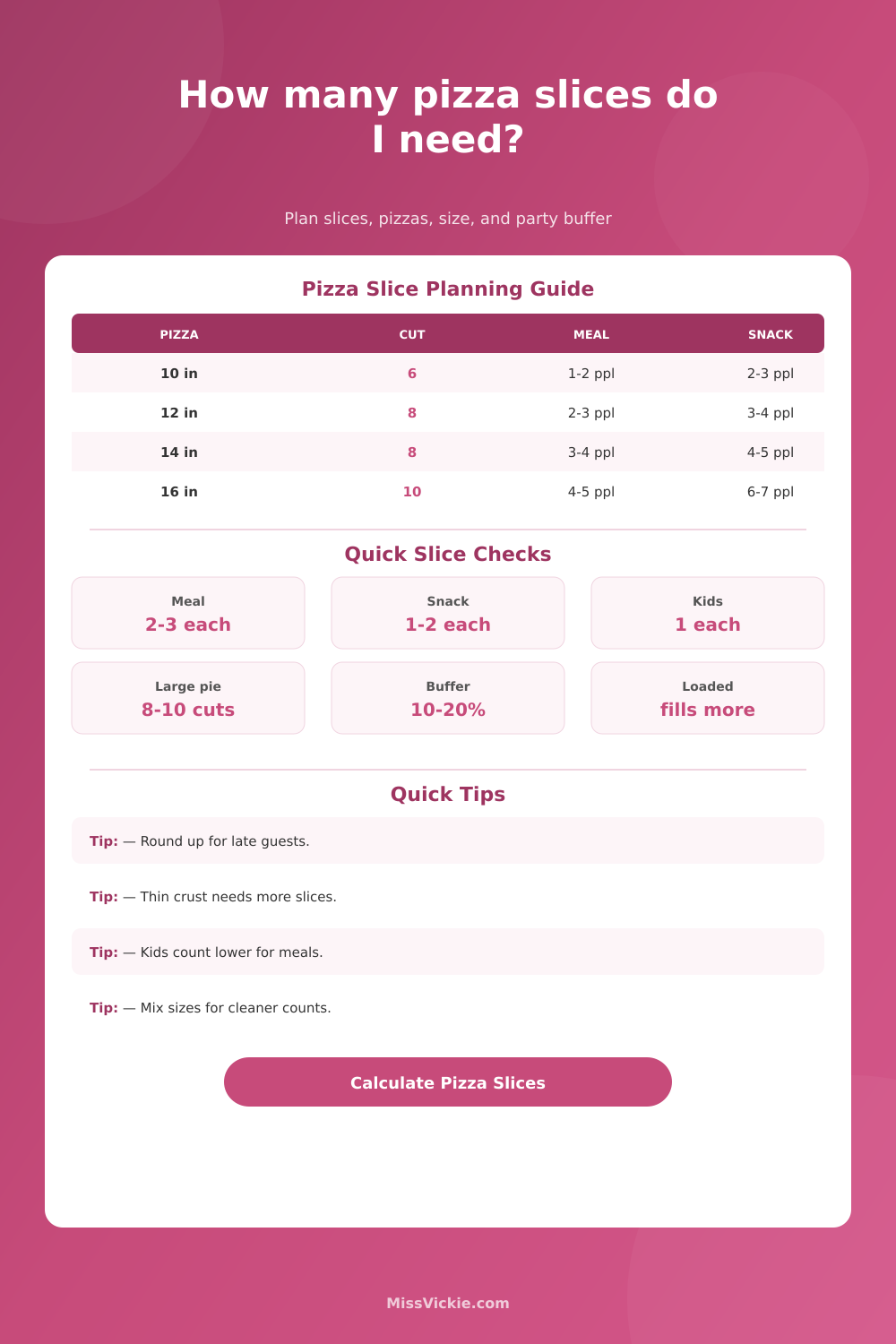
| 10 in | 79 sq in | 6 slices | 13 sq in |
| 12 in | 113 sq in | 8 slices | 14 sq in |
| 14 in | 154 sq in | 8 slices | 19 sq in |
| 16 in | 201 sq in | 10 slices | 20 sq in |
| 18 in | 254 sq in | 12 slices | 21 sq in |
| Topping load | Fullness effect | Planning note | Best cut |
|---|---|---|---|
| Cheese only | Needs a bit more | Round up for adults. | Classic or party |
| Standard toppings | Baseline | Good for mixed groups. | Classic |
| Veggie heavy | Slightly lighter | Add buffer if crust is thin. | Classic |
| Loaded pizza | Fills faster | Order fewer extra slices. | Party cut |
| Deep dish | Most filling | Small slices work well. | Small cut |
| Group | Snack order | Meal order | Hungry order |
|---|---|---|---|
| 4 people | 1 large | 2 large | 2 large |
| 8 people | 2 large | 3 large | 4 large |
| 12 people | 3 large | 4 large | 5 large |
| 20 people | 5 large | 7 large | 9 large |
| 30 people | 7 large | 10 large | 13 large |
Pizza shops vary in diameter and cut count. For exact catering, ask the shop for its large pizza diameter and standard slice count.
6.Pizza planning tips
You’ve ordered a pizza for over three folks before. There’s an anxiety that comes up at this order number. How many pizzas do I get? Do I go with two medium pies? Or is one large and a wing order better? In the space between hungry and satisfied lies the potential for a bad order.
If left to the whims of human guesswork, most people counts heads as their only guide. That’s risky business. Pizza has a certain physics, and ignoring that physics will lead to ordering too much or, worse, a pile of stale leftovers.
How to Order the Right Amount of Pizza
Once you enter your party size and how hungry (or not) everyone is, the calculator do the rest. No more guessing! No more chaos! Just well-laid plan.
People’s biggest error is to think of all pizzas the same size as if they’re simply linear increments. “Sure, a ten inch pizza is smaller then a twelve-inch pizza,” they say. But a twelve-inch pizza have much more surface area. And the difference between edible space increases exponentially by diameter. This is precisely why I like the reference table at the top of page so much. Instead of just tallying up your number of pies, it tell you exactly how many square inches of pizza you’re getting.
Once you realize that a sixteen inch pie provide far more food than two ten inch pies, it doesn’t seem so abstract… It makes fiscal sense.
Most consumers has no idea how important crust is. To account for that, the calculator factor in the width of its outer rim, since no one eats that part of the pie as much as they eat the center. In other words: Ordering thick crust (or even deep dish) is like ordering fewer square inches of edible topping per slice. This calculator take that into consideration and reduces the total amount of “effective” area.
It’s a tiny little detail. But avoiding the disaster scenario where ten people stand there staring at three impressive-looking pizzas without any actualy pizza meat inside them is worth it.
Load type also completely alters the satiety curve. A plain cheese slice is going to be airy and light, people will consume more of those before they’re full. On the other hand, a densely-loaded pizza featuring lots of sauce, sausage and peppers are going to be heavy. They’ll fill up on fewer bites. This density is included in the calculator’s recommended number of slice per person.
Pick a heavier topping style and it recommend a little less because the meal is hitting different. It’s all about adjusting for weight of the meal against the hunger of your group.
The algorithm also understands the concept of serving size, that’s part of its job definition. Is the slice being eaten from a party platter? It’s probably not going to be eaten like a full main meal, so the algorithm change the per-person goal downward, taking into account context. But if there’s a whole bunch of pizza on the table, but no other options (perhaps you’re hunkered down for some late-night gaming?), then the algorithm know you’ll likely consume more.
Hunger is context-dependent, too, that’s something it knows. Big groups need buffer zones. When you go with big groups, people shows up at different times. Some are hungry, some aren’t. Children will sneak extras from other people’s plates while no one is watching. Having a 10-20 percent buffer isn’t wasteful; it’s insurance against social friction.
Better to end up with a couple of leftovers than be the guy who ran out of food at hour one.
The preset buttons on the calculator offer a helpful shortcut for common scenarios. An office lunch is a different beast different than a kid’s party; kids eat smaller portions, but they’re also more difficult to predict when it comes to snacks. The presets help establish a good baseline which you can adjust based off knowing your own group’s tendencies. It takes away the need to mentally restart at zero.
In the end, whether it’s a triangle or not doesn’t really matter when it comes to ordering pizza; it matters that you’re thinking about the people whose stomachs will be full as a result. Let this tool remove all factors from the equation: now you get to concentrate on the real party. All you have to do is figure out who’s going to eat it and what else they’re having. After that, let the numbers do their thing.
Nobody recalls the size of the pie they ordered, but everybody recalls if they got fed.