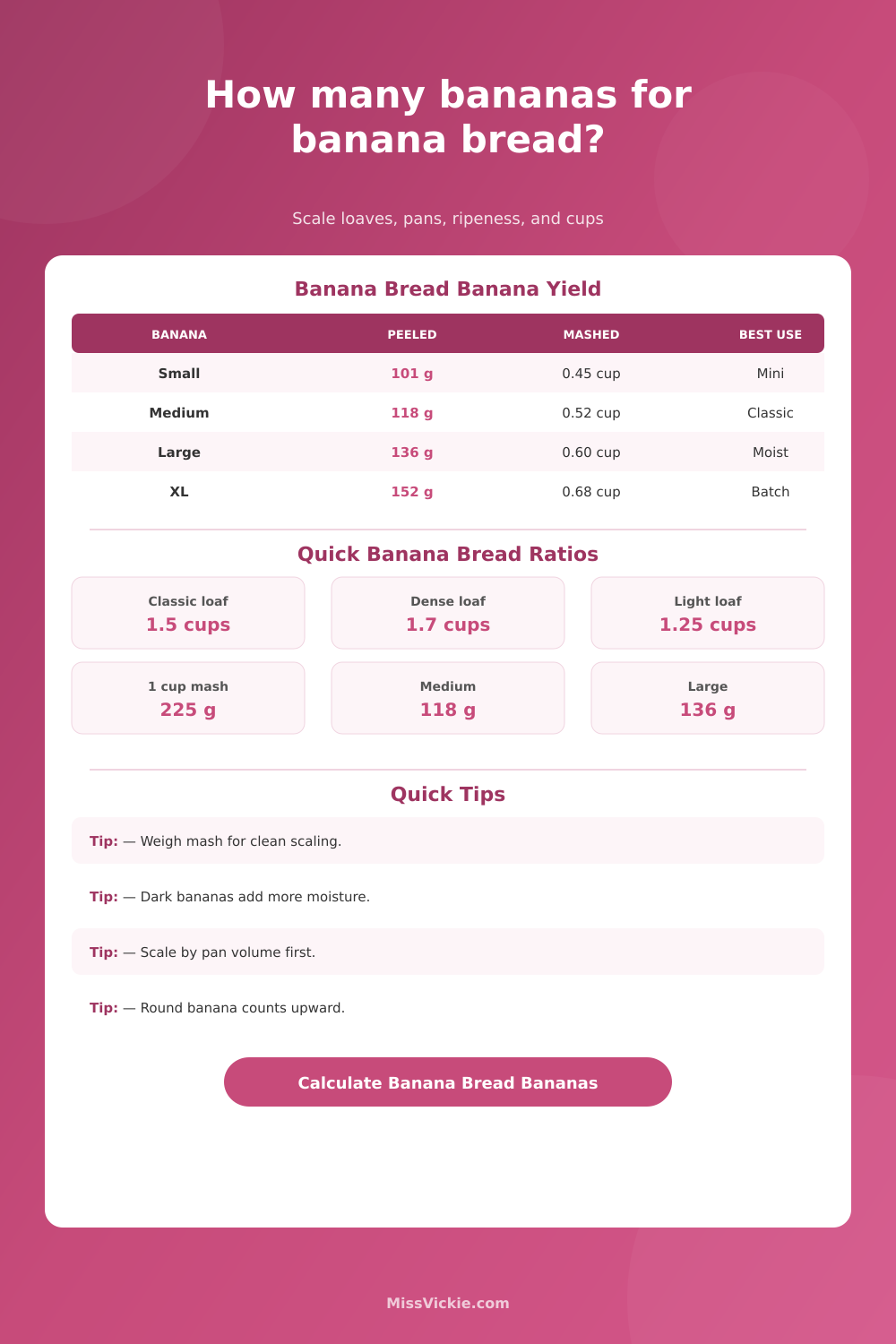
Bananas for Banana Bread Calculator
Scale banana bread from loaf count, pan size, banana size, ripeness, target mashed cups, recipe style, moisture preference, and extra mix-ins.
Choose a bake that sounds close, then adjust the loaf count, banana size, ripeness, and mix-ins for your kitchen.
Banana plan ready
Use the rounded banana count for shopping and the cup target for recipe scaling.
Ingredient Breakdown
Recipe Adjustment
Scaling Note
| Banana Size | Peeled Weight | Mashed Cup Yield | Best Banana Bread Use |
|---|---|---|---|
| Small banana | 101 g / 3.6 oz | 0.45 cup / 106 ml | Fine-tuning small loaves, muffins, or topping off a cup target. |
| Medium banana | 118 g / 4.2 oz | 0.52 cup / 123 ml | Most recipes mean this size when they say 3 bananas for 1 loaf. |
| Large banana | 136 g / 4.8 oz | 0.60 cup / 142 ml | Good for extra-moist loaves and recipes with whole grains. |
| Extra large banana | 152 g / 5.4 oz | 0.68 cup / 160 ml | Use fewer pieces, then check batter thickness before baking. |
| Thawed frozen banana | 115 g / 4.1 oz average | 0.54 cup / 128 ml | Drain only if the recipe is already very wet or fruit-heavy. |
| Pan or Output | Pan Factor | Classic Banana Target | Rounded Banana Count |
|---|---|---|---|
| 9 x 5 inch loaf pan | 1.00 | 1.50 cups / 338 g | 3 medium or 3 large bananas |
| 8.5 x 4.5 inch loaf pan | 0.86 | 1.30 cups / 293 g | 3 medium bananas |
| 8 x 4 inch loaf pan | 0.75 | 1.13 cups / 253 g | 3 small or 2 large bananas |
| Mini loaf pan | 0.27 | 0.41 cup / 91 g | 1 small banana per mini loaf |
| Standard muffin cup | 0.083 | 0.13 cup / 28 g | 3 medium bananas for 12 muffins |
| 8 inch square snack cake | 0.88 | 1.32 cups / 297 g | 3 medium bananas |
| Recipe Style | Banana Ratio | Texture Goal | Adjustment Signal |
|---|---|---|---|
| Classic moist loaf | 1.50 cups per 9 x 5 | Sliceable, banana-forward crumb | Use the calculator result without changing flour. |
| Light breakfast loaf | 1.25 cups per 9 x 5 | Less dense, more bread-like slices | Use less banana or add a small flour nudge. |
| Dense bakery-style loaf | 1.75 cups per 9 x 5 | Heavy, dark, moist crumb | Watch bake time and cool fully before slicing. |
| Oil-based soft crumb | 1.45 cups per 9 x 5 | Very tender even after chilling | Avoid extra liquid when bananas are blackened. |
| Sour cream or yogurt batter | 1.35 cups per 9 x 5 | Tangy, tender, moist crumb | Reduce banana slightly if batter looks loose. |
| Gluten-free batter | 1.60 cups per 9 x 5 | Moist crumb without gumminess | Rest batter before judging thickness. |
| Egg-free or vegan batter | 1.65 cups per 9 x 5 | Banana supports binding and moisture | Do not overload fruit mix-ins. |
| Mix-in | Moisture Effect | Banana Cup Change | What to Watch |
|---|---|---|---|
| No heavy mix-ins | Neutral | No change | Use the recipe style as the main guide. |
| Walnuts or pecans | Slightly drier bite | Add about 2 percent | Nuts absorb a little surface moisture during baking. |
| Chocolate chips | Richer but not much wetter | Add about 1 percent | Chips make slices seem softer when warm. |
| Blueberries or chopped fruit | Noticeably wetter | Reduce about 5 percent | Fruit pockets can make the center seem underbaked. |
| Oats or whole grains | Drier after resting | Add about 6 percent | Oats keep taking moisture after baking. |
| Streusel or crumb topping | Drier top, soft center | No cup change | Judge doneness from the center, not the topping. |
| Nuts plus chocolate chips | Heavier batter | Add about 3 percent | Fold gently so the loaf rises evenly. |
Ingredient data uses common kitchen yield estimates: one cup mashed banana is about 225 g, with peeled banana weights based on standard small, medium, large, and extra large fruit categories.
When you’re baking a banana bread, it’s hard to know whether you should throw in one more overripe banana. Or maybe you have a few banged-up bananas but aren’t sure if they’ll fill up a single loaf or a batch of muffin.
There is some math involved here, the sort that home economics classes don’t cover. And the period of time between fruit and cake can be awkward. Bananas, after all, come in various states of ripeness, different sizes, varying degrees of sweetness, and water content based off how long they sat on the counter or if they went through a freeze-thaw cycle. It’s a messy business.
Why This Calculator Helps You Bake Better Banana Bread
To do this, the calculator use a bunch of scale logic to convert your specific bunch (in grams, or cups if you prefer) to match your intended texture and pan size. Why? Because mashed fruit doesn’t weigh the same as regular-sized chunks; whether you stir gently or aggressively changes its density. For example, a small banana might yield about half a cup of mash, whereas an extra large could go over two thirds. So if recipe says 3 med. Bananas, but you just have 2 large, there’s no perfect way to adjust the math unless… You use the calculator.
By choosing your banana size/ripeness, it’ll spit out a target amount that lines up with what you’ve got in the kitchen. Flavor isn’t the only thing that shifts as fruits ripen; their moisture content also changes significantly. Though still firm to touch, a slightly speckled, yellow banana will contain less liquid when mashed up in your batter because its cells is structured in such a way as to hold that moisture tight. When the outside is completely black, and the interior is brown, the majority of the banana’s starches has turned into sugar. But there is also more moisture inside its structure. Unless you counteract this with a longer baking time (or adding more flour), the excess moisture can cause your loaf to be gummy. These yield amounts are broken out in the reference tables on the page.
You’ll understand how one banana would react differently (even after defrosting) then another. And of course there’s your own taste, and how you like your bread sliced. Is it best in thicker slices, which need a knife? Or do you prefer something more tender, with a lighter crumb? The calculator lets you slide this around inside the recipe, changing the banana-to-flour ratio depending on what kind of bread you want. So when you pick “bakery” (meaning a denser bread), it will suggest more bananas per loaf compared to picking “light” (meaning a lighter crumb).
It’s a common trap for home bakers: they don’t know if they made their previous batch too moist, or too dry. But maybe it was just because they used too much or too little of an ingredient. I think it would of been fun to see versions where the user can experiment with ingredients beyond just bananas, perhaps with applesauce or different kinds of flours.
The last factor has to do with mix-ins: Dry agents like pecans and walnuts soak up moisture from other batters around them while they’re baking. If you don’t take this into account, that can result in a drier finished product. On the flip side, something fatty and wet, such as chocolate chips or blueberries, could add water and fat to the mixture, which can cause the middle to taste underdone, although it’s actualy safe to consume. That’s where the tool comes into play, it takes all of these factors into consideration and tells you how much you should increase/decrease amount of liquid. It will let you know what type of bananas to purchase and how they’ll work with the rest of your ingredients.
Measuring instead of guessing will help you get repeatable results without having to have a PHD in baking science. If you are trying to make more than one loaf (or even send these as gifts) then we recommend weighing out your mashed banana. It’s the most accurate, least messy way to go about this. Using a kitchen scale also eliminates the “is that level, or heaped” guesswork associated with using cups. If cups are more your thing, keep in mind that tightly packing the mash into the cup adds weight, so you’ll end up increasing the moistness of your batter.
It takes the stress out of baking. You won’t have to pray that you guessed which three bananas were the “right” ones. Six mini loaves for neighbors or one substantial loaf for yourself? Whatever it is, you know exactly how many bananas will be required and can relax into the moment (by mixing gently, baking at the right temperature, and waiting until that crust smells like heaven). The pile of brown-spotted bananas that had you stumped an hour earlier becomes just another essential part of a trustworthy recipe.