Bananas Per Cup Calculator
Estimate how many whole bananas to buy or peel for mashed, sliced, chunked, pureed, frozen-thawed, baked, smoothie, baby food, topping, and fruit salad cup targets.
🍌Banana Presets
Choose a common kitchen job, then adjust cup target, banana size, prep form, ripeness, peel waste, recipe type, and packing density.
⚖Banana Inputs
Banana cup estimate
Your banana estimate appears here.
Chosen Settings
Yield Breakdown
Shopping And Prep Plan
📌Fast Banana Cup Cards
🔍Prep Form Comparison Grid
Best baseline for banana bread, muffins, pancakes, and snack cakes.
Coins stack with air space, so fewer bananas fill a cup.
Smooth cups pack heavy and suit baby food or shake bases.
Frozen slices measure bulky before blending and tighter after thawing.
🥄Banana Prep Form Table
| Prep form | Typical cup weight | Medium bananas per cup | Best use | Measuring note |
|---|---|---|---|---|
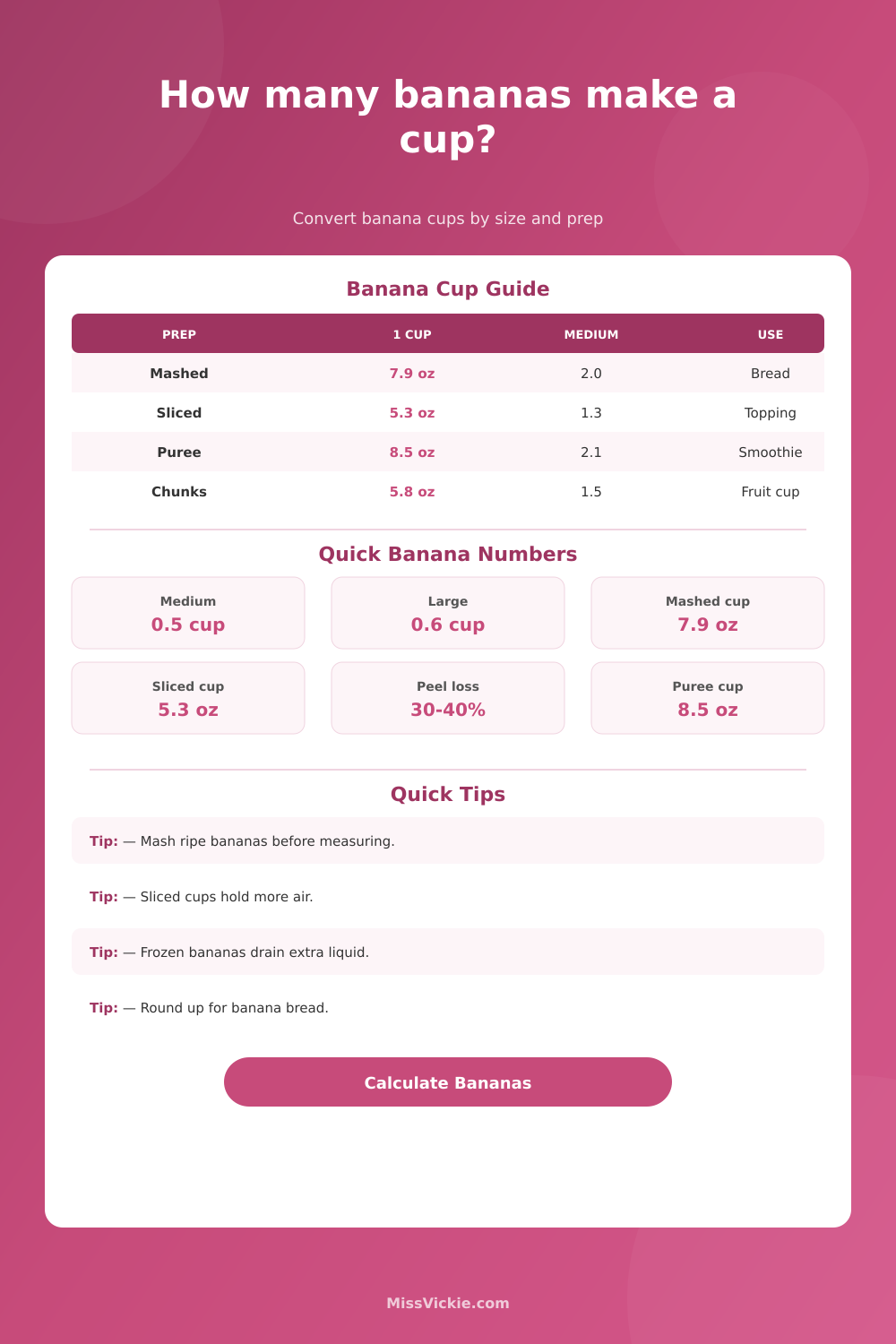
| Mashed banana | 7.8 to 8.1 oz / 220 to 230 g | About 2 | Banana bread, muffins, pancakes | Mash first, then level the cup |
| Sliced banana coins | 5.0 to 5.5 oz / 142 to 156 g | About 1.3 | Oats, cereal, yogurt, topping | Loose slices hold air gaps |
| Banana chunks | 5.6 to 6.2 oz / 159 to 176 g | About 1.5 | Fruit cups, snack bowls, skewers | Large pieces measure lighter |
| Smooth banana puree | 8.3 to 8.7 oz / 235 to 247 g | About 2.1 | Baby food, sauces, smoothies | Blended puree packs heaviest |
| Frozen sliced banana | 6.0 to 6.6 oz / 170 to 187 g | About 1.6 | Nice cream, smoothie packs | Measure before thawing if bagging |
| Thawed mashed banana | 8.0 to 8.8 oz / 227 to 249 g | About 2.1 | Quick bread from frozen fruit | Include liquid unless draining |
🍌Banana Size Table
| Banana size | Edible weight | Mashed cup yield | Sliced cup yield | Shopping note |
|---|---|---|---|---|
| Mini banana | 2.3 oz / 65 g | 0.28 cup | 0.45 cup | Use for snack boxes and garnish |
| Small banana | 3.6 oz / 101 g | 0.45 cup | 0.68 cup | Good for kids portions and toppings |
| Medium banana | 4.2 oz / 118 g | 0.53 cup | 0.78 cup | Standard recipe conversion |
| Large banana | 4.8 oz / 136 g | 0.61 cup | 0.9 cup | Useful when recipes call for big fruit |
| Extra large banana | 5.4 oz / 152 g | 0.68 cup | 1 cup | Round down count if bunch is huge |
| Mixed bunch | 4.4 oz / 125 g | 0.56 cup | 0.82 cup | Best for grocery bunch averages |
🌱Ripeness And Peel Table
| Ripeness | Texture factor | Best cup form | Peel and trim note | Recipe fit |
|---|---|---|---|---|
| Firm yellow-green | 0.96x | Sliced or chunks | Less bruising, firmer peel | Fruit salad and topping |
| Yellow, few spots | 1.00x | Sliced or mashed | Clean peel, mild aroma | Oats, snacks, pancakes |
| Speckled and sweet | 1.03x | Mashed | Standard baking baseline | Quick bread and muffins |
| Very ripe and fragrant | 1.06x | Mashed or puree | Soft spots may need trimming | Batter, sauces, smoothies |
| Black peel, soft flesh | 1.08x | Mashed | High aroma, possible bruises | Banana bread and cake |
| Thawed frozen ripe | 1.10x | Thawed mash | Liquid counts if kept | Baking and blended cups |
📋Recipe Planning Table
| Recipe type | Common cup target | Best banana state | Medium banana count | Planning note |
|---|---|---|---|---|
| Standard banana bread | 1.5 to 2 cups mashed | Speckled or very ripe | 3 to 4 bananas | Measure mash after peeling and crushing |
| Banana muffins | 1 to 1.5 cups mashed | Speckled | 2 to 3 bananas | Use extra if batter needs strong banana flavor |
| Smoothies or shakes | 0.5 to 1 cup per drink | Yellow or frozen | 1 to 2 bananas | Frozen pieces blend thicker than fresh slices |
| Baby food puree | 2 to 4 cups puree | Very ripe | 4 to 9 bananas | Puree cups pack dense and smooth |
| Oats or yogurt topping | 0.25 to 0.5 cup per bowl | Yellow | 1 banana for 1 to 2 bowls | Slice just before serving for best color |
| Frozen dessert | 3 to 6 cups frozen slices | Ripe and frozen | 5 to 10 bananas | Bag slices flat so cups are easy to portion |
💡Banana Measuring Tips
Banana yield changes with size, ripeness, peel thickness, bruising, freezing, cup packing, and whether thawed liquid is kept or drained.
When most baking recipes say “a cup of banana,” what they realy mean is: How many real-life bananas does it take to get there? Staring at the pile on the counter; three speckled bananas, a bowl that seems half-empty, you’re wondering if your breads going to turn out dry or just downright dense. It’s got nothing to do with math; it has everything to do with density.
A cup of sliced-up coins is lighter than a cup of mushed banana (because the spaces in between each slice has room to fill up with air). That make all the difference when it come time to go peel some fruit.
Why Banana Size Matters in Baking
Once you have chosen how you plan to prepare your banana (which eliminates the guessing game during batch planning), the calculator will do the rest for you. If you select mashed for your banana bread, it take into account that the fruit will pack tight when it’s been crushed. About one half cup of mash equal a single whole medium banana. This means that if your recipe require two cups of mashed banana, you would of use four bananas, not three. One more banana are the difference between a cake that is a crumbly brick and a moist loaf. These is small differences, but they matter when it comes to baking. Margins matter.
Ripeness is another thing that affects the equation as much or more than size. When you slice a firm yellow banana, it keep its shape and forms air pockets in the slices, so when they’re stacked in cups, those slices end up being lighter. Compare that to a banana with black spots all over, the kind that’s basically syrup by comparison. That stuff mushes together into a dense puree that fill a cup quicker.
The tool handles that change in texture. Because the flesh has broken down entirely, using very ripe fruit increases your estimated yield per banana a bit. You may get away with less fruit overall then you would of had you gone with some that were still green-tipped. This is precisely why recipes always call for brown spots. Not only do they want sweet, they want volume efficient.
Another sneaky variable is peel waste. Depending on the banana, around 30-40 percent of each banana are peel by weight. So even though you may have purchased a pound of whole bananas, you’re only left with six ounces of actual banana flesh. To account for this, the calculator includes an option where you can estimate how much you think you’ll lose from peels, and adjusts the final tally to match how much you should purchase, rather than how many you’d like to consume. In particular, this can be important at the grocery store where you might buy bulk items.
For example, you could assume that three big bananas will get you two cups of puree; but if thirty to forty percent of their weight are peel, you’ll fall short. This tool helps connect the weight on the shelf to the quantity you want to eat.
Another type of physics involve frozen bananas. When you slice them and put them in a freezer bag, those ice crystals expand and cause each slice to occupy slightly more volume then it would after defrosting. Measure the frozen slices straight into a cup and you’ll find yourself with too much banana. That’s why the frozen prep takes that expansion into account and adjusts accordingly. It’s a subtle thing, but prevents smoothie batches from becoming watery as the ice thaws. No one thinks about the displacement effects of freezing bananas. Most people just do it. But thinking about it preserve texture down the line.
To be clear: Bananas aren’t something you measure perfectly; they’re just something you can measure consistently. Slice all those bananas for your morning oatmeal? Expect the same each day. What if you mash some and cut up the rest all week long? Your oatmeal will be all over the place in terms of both texture and sweetness.
That’s why it’s so clear from the reference tables on the page: Weight depends on form. It can be heavy (mashed) or light (sliced). Know that, and you don’t have to pick up a scale at cooking time. Rather, it becomes a sanity check when baking many at once.
Need four speckled bananas for that loaf? Just go grab ’em. Trust the density, and the rest will follow.