Chicken Breast Cup Yield Calculator
Estimate cooked cups from raw or cooked chicken breast weight, breast size, shredded, diced, sliced, or chopped style, bone state, trim loss, cook method, packing density, and cup target.
🍗Chicken Cup Presets
Choose a common kitchen job, then adjust weight, cut style, bone state, trim, cooking method, cup packing, and target cups.
⚖Chicken Breast Inputs
Chicken breast cup yield
Your cooked cup estimate appears here.
Input Profile
Yield Math
Target Check
🍛Fast Cup Rules
🔍Cut Style Comparison Grid
Fluffy strands create lighter cups for tacos, enchiladas, and pulled chicken.
Small cubes pack evenly for bowls, pasta, rice, and meal prep containers.
Loose slices suit plates, wraps, salads, and chilled lunch portions.
Fine chopped meat packs dense for chicken salad and sandwich filling.
Chunky cubes leave more air in the cup and work well in casseroles.
Whole pieces are better planned by cooked ounces instead of cups.
Gentle filling lowers cup weight and raises visible cup volume.
Pressing meat into the measure raises weight per cup.
🥄Cooked Cup Weight Table
| Prepared chicken style | Standard cup weight | Loose cup | Firm cup | Best kitchen use |
|---|---|---|---|---|
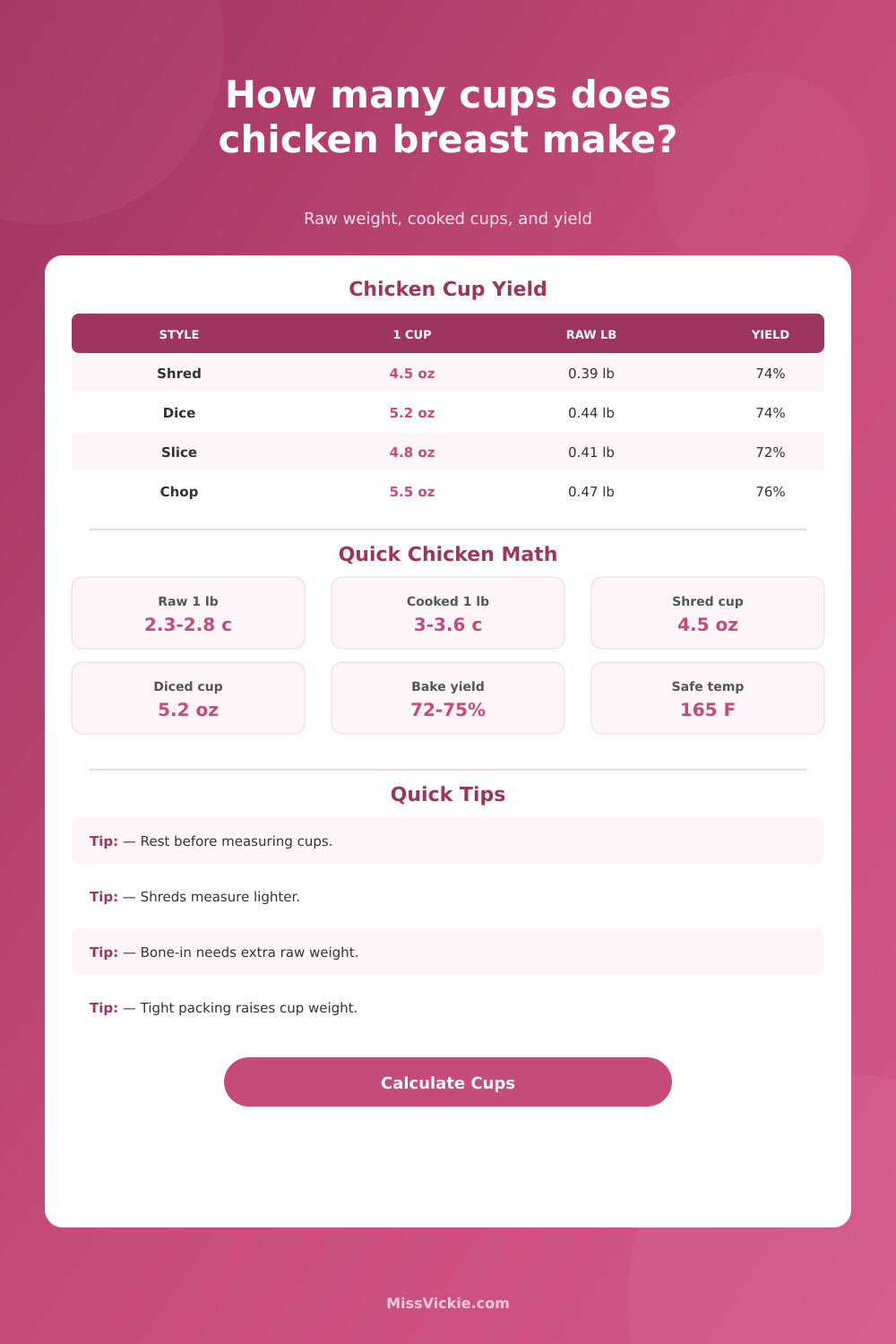
| Shredded breast | 4.5 oz / 128 g | 4.1 oz | 5.0 oz | Tacos, enchiladas, sliders, soup topping |
| Diced breast | 5.2 oz / 147 g | 4.8 oz | 5.7 oz | Rice bowls, pasta, salads, meal prep |
| Sliced breast | 4.8 oz / 136 g | 4.4 oz | 5.3 oz | Dinner plates, wraps, chilled lunches |
| Chopped salad meat | 5.5 oz / 156 g | 5.1 oz | 6.1 oz | Chicken salad, sandwich filling, snack cups |
| Large cubes | 4.7 oz / 133 g | 4.3 oz | 5.2 oz | Casseroles, pot pie, skewers, soup meat |
| Whole breast portions | Use weight | Use weight | Use weight | Plate service and protein portions |
🔥Raw To Cooked Yield Table
| Cook method | Cooked yield from edible raw | Approx cups from 1 raw lb | Best style match | Planning note |
|---|---|---|---|---|
| Poached or covered pan | 78% | 2.8 shredded cups | Shreds and salad meat | Gentle heat keeps more moisture in the breast. |
| Baked breast | 74% | 2.6 shredded cups | Diced, sliced, chopped | Standard oven cooking is a good default estimate. |
| Grilled breast | 70% | 2.5 shredded cups | Sliced plates and bowls | Surface drying lowers finished weight. |
| Air fried breast | 69% | 2.5 shredded cups | Sliced or diced meal prep | High airflow can reduce cup yield. |
| Slow cooked breast | 76% | 2.7 shredded cups | Shredded filling | Drained juices change measured cups. |
| Held hot for service | 65% | 2.3 shredded cups | Buffet pans | Plan extra for moisture loss during holding. |
🧪Bone And Trim Table
| Chicken breast form | Non-edible share | Typical trim | Cup yield effect | Use when |
|---|---|---|---|---|
| Boneless skinless | 0% | 2 to 5% | Highest cup yield per raw pound | Most recipe conversions and meal prep |
| Boneless with skin | 6 to 8% | 3 to 6% | Lower if skin is removed after cooking | Roasting for crisp skin or richer flavor |
| Bone-in skin-on | 30 to 35% | 4 to 8% | Needs much more raw weight per cup | Roasted split breasts and soup meat |
| Bone-in skin removed | 22 to 26% | 3 to 7% | Better than skin-on but still lower | When bone flavor is wanted without skin |
| Cooked deboned meat | 0% | 0 to 2% | Measure directly as cooked cups | Leftover breast, rotisserie breast meat |
📋Common Chicken Cup Targets
| Recipe job | Cooked cup target | Best cut style | Raw boneless breast | Medium breasts |
|---|---|---|---|---|
| Chicken salad lunch | 3 cups | Chopped | 1.4 to 1.6 lb | 4 to 5 |
| Taco night | 4 cups | Shredded | 1.6 to 1.9 lb | 5 |
| Casserole pan | 4 cups | Diced or cubed | 1.8 to 2.1 lb | 5 to 6 |
| Meal prep bowls | 8 cups | Diced | 3.5 to 4.0 lb | 10 to 11 |
| Soup pot | 5 cups | Shredded or cubed | 2.0 to 2.4 lb | 6 to 7 |
| Sandwich tray | 10 cups | Chopped | 4.5 to 5.2 lb | 12 to 14 |
💡Chicken Cup Measuring Tips
Chicken breast cup yield shifts with breast size, cook temperature, resting time, trimming habits, bone removal, skin removal, draining, and how tightly meat is packed into the cup.
It turns out most recipes assume chicken is liquid: “And 2 cups of shredded chicken” is what most recipe ask for as though this was milk or flour, something with consistent volume even if it doesn’t look quite right when it goes into the recipe’s bowl. You grab your measuring cup, plop in the meat, and then behold, too little or too much; too loose a pile or one tightly packed so that no space remains around the shreds. The problem isn’t that meat shrinks (it does), but rather that the ingredient will change it density once cooked, which is why volume isn’t equal to weight. What you need to realize is that yield is not just shrinkage, but also a matter of what happens to that shrunken meat in a container.
To use the calculator, you simply input your variables (see below) and the calculator do the rest; no more guessing at the amount of raw protein required to produce a certain number of final serving. It also gets you cooking confidently, instead of blindly trusting whatever your gut tells you.
Why Chicken Recipes Fail
Most importantly, people neglect one variable: cut style. A cup of diced meat has much less air trapped within its strands than a cup of shreds; therefore a cup of shredded chicken will weigh much less different than a cup of diced meat. By 2 ounces. Not trivial. If you’re making a recipe calling for cups of chopped chicken salad and you substitute shredded chicken, you’re putting less protein into each serving then the recipe intends. You may feel like you nailed it, but you don’t have the ratios correct.
The other key factor is what you cook it with. Dry heat will be less effective at preserving weight than moist heat. Grilled chicken (or air fried) lose some moisture through evaporation during cooking. Poached or slow-cooked chicken retains more of it within the muscle fibers, so it has a greater yield percentage than something cooked dry. And if you overcook your breast in the oven by baking it too hot for too long? You’re not only getting rid of fat. You’ll also lose actual weight that would of filled those cups. This is where the table on the page help make clear: the gentler cooking methods increase your yield by a few percentage points above aggressive roasting. Small difference, but makes a difference when you’re serving a crowd.
Another stealthy yield-killer: Bone. Sure, the bone-in skin-on chicken breasts looks like a bargain on the sticker… Until you realize that the price per pound doesn’t count bones as edible. Depending on the size, as much as one-third of the breast weight may be inedible. There is also all that extra water. Removing bones and skin post-cooking leaves you with much less finished product than what raw label promises. If your recipe calls for a certain amount of finished product, like cups of cooked chicken for meal prepping, you’ll have to buy much more raw weight of the bone-in version. This is because some will be wasted. Most people don’t think about this margin when shopping, until they’re digging around inside the last bag and find it falls short by three cup.
The last wildcard in any kitchen conversion: How tightly is your protein packed? A cup scooped out loosely makes a big difference compared to one scooped out tightly by pressing down the scoop. It can add ten percent (or more) to weight of each cup. This explains why some recipes that call for exact measurements don’t work the same way when repeated directly. What looks like a cup of flour for one cook might be a loose cup for the other, firm cup.
That’s where the tool comes into play; it accounts for those differences, and lets you tune it to your personal habits. Do you tend to pack down firmly when filling a cup? Your results will be different than someone whose fillings is fluffy. But knowing those trade-offs is what makes even a routine grocery run an exact science. Suddenly you’re not purchasing more than necessary “just in case.” You aren’t blindly eyeballing the amount of chicken to buy, either. Instead, you’re calculating exactly how much (and which cuts) based off how you plan to prepare and cut it.
The next time you go to grab that bag of breasts, consider: do you want dense chunks to put in casseroles, or light shreds to use in tacos? Not only will your answer inform your poundage, but also how many cups will wind up on your plate. Learning this little equation will make sense of all the guesswork that occurs when estimating in the kitchen.